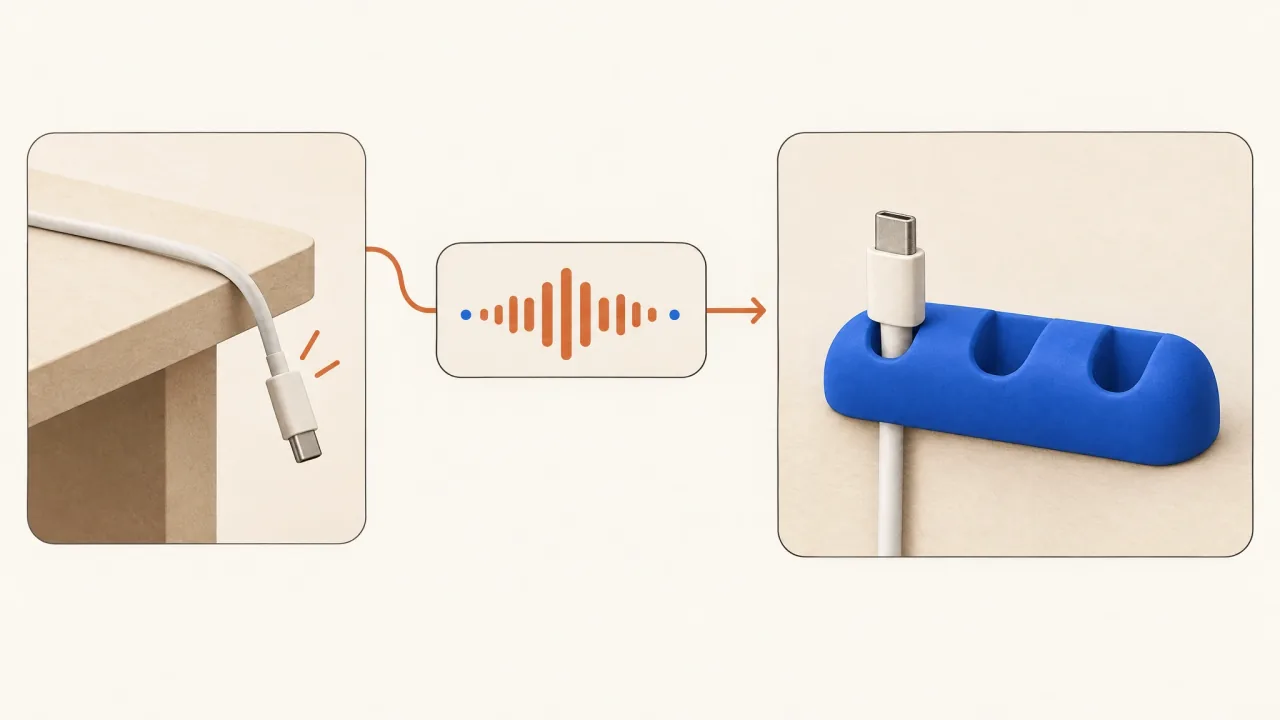
Decide what the opening image and line each need to explain. The image can establish a situation while the line helps the viewer interpret it. If both just announce a surprise, the opening may feel busy without making the surprise matter.
For example, a charging-cable end slipping below a desk shows a physical problem. “The loose end needs somewhere to wait” explains that the story is about where the cable rests between uses. You don't need the line to describe every movement the viewer can already see.
Image and speech can also repeat each other when that helps. A new category may need the same essential information in both. Choose how they work together, and leave enough context for someone watching without sound.
Choose the opening's unfinished question
Before you choose a camera move or write a clever line, decide what the opening needs to establish. The viewer may need to recognize an unfamiliar object, understand a use situation, notice an inconvenience, or consider an objection. Use the ad-angle examples to choose that buying question before working out how to show it.
Write the requirement plainly: “The viewer should see where the loose cable end goes when it is not connected.” Then divide the explanation between the image and line.
Use the image to show position, scale, movement, or a visible relationship. Speech can name the category, qualify what the scene means, or explain why the next demonstration matters. Check both for implied functions the product brief doesn't support.
“This charges everything faster” gives the cable keeper an unsupported function, however attractive the desk looks. Showing several devices actively charging could imply the same thing. Use the specific-line rewrite worksheet to replace the promise with wording the supplied facts support.
Three relationships to consider
Complement: the image supplies the concrete situation; the line supplies the reason to keep watching. A hand reaches below a desk while narration asks, “Where should the end rest between charges?” The next shot needs to answer that question.
Clarify: the image is interesting but ambiguous; the line names what it is. A close view of three cobalt-blue slots might need “A desk cable keeper” to prevent the opening from becoming a guessing game. Category identification can be more useful than a second joke.
Reinforce: image and speech repeat an indispensable fact. A clear three-slot view accompanied by “Three places for loose cable ends” can emphasize the mechanism. Repetition earns its place when the information is necessary, rather than filling time.
Pick the relationship deliberately. If both the animation and line are abstract, neither may explain the product. If a dramatic scene shows one problem and the narration explains another, the viewer has to reconcile two different stories.
Worked example: the falling cable and the waiting place
This pre-production exercise uses a fictional matte cobalt-blue cable keeper with exactly three slots. Its defined job is to keep loose charging-cable ends at a desk edge. The scenes below are proposed storyboards. They don't document produced videos or customer observations.
Start with this rough opening:
Image: a cable slips over the desk edge into an exaggerated dark void.
Line: “Into the unknown.”
The image and line both suggest mystery, leaving the practical issue and its connection to a cable keeper unexplained. They could introduce a science-fiction film just as easily as a product demonstration.
A revision focused on the problem could be:
Image: an ordinary desk edge; the loose connector drops out of reach.
Line: “Give the loose end somewhere to wait.”
Next beat: show the keeper at the desk edge, then a cable end resting in one slot.
Here, the image shows the location and movement. The line introduces the proposed solution without promising to eliminate every dropped cable. The next beat shows the actual product relationship that connects them.
To lead with how the product works, try opening on it instead:
Image: a readable close view of one cable end resting in the three-slot keeper.
Line: “Between one charge and the next.”
Next beat: widen to establish the keeper's position on an ordinary desk.
The image now shows the relationship between the object and action, while the line gives a use context. You've changed the opening brief, but haven't established which version will perform better. The six-angle planning exercise explores the same possible reasons to lead with the problem or mechanism. Neither direction has an observed campaign result.
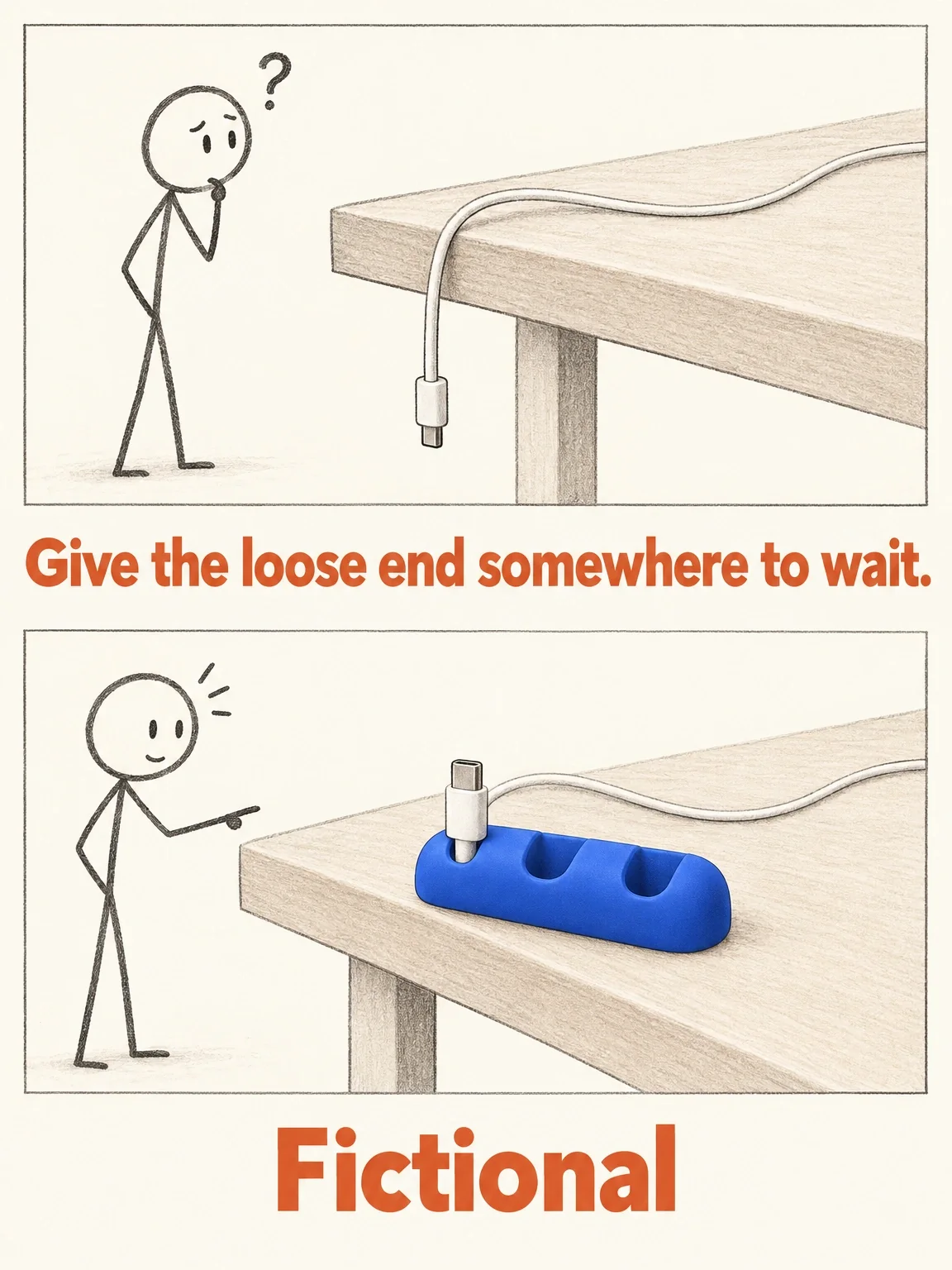
The image shows the situation; the line interprets it
The fictional opening shows a falling cable, names its need for a waiting place, then reveals the resting relationship.
View full-size (opens in a new tab)Image explanation
- The falling cable image shows displacement. The line interprets that situation as needing a waiting place.
- The next view shows the cable already resting in the three-slot keeper. It leaves insertion and any automatic attraction unproven.
Run this hook-role exercise
Choose one approved product fact and one possible opening, then complete the card before requesting production:
Opening question: [what must become understandable?]
Approved fact: [what the product actually does]
Image job: [one observable situation, action, or relationship]
Image description: [what is visible, including product position]
Spoken job: [interpret, identify, qualify, or reinforce]
Exact illustrative line: [words to try, not a final transcript]
Relationship: [complement, clarify, or reinforce; why]
Next beat: [the shot that resolves the opening]
Sound-off support: [essential image or short category text]
Possible wrong inference: [what a viewer could mistakenly conclude]
Revision to prevent it: [one specific change]
Hide the line and describe what the image tells you on its own. Then hide the image and do the same for the words. Review them together: does one complete the other, or do they create conflicting expectations?
You don't need the full ad in each channel. Look for important information that depends on something the viewer may not hear or understand. For a wider review, use the sound-off storytelling guide.
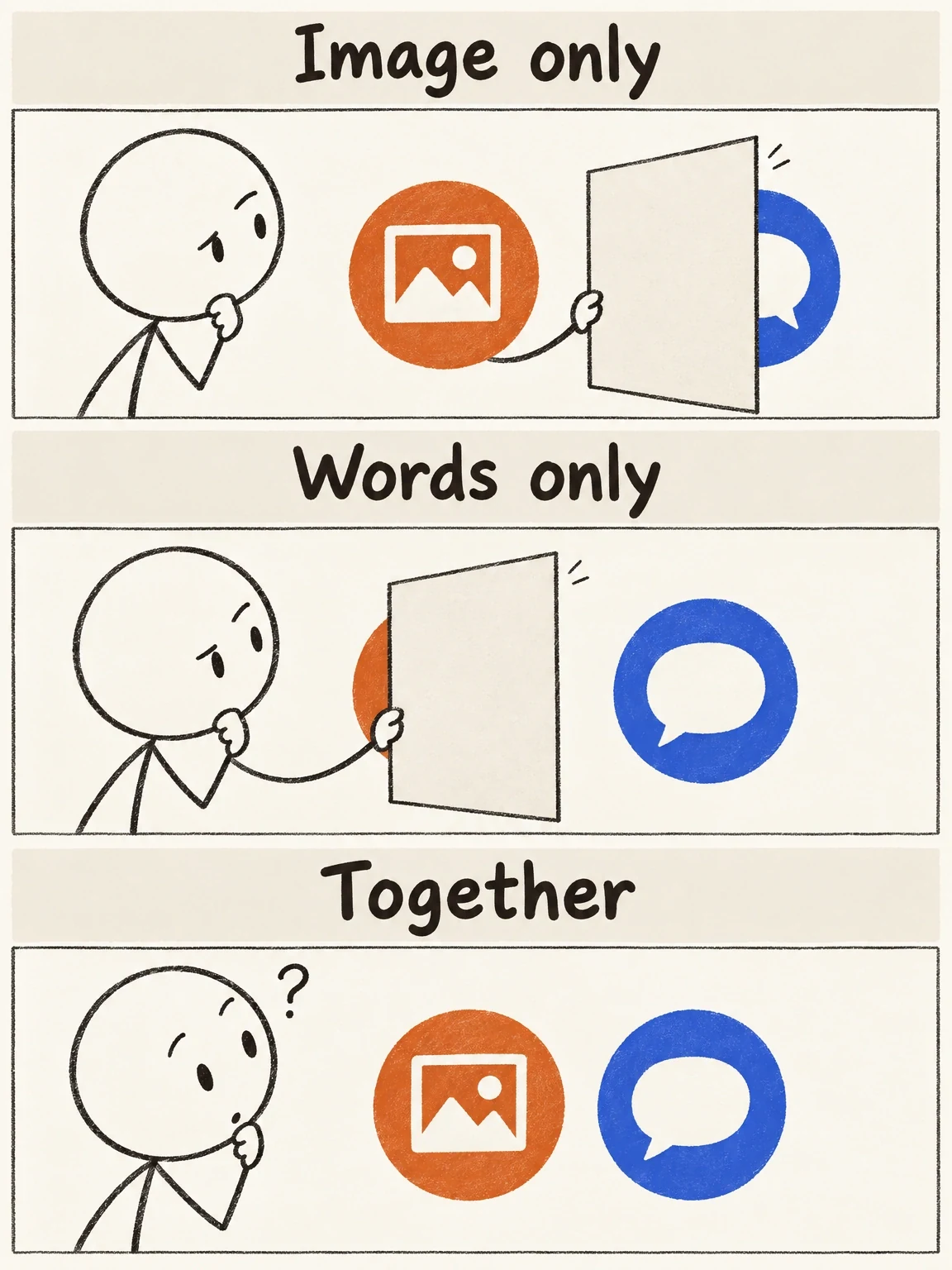
Two-channel hide and seek
Hide the line, then hide the image. Each pass helps identify what that channel contributes before you review them together.
View full-size (opens in a new tab)Image explanation
- Start with one approved product fact and a candidate opening. Hide the line to describe what the image establishes, then hide the image to describe what the words establish.
- Check the pair for compatible expectations, completed or conflicting meanings and essential information that depends on a missing channel. Important information may need sound-off support, but each channel needn't carry the entire ad.
- The empty pictograms describe a review method. They supply no actual hook-comprehension, attention, performance or campaign results.
Turn the role assignment into useful feedback
“Make the hook stronger” leaves the production decision unresolved. Try: “Preserve the falling-cable action. Replace the mysterious narration with a line about the loose end's resting place. Make the next shot show the keeper at the same desk edge.”
If several openings need to lead into one unchanged continuation, use the modular-hook specification to plan the join as well as the hook roles. Keep the required product explanation fixed while you choose which opening question to vary.
Bring the completed card, approved product references, and a real viewer action into the product-ad workflow. Then open Fablo to produce the opening and its next beat. Recurring monthly credits fund ongoing creative production in Fablo. Estimate the image, speech, assembly, and room for corrections before requesting more openings.