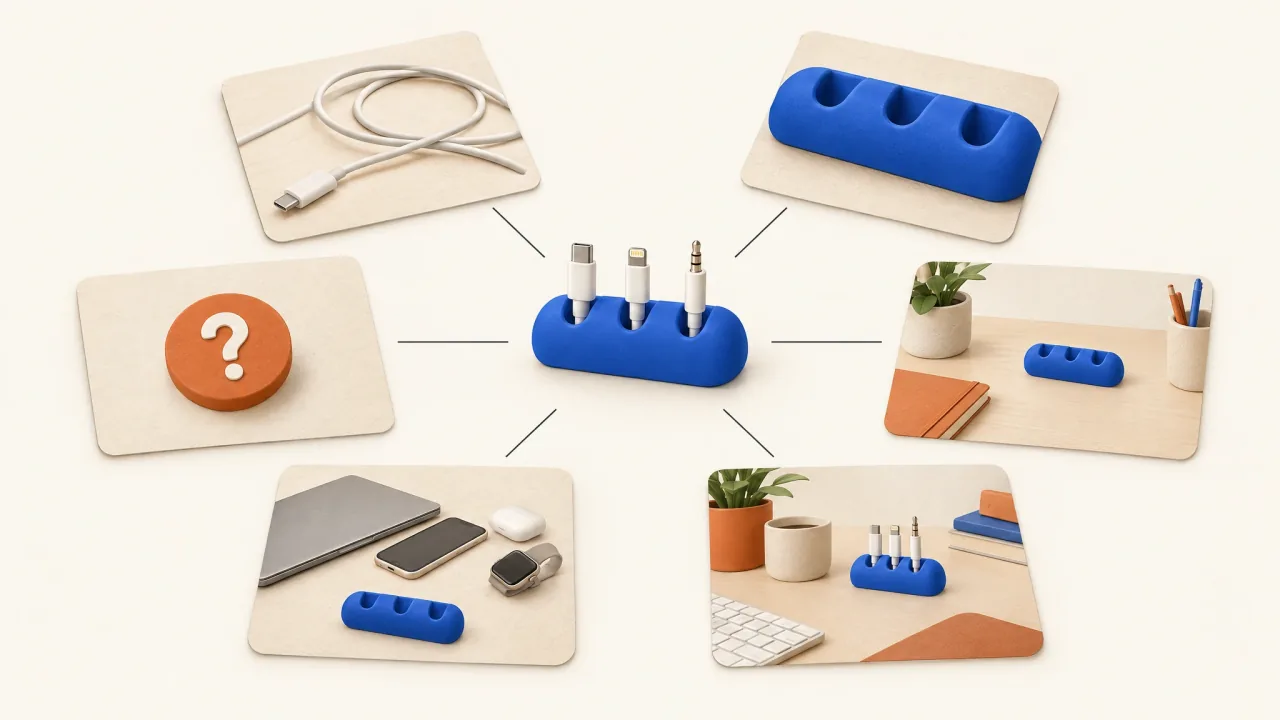
You'll write a slate of creative-angle briefs for your product and choose one direction to produce. The example has six hypotheses, but your slate should follow the buying questions that fit your product. Keep fewer directions if extra ones would repeat a motivation or invent a need.
An angle gives someone a reason to buy. You can express that reason through animation, lighting, or a presenter's style.
This lesson provides written hypotheses and exercises. The requested demonstration media hasn't been returned. None of the concepts is an accepted output or a campaign winner.
Bring approved product facts, useful references, an audience situation, and an exact offer and action. If you're missing those, work through the first-product-ad lesson first.
1. Freeze the factual brief
Write a short fact block for every concept to follow. The example uses a fictional cobalt-blue cable keeper with exactly three slots. Its job is keeping loose charging-cable ends at the desk edge. Keep that job consistent: it isn't a charger, and the example has no evidence of a measured productivity benefit.
The slate below uses supplied assumptions about desk workers. They haven't come from customer research or testimonials, and they aren't proven winners.
2. Give each motivation a different communication job
For each direction, complete “This might matter when…” and describe the product moment that would support it. These six motivations are specific to the cable-keeper example.
For your product, start with unanswered buying questions. What problem matters? Which supported mechanism needs explaining? Do you have a source for an objection, or should you label it as a hypothesis? Consider relevant use situations, routines, and purchase preferences, too. Choose the questions that fit and write your own motivations before deciding on a treatment.
A1: Retrieval frustration: problem-led
A loose cable end slips below the desk. The hypothesis is that the annoyance of retrieving it gives someone a reason to want a visible resting place. The proposed deep-sea expedition turns that situation into a visual metaphor. Bring it back to a literal desk demonstration, describing the inconvenience without inventing how often it happens or claiming time saved.
A2: Understanding the mechanism: demonstration-led
Someone needs to understand what this small object does. The hypothesis is that clear views of the slots and desk edge will explain its job. A miniature inspection stage could help show those details. List the views you'd need to explain the mechanism without relying on narration alone.
A3: Justifying another desk object: objection-led
Someone is skeptical of adding another gadget. The hypothesis is that showing one modest job makes the object easier to evaluate. An exaggerated pile of unnecessary desk devices is the proposed treatment; it doesn't establish a real customer objection. Answer “Why add this?” by explaining the supported job, without inventing superiority.
A4: Enjoying a reset ritual: ritual-led
Someone arranges their desk before the next task. The hypothesis is that putting cable ends in place can be part of a satisfying reset. The proposed clay world expresses that ritual. Choose the small arranging action that carries the message, keeping out claims that tidying reduces stress or changes wellbeing.
A5: Switching devices: use-case-led
Someone alternates between a phone and a work device at the same desk. The hypothesis is that a resting place for cable ends fits that working pattern. A fictional presenter can demonstrate the situation while remaining clearly an explainer. Show the switching context so this direction has its own message instead of repeating A1's lost-cable story.
A6: An organized-desk identity: identity-led
Someone likes a deliberate place for small objects. The hypothesis is that the keeper fits an “everything has its place” preference. Tiny travellers arriving home are the proposed visual metaphor for that preference. Describe the organized desk, make the audience identity clear, and bring the metaphor back to the actual product job.
3. Run the overlap check
Hide the visual-treatment descriptions and read the situations and hypotheses on their own. If two briefs still sound interchangeable, make their motivations more specific before producing them.
Next, decide what the body needs to show. A mechanism concept needs views that explain how the object works. A switching-device concept needs to show that use situation. If every opening leads to the same generic body, you may lose the difference you wanted to explore.
The angle examples article works through this distinction with more written directions for the same fictional prop. Use the planning guide to make your buying reasons more specific. It doesn't include a record of produced media.
4. Select one direction and define acceptance
Choose the question you'd find most useful to explore first. Confirm the scope and spend before production. When the candidate comes back, check that it communicates the motivation, preserves the product, explains the demonstration, and uses the approved claims, action, and format.
Watch the whole candidate. Final critical checks address serious production defects, while you decide whether the creative meets the brief. Record “selected for this hypothesis,” not “winning ad.” You'll need separate campaign evidence to judge its effectiveness.
Copyable customer brief
Develop up to [number] distinct angle briefs for [product], using references.
Fixed facts and identity details: [approved facts and essentials].
Audience situation: [context; mark assumptions explicitly].
Product-specific buying questions and motivations: [supplied list].
Evidence or assumption label for each motivation: [basis].
Keep only directions that fit these facts and questions; return fewer
if additional ones would repeat a reason or invent a product need.
For each, give the situation, buying hypothesis, and required
product demonstration. Choose visual treatments afterward.
Exact offer, action, and destination: [wording and URL].
Selected direction to produce: [one selection].
Format: [placement, ratio, duration]. Explain estimated spend first.
Produce your selected angle in Fablo. Use Creative Variations when you're ready to brief the next task with a clear scope.