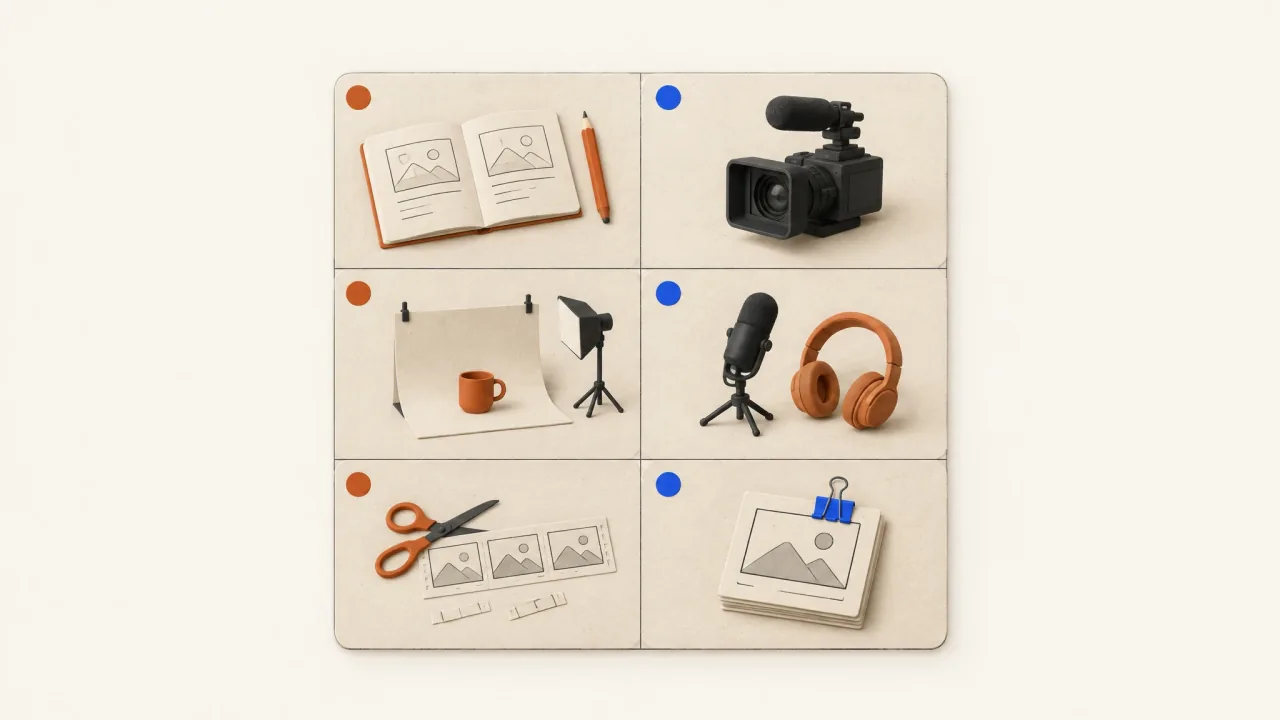
Use Creative Variations to develop multiple ad directions from one factual product brief, or try different openings for a chosen message. For each version, you should be able to explain what changed, what stayed fixed, and why a viewer might care.
Six colour palettes can express the same buying reason. To change the concept, a new setting needs to support a different audience situation, objection, or motivation.
The example below is a written angle-planning exercise. It doesn't include a produced concept set or a completed variation test with the video body kept unchanged.
Choose the variation task first
Choose distinct concepts when you want to explore different reasons to consider a product. One ad might explain the mechanism and another answer a purchase objection. Their openings, demonstrations, and wording can all change to fit those different messages.
Choose opening variants to try different ways into the same message. Specify the body, offer, demonstration, and ending to keep. This narrows the task, though a new opening can still need changes to timing, audio, or transitions.
Choose visual treatments to explore how an existing concept could look. A miniature world and an ordinary desk scene can carry the same message. Label those alternatives as treatments so they're distinct from new angles.
Name the task in your brief so production knows what to change and you know how to judge the candidates.
Required inputs: a fixed brief and a changing variable
Supply product references, approved facts, the exact offer, viewer action, destination, format, and any source creative you've selected. Mark the details every version must preserve, including distinctive shapes, packaging, and brand assets.
Then name the variable to change. For concepts, write a one-sentence buying hypothesis for each direction. For openings, say which question you want each opening to raise for the viewer. Tell Fablo which direction to produce first and how much work to include in the estimate.
Fablo develops the selected scripts and visual plans, produces the requested candidates, and assembles each into an ad you can review. Scope and estimated spend should account for the new material needed. Be clear about which ideas you want drafted and which you want rendered.
A useful six-direction example
The six-angle planning lesson uses a fictional three-slot desk cable keeper. It explores six supplied motivations: retrieval frustration, understanding the mechanism, justifying another desk object, enjoying a reset ritual, switching devices, and identifying with an organized desk. Work through it to write a slate for your own product.
The proposed deep-sea opening expresses retrieval frustration, while the planned clay animation expresses the reset ritual. Each style supports a motivation; the motivation gives the angle its name. These are creative hypotheses without customer-research findings, produced ads, or proven campaign results behind them.
Accept a set, not just individual pretty videos
Review each complete candidate against its brief, then compare the set. If an opening promises a different message but the body repeats the same generic problem-and-solution pitch, reject that direction as redundant.
An acceptable set preserves the product and approved offer, communicates each intended motivation, and identifies every version clearly. Final critical checks on the assembled videos address severe changes to the product, broken speech, incorrect offers or actions, and major visual defects. You make the creative selection and can request a specific fix. Choosing a campaign winner needs separate evidence.
The angle examples article explains how changes in persuasion differ from changes in appearance.
Limits worth planning around
Allow more production and review work when you request more candidates. A subscription balance won't give you a fixed number of finished ads. Complex interactions, exact brand details, and transitions into a preserved body may need corrections.
Judge whether the videos meet your brief separately from their campaign results. Fablo uses feedback within the production conversation. It doesn't automatically optimize ROAS or bring every asset into a new chat, so supply the relevant context when you start one.
Copy and adapt this brief
Develop [distinct concepts / opening variants / visual treatments]
for [product and brand], using the attached references.
Fixed facts and product details: [approved facts and essentials].
Audience situation: [specific context].
Exact offer, action, and destination: [wording and URL].
Format: [placement, ratio, target duration].
Directions to explore: [one buying hypothesis per concept,
or one opening question per variant].
Preserve from the selected creative: [body, demonstration, ending].
Produce this direction first: [selection].
Explain what changes, what stays fixed, and estimated spend.
Let me select the complete candidates before accepting delivery.
Open Fablo and create your next variation. If you need to make the base ad clear first, start with Product Ads.