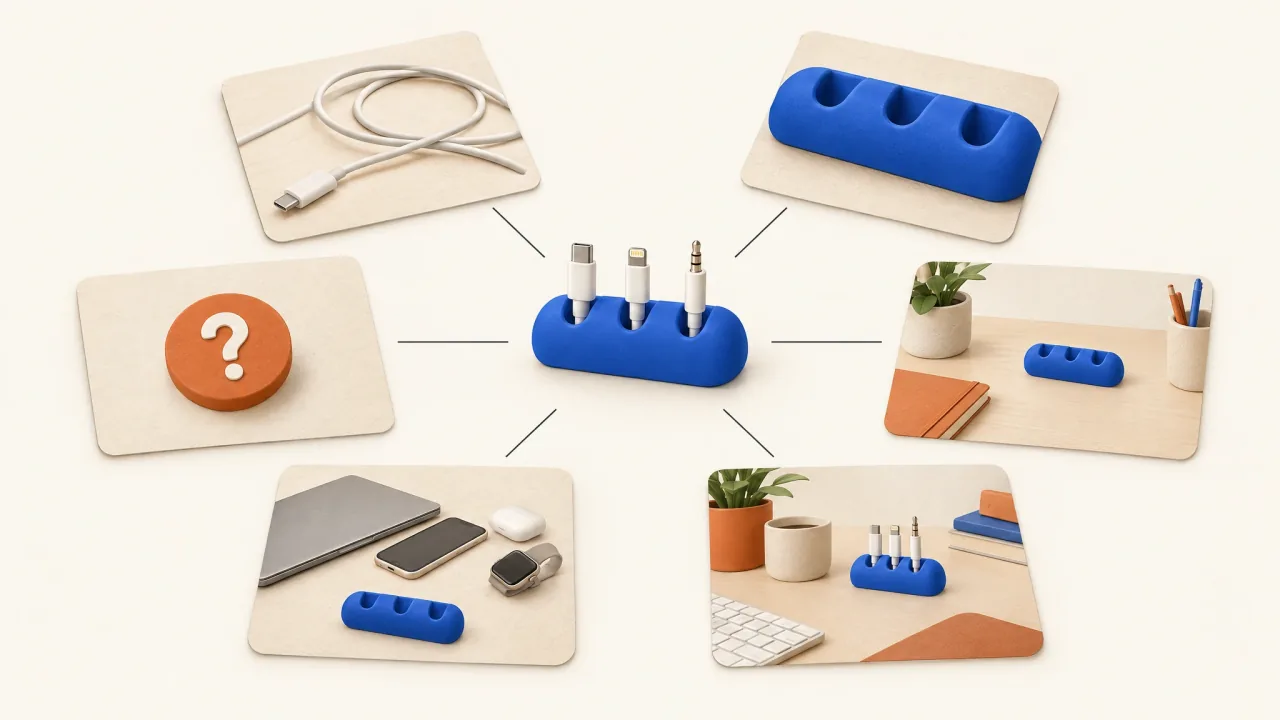
Before asking for six ads, write six different answers to the question: why would this person want the product? Changing the setting, presenter, or rendering style while keeping the same answer gives you variants of one angle.
An angle is the reason you think someone might want to buy. Style is how you express it. "Keep your charging cable within reach" is a possible buying reason; deep-sea cinema, clay animation, and a casual presenter could all express that same reason. Use the concept-versus-treatment audit if a planned set looks varied but keeps making the same argument.
The examples below are proposed directions for a fictional desk cable keeper. It's matte cobalt blue, has exactly three slots, and keeps loose charging-cable ends at a desk edge. Those details are creative assumptions. There's no customer research, returned ad, or campaign finding behind them. Working with a narrow product brief makes the differences between buying reasons easier to see. The companion six-angle planning lesson uses these directions to help you plan a set of concepts.
1. Problem-led: the cable that disappears
Buying reason: I am tired of retrieving the cable end from below my desk.
The opening could follow a slipping cable into an absurd underwater expedition. That fantasy exaggerates a familiar situation before returning to an ordinary desk, where the keeper gives the loose end a place to rest.
Illustrative hook: "Back under the desk for your cable?"
Give the return to the desk enough attention. An ocean sequence can't resolve the problem if the viewer misses the product action. Show the cable end resting in a slot, without implying time savings or universal compatibility that the brief doesn't support.
2. Mechanism-led: show what the object does
Buying reason: I understand the job, but need to see how this small object helps.
Build a miniature inspection stage around the product. Show the three slots clearly, then a cable resting in one. A wider view can explain where the keeper sits on the desk. Use the minimal demonstration shot list to give each view something specific to explain.
Illustrative hook: "Here's where the loose end goes."
The theatrical stage still has an explanatory job: help the viewer understand what the object does. Show the known interaction and leave hidden mechanisms, installation methods, and material properties out unless they're supported. An unusual shape alone won't explain the product.
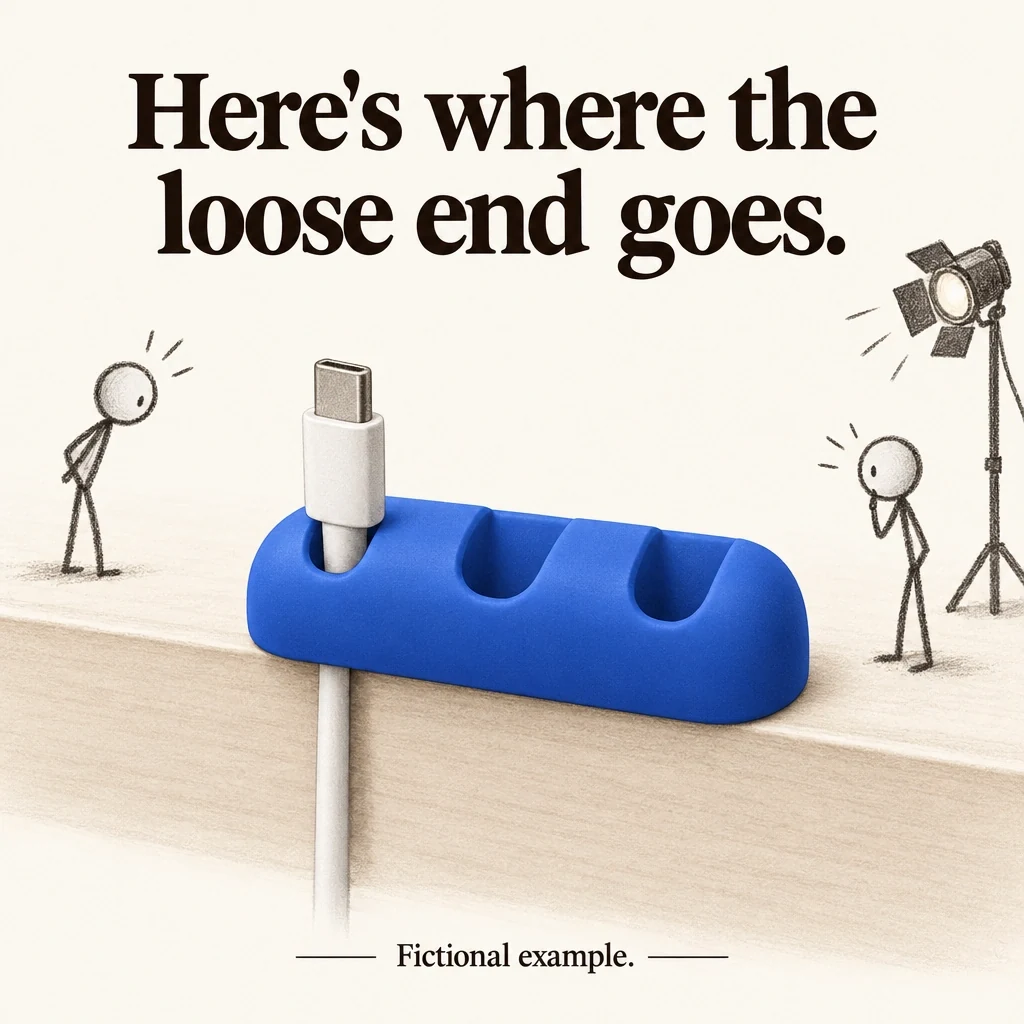
A mechanism-first concept frame
A tiny audience inspects the fictional keeper's everyday job: giving a loose cable end somewhere to rest.
View full-size (opens in a new tab)Image explanation
- A loose cable rests in one of the cobalt-blue silicone keeper's exactly three slots at a desk edge.
- The miniature stage is a visual treatment for explaining an unfamiliar object. It adds no product mechanism or result.
3. Objection-led: does another desk object earn its place?
Buying reason: I do not want more desk clutter, but could make room for something with a clear job.
An exaggerated pile of unnecessary gadgets could give the opening some dry comedy. Then show the small keeper in a simple composition, holding loose cable ends at the desk edge.
Illustrative hook: "What earns a place on your desk?"
The objection is whether the keeper is useful enough to justify another object on the desk. Keep the contrast fictional and visual, then let the demonstration explain its usefulness. The brief doesn't support claims that competing products are overpriced or ineffective.

An object earns its place by having a readable job
This fictional concept asks whether the keeper earns a place on the desk. Its visible resting-cable job supplies the answer.
View full-size (opens in a new tab)Image explanation
- The supplied objection asks whether another desk object is useful enough to include. It makes no claim that competing products fail.
- A clear view of the three-slot keeper's resting-cable job answers that question. The concept invents neither space savings nor customer research.
4. Ritual-led: the end-of-day desk reset
Buying reason: I enjoy returning my workspace to an orderly state.
A tactile clay-world treatment could show a small reset: a notebook closes, a cup moves aside, and loose cable ends return to the keeper. Keep its geometry recognizable even in that stylized world.
Illustrative hook: "Put the desk back the way you like it."
The buying reason comes from the reset ritual. Clay gives it a style, and a photorealistic version could make the same argument. Keep the product's contribution to the visible act of arranging a cable. Any promise about concentration, stress, or productivity would need separate evidence.
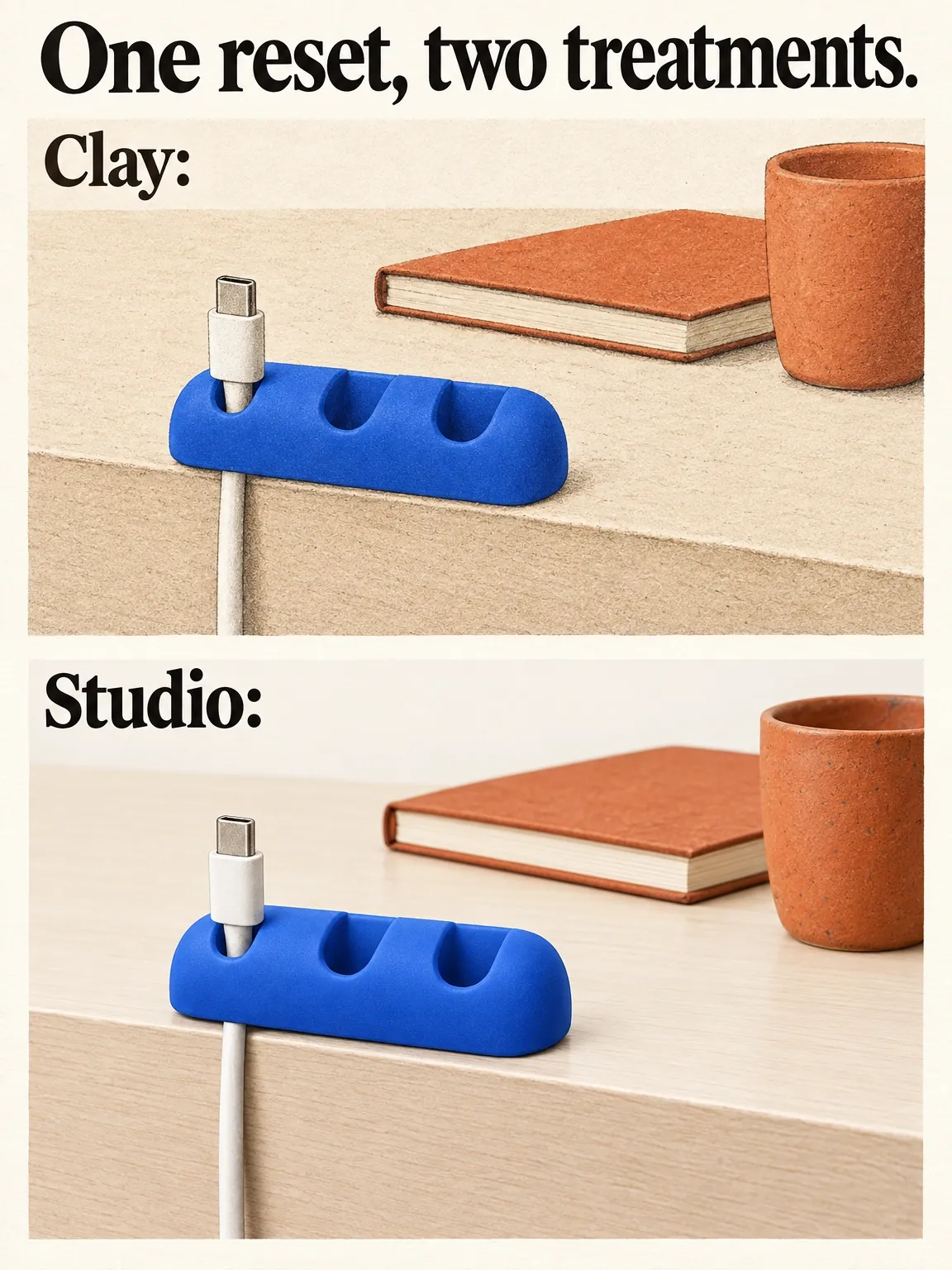
The reset is the angle; clay is one treatment
Two fictional keeper treatments share the same desk reset: notebook closed, cup aside and a loose cable resting over the edge. Clay changes the look of the same idea.
View full-size (opens in a new tab)Image explanation
- Both desk views show the same proposed end-of-day reset: a closed notebook, a cup set aside and one continuous white cable resting in the keeper's left slot and hanging over the front desk edge.
- The assumed buying reason is enjoying a workspace returned to order. Both views keep the matte cobalt-blue silicone body, exactly three slots and two empty slots; the loose cable is not plugged into a powered port.
- These fictional stills leave the reset and handling actions unshown. They provide no evidence of concentration, stress or productivity effects, a finished Fablo ad or a campaign comparison.
5. Use-case-led: switching between devices
Buying reason: I move between devices at the same desk and want their cable ends to have a consistent resting place.
A fictional presenter could alternate between a phone and a work device, with two clear moments showing a loose cable returning to its slot between uses. Close product views can explain this without a complicated hand sequence.
Illustrative hook: "One desk. Different devices throughout the day."
This angle asks whether the keeper fits a particular working situation. It holds cable ends; it isn't a charger, charging hub, or speed upgrade. Keep the presenter's role clear too: they're explaining a staged scenario, without claiming a customer's personal result.
6. Identity-led: a deliberate place for small things
Buying reason: I like a desk where everything has an assigned place.
Imagine loose cable ends as tiny travellers returning to a desk-edge neighbourhood. The keeper is their recognizable home. Then return to an ordinary workspace where small things have deliberately assigned places.
Illustrative hook: "Even the smallest things can have a place."
The imagined audience is someone who values an organized desk. The travellers simply express that preference as a metaphor. This differs from the reset ritual because it celebrates an ongoing preference, while the ritual shows a particular action. Both motivations are assumptions; neither establishes what real customers want.
Choose angles according to what you need to learn
You don't need to fill all six categories. Choose the buying questions your brief hasn't answered:
- If the product's job is unfamiliar, start with mechanism clarity.
- If the situation is familiar but easy to ignore, explore the problem or use case.
- If the product faces a specific objection, address that objection directly.
- If you have a plausible routine or identity motivation, explore it while recording the assumption.
Write each buying reason as a sentence before choosing a visual treatment, then remove the style words. If two sentences still say "stop losing your cable," they belong to the same angle family, however different the videos might look.
Copy this angle brief
Product: [name and category]
Approved facts: [only facts the ad may state or demonstrate]
Viewer situation: [a specific moment in which the product matters]
Buying reason: [one sentence, without style or camera language]
Assumption to explore: [why this reason may matter to this viewer]
Required demonstration: [the visible action that explains the job]
Visual treatment: [how the reason will be expressed]
Identity to preserve: [product geometry, colours, labels, supplied references]
Keep consistent across the set: [approved facts, offer, CTA, format]
Do not imply: [unsupported claims, testimonials, or product functions]
Viewer action and exact destination: [approved action and URL]
Deliverable: [duration, aspect ratio, audio and caption requirements]
Selection criteria: [recognizable product, readable job, clear buying reason]
Exploring angles changes both the argument and the scenes supporting it. If the complete ads later run in a campaign, the results will describe those whole executions. You won't be able to isolate the effect of style alone. For a later hook comparison, use the preserved-body hook specification to define the body to keep and the opening to change.
Start with a small set of buying questions. The creative-variations workflow explains how to brief distinct concepts and review the returned set, without rendering every direction at once.
Pick a buying reason, fill the brief with approved product facts, and open Fablo to produce your next ad direction. Fablo's monthly plans provide recurring credits for ongoing production. Before producing the set, agree on the scope and estimate, including checks and room for corrections.