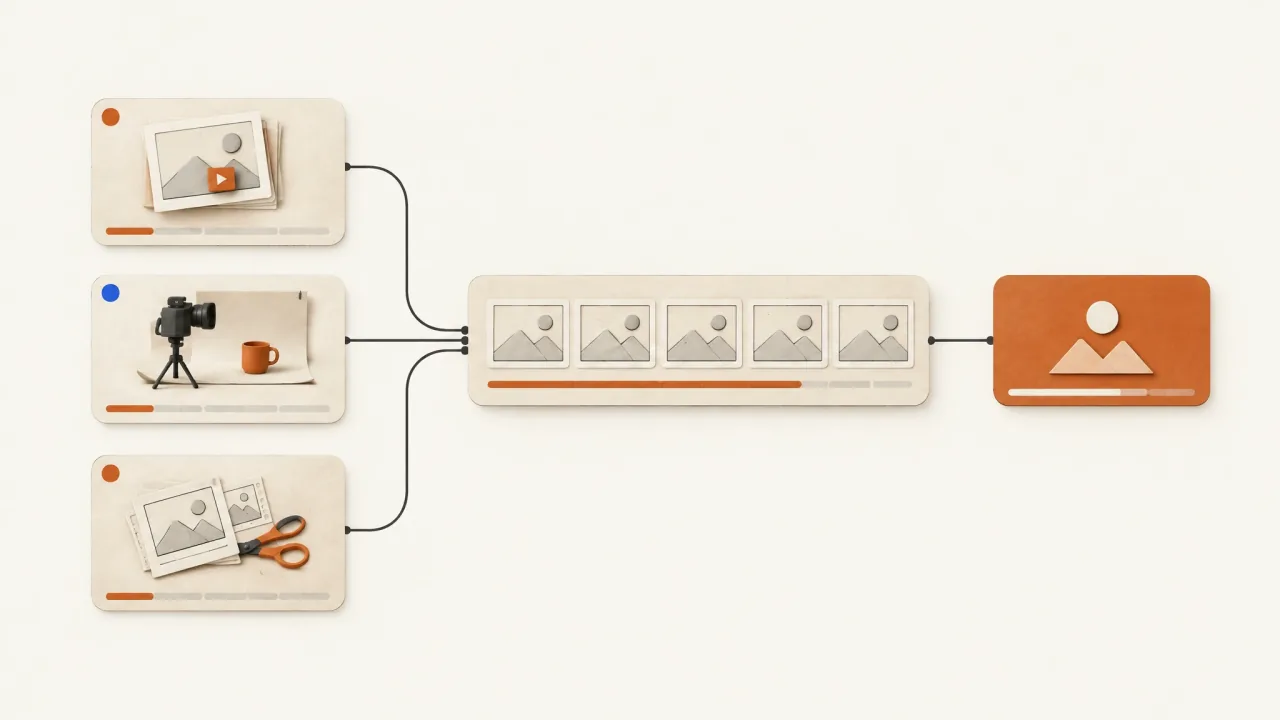
Choose where the body begins before writing alternate hooks. Each opening needs to lead naturally into the same next shot, sentence, and product explanation. Once that join works, you can swap the openings without changing the body.
A request to “Make three versions of this ad” may change the demonstration, delivery, soundtrack, captions, and ending along with the opening. Those are complete ad versions, even if their message is similar. For three hooks over one preserved body, you'll need to specify what stays fixed.
Name the media that stays unchanged and the exact portion allowed to vary. Use the production-matrix guide to set how many openings and formats you're commissioning. The worked specification below is for planning; it hasn't been rendered or verified.
Define what the opening can change
An opening can have its own image, words, sound, and short on-screen text. Use the visual-versus-spoken hook exercise to decide what each channel needs to do. When several elements change together, call the unit an opening package. Campaign results from that comparison couldn't isolate the effect of a single spoken line.
Match the variants to what you want to compare. If you're exploring wording, keep the image and delivery where practical. If you're exploring a visual setup, avoid rewriting the whole voiceover at the same time. You don't have to change only one element in every project; choose the scope that answers your production question.
Keep a clear record of the body: the accepted source file, entry frame, audio boundary, and ending. Preserve the product demonstration, body narration, caption timing, offer, and CTA unless the brief calls for a broader change.
Write a body entry that stands on its own
A body that begins “That's why it works” depends on what came before, and different hooks may not explain the same thing. “Three slots at the desk edge” names a concrete product relationship that can follow several relevant openings.
Check the first image too. If the body starts with a person finishing a gesture, each opening needs to establish that person and action for the cut to make sense. A clear product shot can give you a more flexible join than a half-completed interaction.
Plan the audio boundary before production so the hook's final word, music tail, or sound effect can end without changing the body's narration. If a transition overlaps the body, specify which elements are shared and which belong to the opening module.
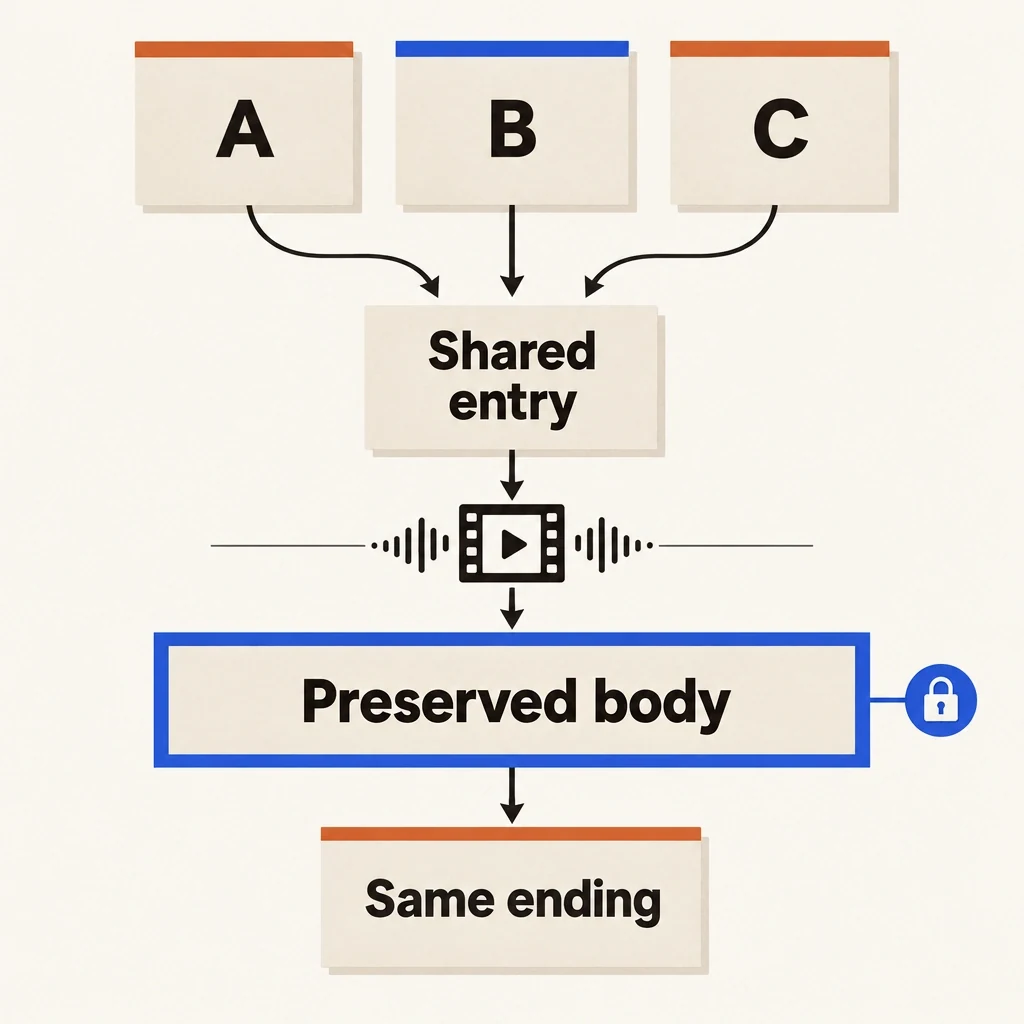
Three entrances, one clear join
Openings are interchangeable only when the same body entry, next sentence and product explanation can follow each one truthfully.
View full-size (opens in a new tab)Image explanation
- Alternative openings must reach one compatible visual and spoken body entry.
- Keep the actual named body media and ending. An opening that requires a rewritten body needs a broader concept brief.
Worked plan: three entrances to a cable-keeper demonstration
Use the fictional matte cobalt-blue three-slot cable keeper, whose defined job is giving loose charging-cable ends a resting place at a desk edge. This plan illustrates a requested 15-second vertical demonstration. An actual master or set of exports hasn't been produced for it.
Allow 0 to 3 seconds for the proposed opening and 3 to 15 seconds for the proposed body. These timings allocate the edit for this exercise; they aren't performance thresholds or measured durations.
Start the planned body with a clear view of the keeper at an ordinary desk edge. Narration begins, “Three slots at the desk edge.” Follow with a closer view of a loose cable end resting in one slot, then a wider desk context. At the end, label the prop as fictional and invite the viewer to make a version in Fablo.
The body explains where the keeper goes and how the cable rests in it. Each opening needs to make that explanation relevant:
- H1: the disappearing end. Show a loose connector slipping below a desk edge. Illustrative line: “Where did the cable end go?” Cut to the planned body without continuing the falling motion into it.
- H2: the unfamiliar object. Show the keeper's recognizable shape against a plain desk setting. Illustrative line: “What is this little blue thing for?” The body supplies the category context and action rather than another mysterious reveal.
- H3: the interval between uses. Show a disconnected cable beside a phone. Illustrative line: “Where does the cable wait between charges?” The body explains the resting place without implying that the keeper charges the phone.
These hooks ask related questions the same product action can answer. A faster-charging promise would lack support in the fictional facts and wouldn't fit this body. Revise that promise; a decorative transition can't repair the mismatch.
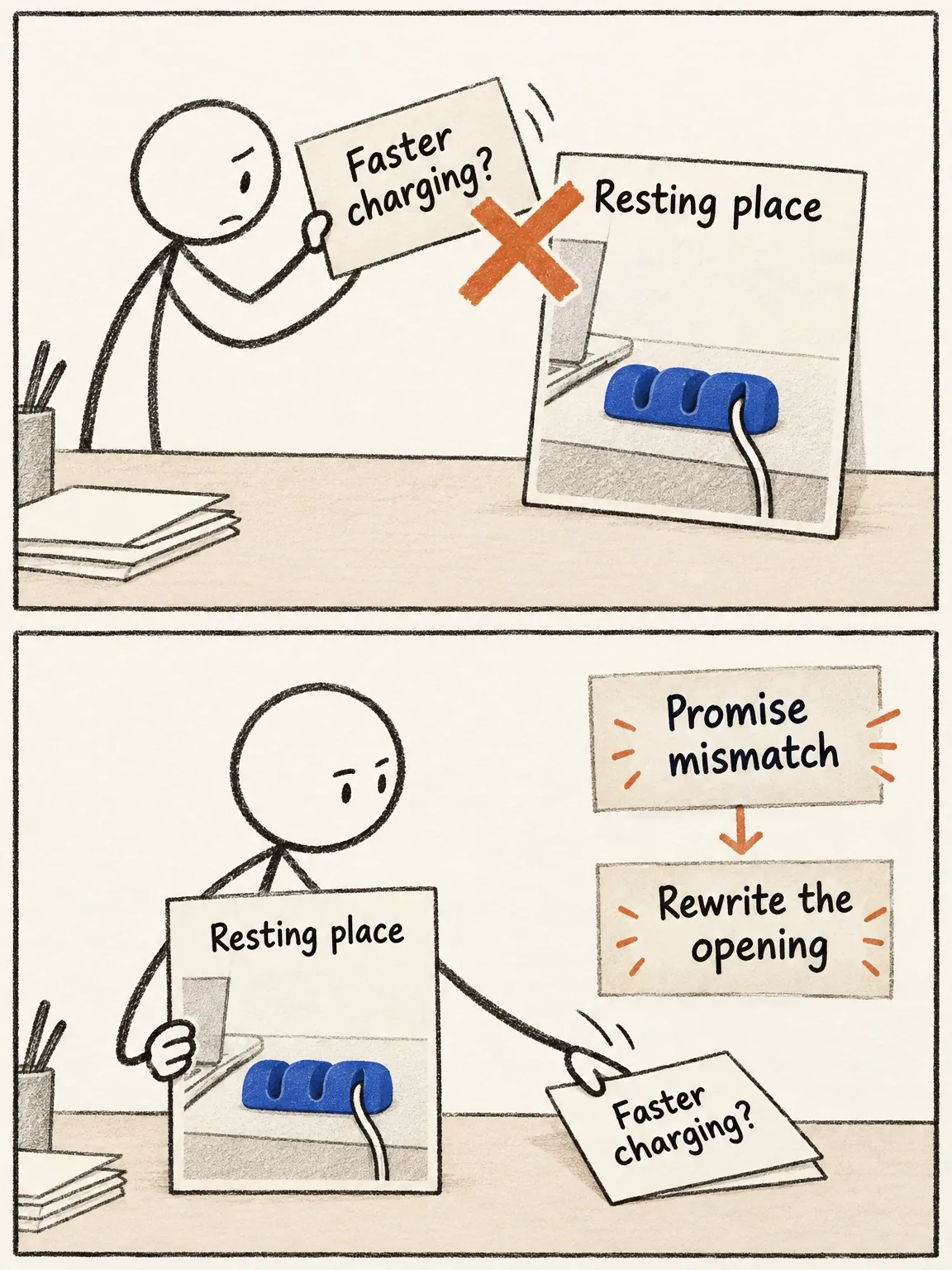
The body cannot answer an invented promise
The fictional keeper's body explains resting cable ends. An unsupported charging question asks it to answer a promise it cannot fulfill.
View full-size (opens in a new tab)Image explanation
- A faster-charging question is incompatible with a body that only explains where loose cable ends rest.
- Rewrite the unsupported opening or explicitly commission a different supported concept. Quietly changing the body breaks the claim that it was preserved.
Copy this fixed-body modular-hook specification
Separate requests from actual media records. Fill the actual fields only after files exist.
Production question: [what the opening comparison should explore]
Changing unit: [line, image, delivery, or opening package]
Body master: [actual accepted file/version; pending if unproduced]
Body entry: [actual frame/time plus first complete spoken sentence]
Body preservation: [picture, narration, captions, music, ending]
Opening allocation: [requested duration; actual duration when returned]
Join rule: [visual arrival, audio boundary, shared transition]
Hook ID: [one stable identifier per requested opening]
Hook setup and illustrative wording: [proposed scene and line]
Promise resolved by the body: [the supported question it answers]
Forbidden changes: [facts, product identity, offer, body media]
Viewer action and exact destination: [approved action and URL]
Requested delivery: [modules, assembled ads, final scripts, posters]
Actual export record: [returned file, join location, inspected status]
Repeat the hook-specific fields for each opening and keep the body fields shared. If a hook can't lead into the agreed entry, revise the opening instead of quietly rewriting the body.
Inspect the join and the preservation claim
When the media arrives, watch the end of each opening through the start of the body. Does the narration finish cleanly? Check that the product is still the same object, the scene relationship makes sense, and captions don't disappear or collide at the boundary.
Compare the assembled body's frames, audio, captions, and sequence with the accepted body master. Similar regenerated footage doesn't count as preserving that media. Record any re-encoding or permitted transition work separately from content changes.
If a hook needs a different explanation later in the ad, revise the opening or classify it as a broader concept variant. Authorize any new body work separately with the scope-and-budget decision sheet. An undisclosed body rewrite would make the comparison harder to interpret.
Use a creative-test asset manifest to identify the actual exports and their shared source. Accepting the production means the requested modules work together and can be traced to that source. Campaign lift needs separate evidence.
Take the specification to the creative-variations workflow and request any correction at the join as a separate revision. Open Fablo to produce the modular opening set. Fablo's monthly plans provide recurring credits. Preserving the body can still leave new media, integration, checks, and corrections to pay for, so review the scope and estimate before commissioning the set.
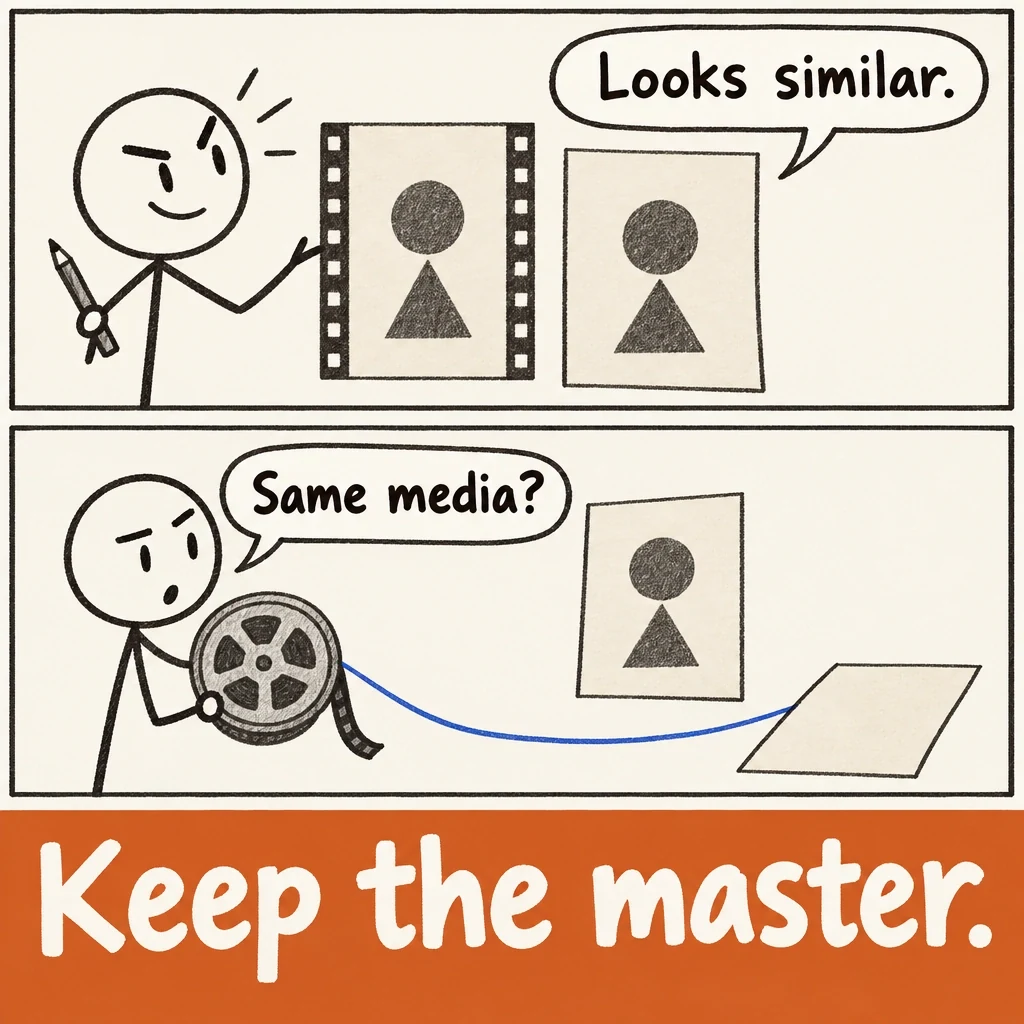
A convincing redraw is not preserved body media
A similar-looking redraw can be a new production. Compare the assembled body with the retained master to check what was actually reused.
View full-size (opens in a new tab)Image explanation
- Retain the accepted body master and compare its frames, audio, captions and sequence with the assembled body. Similar regenerated footage leaves reuse of that media unproven.
- Record permitted transition work and re-encoding separately from content changes; preservation implies no universal byte-for-byte export requirement. Inspect the join for completed narration, coherent scene relationships and caption collisions.
- The cartoon contains abstract hypothetical media. It provides no returned body master, verified join or accepted fixed-body packet for the article.