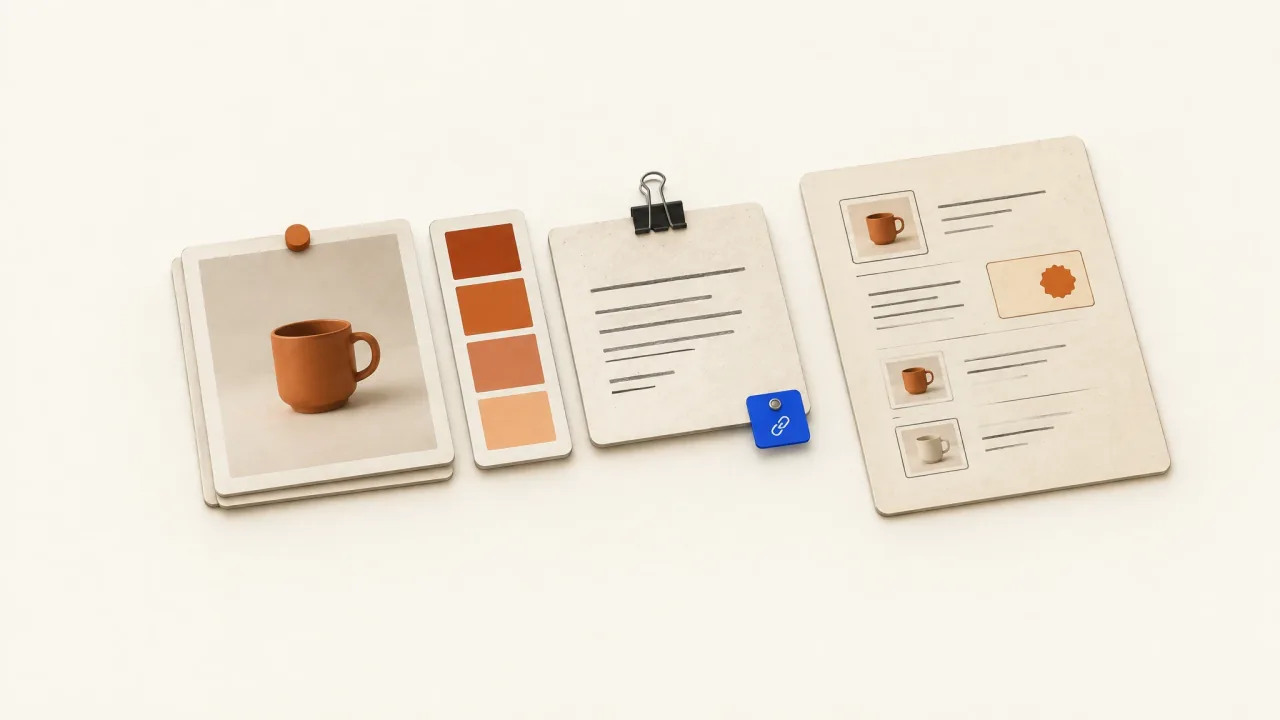
Start with an ordinary product. Choose a constraint and write a brief that makes the rule useful while keeping the product facts intact.
The Lab gives you a creative exercise with a clear scope. Work through the written examples below, then take your own brief into production. The examples describe proposed directions; they don't show produced results.
Rule 1: change the reason, keep the product
Choose two different buying questions about one product. Write each message before deciding what its world should look like. Keep the references, supported facts, and actual offer fixed.
Hide the treatment descriptions and check whether the messages still differ. If they mean the same thing, make the buying questions more specific.
Use the six-angle examples to separate buying reasons
Rule 2: the impossible world must explain an ordinary job
Give a familiar product an extravagant setting. Then describe the product-in-use moment that connects the spectacle to what it actually does.
Choose the shot you'd keep if the rest of the fantasy disappeared. It should explain the product without implying a fictional capability.
Plan the bridge with the cinematic product-ad guide
Rule 3: the opening image names the product
Choose a product that might be hard to identify in an atmospheric scene. Plan an opening that makes the object recognizable and keeps the look you want.
Write down what needs to be visible in the opening, what can wait, and which ambiguity the composition should remove. You're planning clearer communication here, without claiming a change in conversion.
Write a focused lamp-reveal request with the scene-revision guide
Turn the rule into a customer brief
Product, approved facts, and references: [inputs].
Audience and use situation: [context].
Chosen creative rule: [one constraint].
Message and literal product moment: [what must be understood/shown].
Details to preserve: [identity, wording, offer, other essentials].
Actual offer, viewer action, and destination: [terms/action/URL].
Format, runtime, and acceptance checks: [requirements].
For a group exercise, ask everyone to state the rule and product job before discussing style. Work on one candidate and one specific review question. The ordinary-product challenge guide has a fuller exercise sheet.