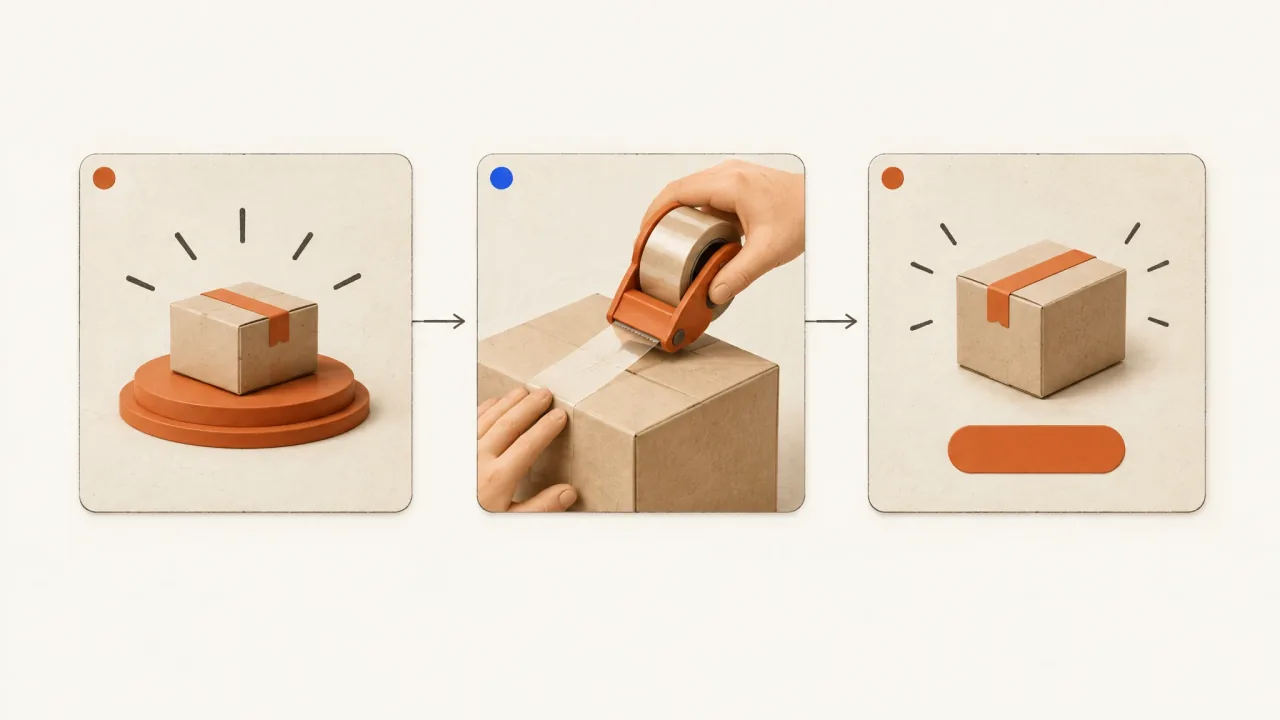
Decide what the spectacle needs to communicate. It might dramatize a relevant situation, make the product action memorable, or express the buying reason. Give the viewer a literal product view too, along with a clear next step.
A cosmic parcel journey might make an excellent film. But if the viewer remembers the sky and can't identify the packing tape, the ad needs a clearer explanation. Adding cinematic detail alone won't solve that.
You don't need three separate scenes. Spectacle draws attention to something meaningful, demonstration explains the product, and the invitation gives the viewer a real action to take. One shot can do more than one of those jobs.
Decide what needs to be literal
Before planning the world, write a sentence stating what the viewer needs to understand about the product.
For an ordinary clear packing-tape roll, that might be: "This tape is used to seal a cardboard parcel." For a three-slot cable keeper: "Loose charging-cable ends rest in the slots at the desk edge."
Use those sentences to decide what the indispensable shot must show and where the factual limits lie. Showing parcel sealing won't establish exceptional strength or weather resistance. Showing a resting cable won't establish faster charging.
Build the metaphor around the use situation. The metaphor-to-mechanism bridge helps you write the return to literal use before planning the fantasy. Keep imaginary physics separate from evidence of a real capability: the cosmic distribution system supplies the fantasy, while the grounded sealing action explains the ordinary object.
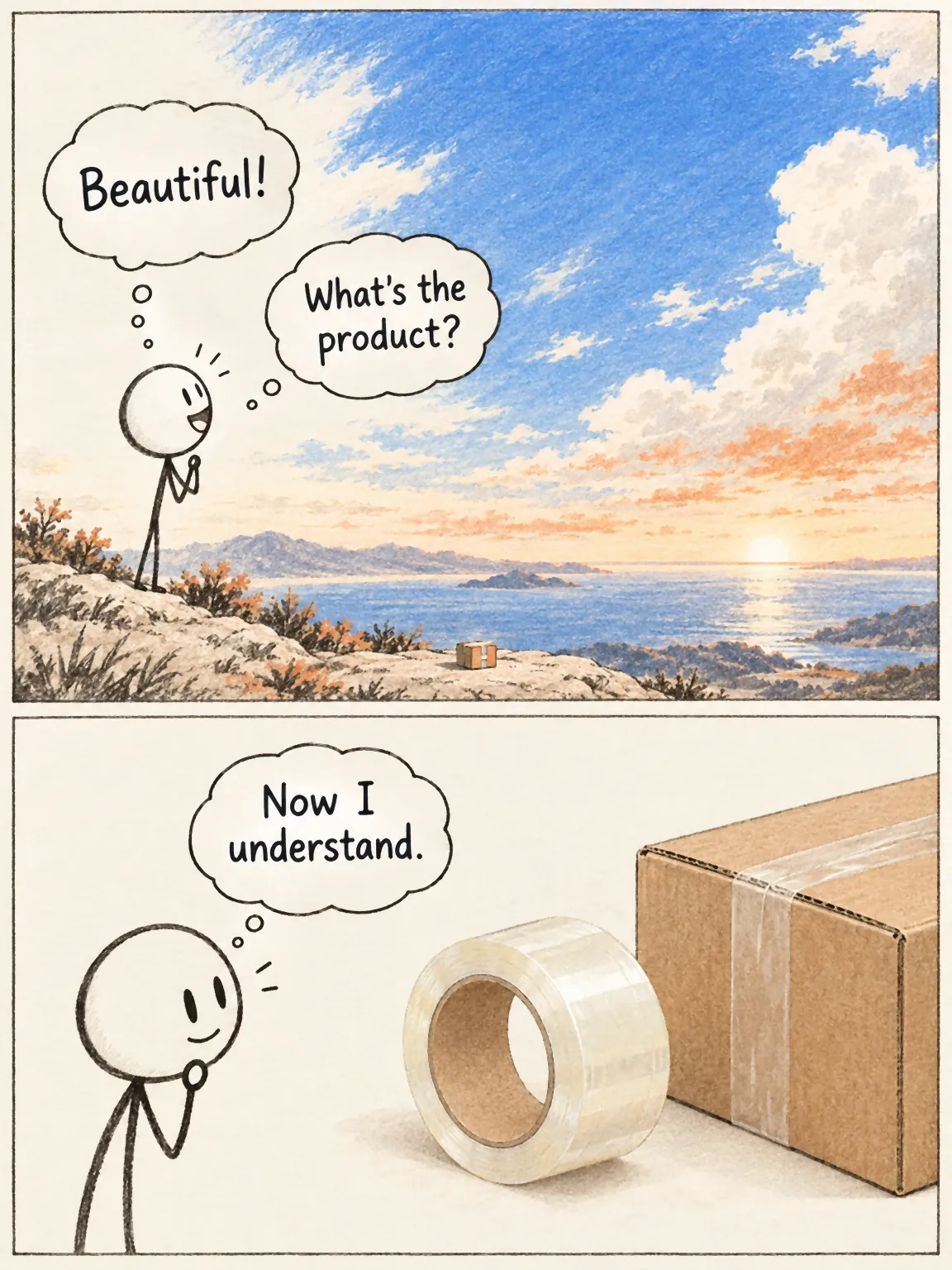
The viewer remembers the sky but misses the tape
The fictional sky can steal the scene. An ordinary roll-and-seam view gives the viewer the product explanation it leaves out.
View full-size (opens in a new tab)Image explanation
- The imaginary sky can be memorable while leaving the product unidentified.
- A literal roll-and-seam view explains ordinary parcel sealing. The fantasy supplies no tape-strength evidence.
Choose the opening according to the explanation burden
Lead with the product or action if the object is unfamiliar, the category is ambiguous, or the mechanism needs attention. That gives the viewer a concrete reference for the cinematic sequence that follows.
A brief metaphor can lead if the situation needs little explanation and the next beat quickly connects it to the product. A disappearing cable can establish the frustration of retrieving it before an underwater fantasy exaggerates that feeling.
Sometimes the demonstration can supply the spectacle. A composed close-up or miniature inspection scene may be visually interesting and explain the product at the same time. Cinematic direction doesn't require an impossible world.
For opening-effect references, inspect the proposed cinematic VFX hook showcase. Focus on how the effect leads to a recognizable product view. Filling the opening with more effects doesn't answer that question.
The Cable Keeper Multiverse explores these choices through proposed problem-led and mechanism-led directions. The ocean setting expresses a reason to buy: avoiding the need to retrieve a lost cable. The theatrical inspection stage expresses a different reason: understanding how the object helps. Both settings are treatments of those arguments.
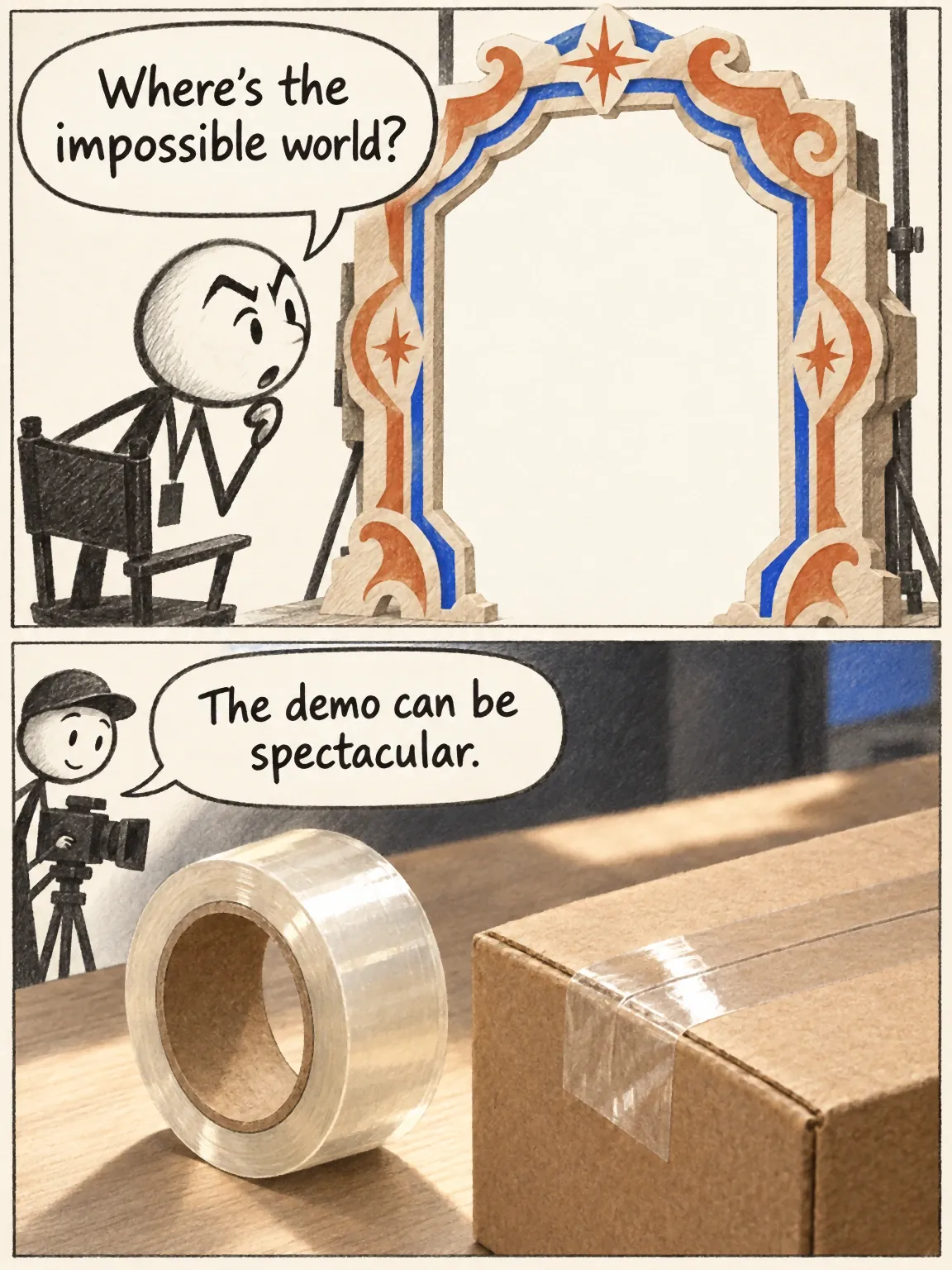
The demonstration can be the spectacle
The fictional tape scene finds its spectacle at the packing table. A strong close composition can explain the product in the same beat.
View full-size (opens in a new tab)Image explanation
- A composed close-up or miniature inspection scene can give a cinematic opening both visual interest and product explanation. Choose the opening for what the viewer needs to understand; an impossible world is optional.
- The roll-and-seam relationship anchors ordinary parcel sealing. This still records no sealing action or exceptional strength, adhesion or protection.
- The miniature is a hypothetical treatment, with no footage from the proposed film or completed Fablo ad. The actual opening still needs selection for product recognition and the brief's explanation.
Worked example: an epic film and a short commercial
In The Last Box on Earth, a fictional packing-tape concept, a miniature courier prepares a parcel beneath an impossible sky. The ordinary sealing action keeps the product recognizable within the fantasy.
The proposed deliverables are a 30-second widescreen film and a 15-second vertical commercial. This is an illustrative pre-production plan. It doesn't report a finished film or a completed edit.
The film could spend time in the courier's world and let the parcel's departure take on an absurd emotional scale. The commercial needs to identify the product, explain the action, and leave time to read the invitation. Simply shortening the film may miss those priorities.
One possible 15-second commercial storyboard
- 0-3 seconds: establish the object and its job. Show the clear tape roll beside a cardboard parcel at an ordinary packing table and begin a recognizable sealing action. Add concise category text if the composition alone is ambiguous.
- 3-6 seconds: expand the situation with the miniature departure platform and impossible sky. Keep the same parcel visually connected to the opening so the sequence doesn't feel like a disconnected second story.
- 6-11 seconds: return to the literal demonstration. Show tape laid across the parcel seam with a clear view of the roll and box. Explain the use without implying a strength test.
- 11-15 seconds: hold a readable product composition and the real next action. Clearly label the fictional demonstration. The prop isn't for sale; invite the viewer to make a version for their own product in Fablo.
These timings are planning allocations. They haven't been measured from a finished ad and aren't a universal pacing formula. If a beat needs more explanation, simplify another so the indispensable action has enough time.
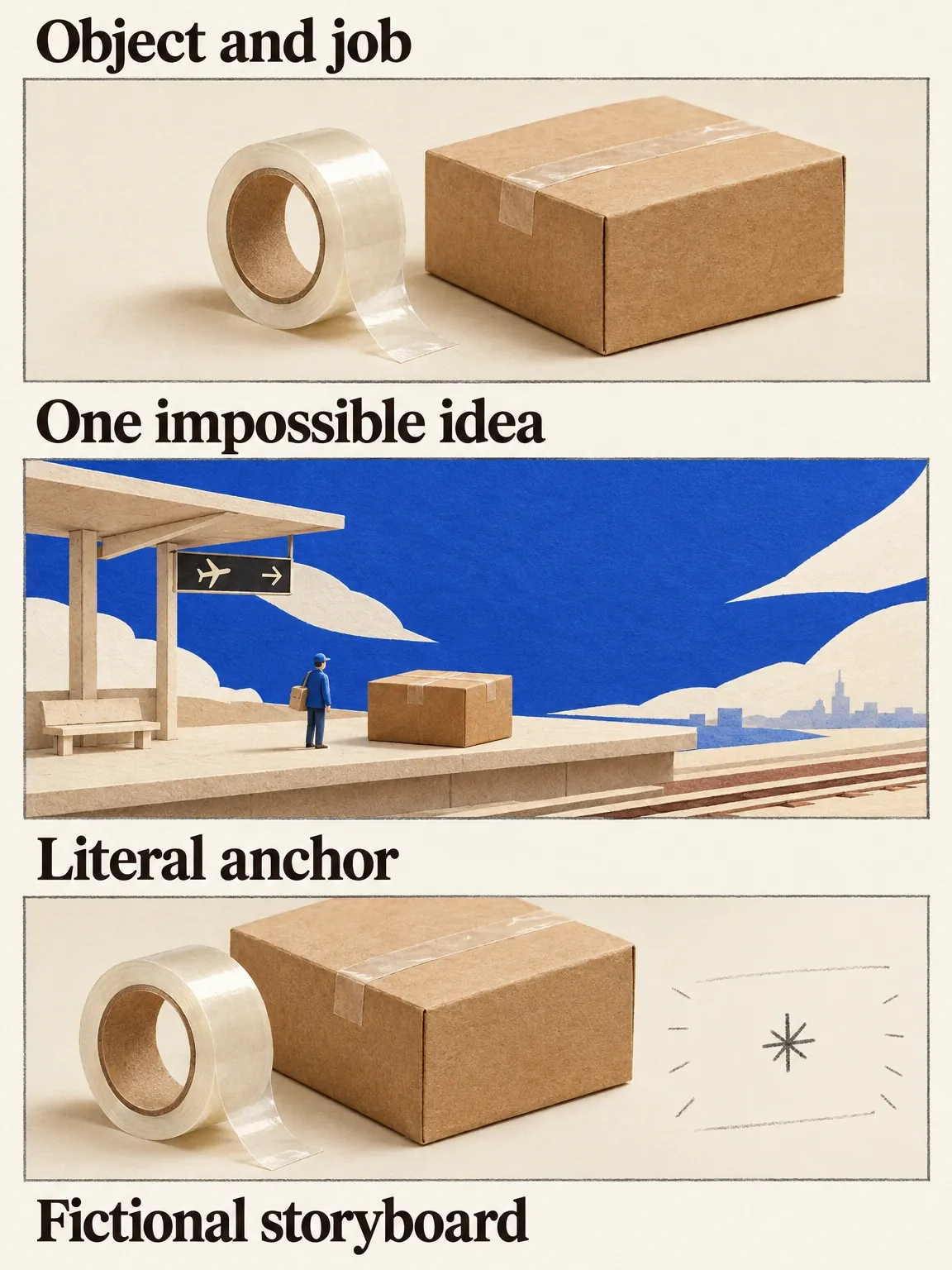
Spectacle with an ordinary product anchor
The fictional tape story leaves the packing table for an impossible sky, then returns to ordinary parcel sealing.
View full-size (opens in a new tab)Image explanation
- The fictional scene identifies ordinary parcel sealing, adds one impossible departure image and returns to the tape roll and seam.
- The finished version still needs its approved invitation. The fantasy supplies no evidence of tape strength or protection.
Translate a film into an ad by editing the argument
Ask what each film beat contributes to the commercial, then look separately at the footage available to do that job. A courier introduction may create atmosphere without helping explain parcel sealing. A single cosmic departure image might preserve the film's character without making you explain its whole fictional world.
For each candidate beat, make one decision:
- Keep it if it advances the buying reason or makes the action readable.
- Change it if the idea matters but the composition, duration, or text hierarchy doesn't fit the new format.
- Remove it if it contributes only lore or repeats a job another beat already does.
Check what happens to a widescreen shot in a vertical crop. The tape may fall outside the frame, or the parcel may become too small. If reframing can't preserve the explanation, request an appropriate product view.
The companion film-to-ad adaptation map works through this fictional packing-tape premise as a written keep/change/remove exercise. Use it to decide what your commercial needs. You'll still need actual footage and records; the map supplies no finished film, commercial, or observed adaptation log.
Copy this cinematic product-ad brief
Product and approved facts: [what it is; what may be claimed]
Viewer situation: [the concrete context that matters]
Buying reason: [one persuasion hypothesis]
Minimum understanding: [what a viewer must know after watching]
Opening requirement: [product, problem, or action to establish]
Spectacle's job: [what the metaphor communicates]
Literal demonstration: [the visible, factual product action]
Identity constraints: [references and details that must stay fixed]
Text and audio priorities: [category, message, caption requirements]
Approved offer: [exact commercial terms or actual non-purchase invitation]
Invitation: [approved action and exact destination]
Requested delivery: [duration, aspect ratio, finished ad requirements]
Exclude: [unsupported capabilities, testimonials, or comparisons]
Preserve in revision: [the useful imagery and product identity]
Review priority: [understanding first; atmosphere and polish after]
Review understanding separately from visual polish
Watch the assembled ad without audio. Can you identify the product, follow the action, and understand the invitation? Then listen with audio on and check whether the narration and sound support that explanation or tell a different story.
Inspect the opening, demonstration, and ending as still frames too. Look for a product hidden by the composition or an invitation that's hard to read. Captions won't fix the first problem, and a beautiful reveal won't fix the second. Check both message and presentation before final selection.
Use the product-ad workflow to plan the complete task, including a clear demonstration and a finished-ad review. Communication checks can guide your production selection. Campaign effectiveness needs separate evidence.
Write the minimum-understanding sentence, choose what the spectacle needs to do, and open Fablo to produce your cinematic product ad. Recurring monthly credits support ongoing production in Fablo. Before budgeting, review an estimate for the whole sequence: literal demonstration, spectacle, assembly, evaluation, and room for corrections.