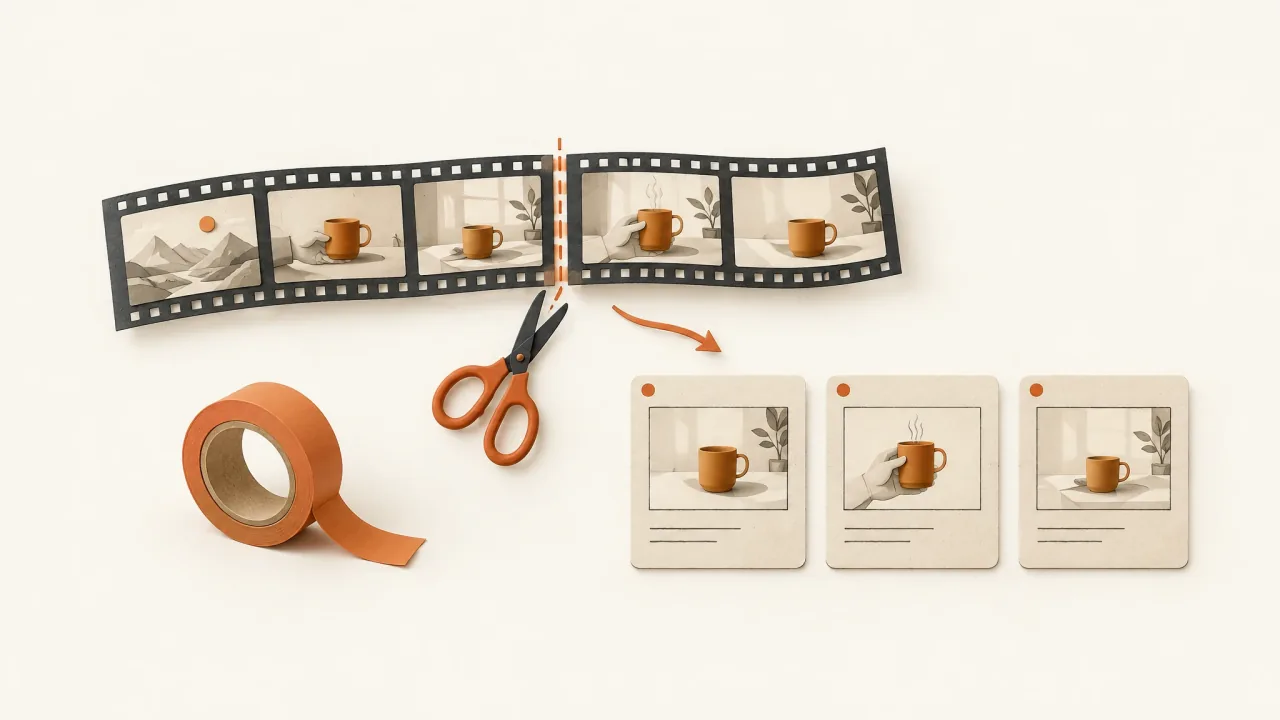
Start by asking what someone must understand about the product without watching the film first. Use that answer to decide whether to keep, change, or remove each candidate film beat. The shorter runtime sets a delivery constraint, but the ad still needs to explain the product.
Keeping the film's opening by default can leave you compressing the middle and squeezing in an invitation at the end. The result may feel like a story trailer while leaving the product unexplained. Give the adaptation permission to begin elsewhere.
The map below uses The Last Box on Earth, a fictional packing-tape premise introduced in the cinematic product-ad structure guide. That companion guide supplies the storyboard and briefing framework. Neither the requested film nor the commercial has been returned. These are pre-production choices to evaluate against future footage; there are no observed edits or campaign results behind them.
Give the commercial its own assignment
In the proposed film, a miniature courier prepares a cardboard box beneath an impossible sky. An ordinary parcel departure takes on an enormous emotional scale, with the journey at the center of the story.
The commercial needs to do less. Identify an ordinary clear packing-tape roll, show parcel sealing clearly, and preserve one distinctive cinematic idea. Then invite the viewer to make their own version in Fablo. Keep the tape's role clear: it's a fictional prop and isn't for sale.
Write the assignment before opening the source material. Without it, the most impressive image can quietly determine what stays.
The structure guide explains how spectacle, demonstration, and invitation work together. Use that framework here to decide which material can still do those jobs in the shorter ad.
Separate the idea from the footage
For each film beat, record two things: what it does in the story and what material you have to express it. Before production, the material field describes a requirement. Once the film returns, replace that with an inventory of actual footage.
"A parcel is prepared for departure" could appear as a wide view with a tiny box, a clear sealing close-up, or a courier reaction. Those are three possible pieces of footage for the same idea. You can keep the idea without keeping all three shots.
Use four fields beside each decision:
- Commercial job: what the viewer needs to understand from this beat.
- Decision: keep, change, or remove.
- Material needed: a usable source shot, a reframe, or a new shot.
- Reason: what would be lost or confused without the change.
These fields make a "keep" decision depend on a shot's usefulness, even if you're attached to it. They also reveal missing coverage before someone promises to solve everything in the edit. If the inventory lacks a view that explains the product action, use the minimal demonstration shot list to specify it.
A worked keep/change/remove map
The entries below work through imagined beats in the proposed tape film. They record planning decisions only; the film has no production history to report here.
The impossible sky: change
Job: carry the absurd scale of the premise into the commercial. Decision: use one readable image rather than a sequence explaining the world. Material needed: a composition where the parcel remains identifiable in a vertical frame. Reason: the sky has value as atmosphere, but the commercial does not need the fictional geography.
The courier introduction: remove
Job: establish a character in the film. Decision: omit a separate introduction from this commercial plan. Material needed: none unless a brief courier action helps explain packing. Reason: identifying the character adds explanation work without identifying the tape. Removing the introduction need not remove the courier from every image.
The parcel-sealing action: keep the function, change its placement
Job: show what the tape does. Decision: make this an early anchor. Material needed: readable views of the roll, tape applied across the cardboard seam, and the resulting sealed seam. Reason: the action must stand alone; it cannot depend on a previous widescreen scene to explain the object.
The cosmic departure: conditional keep
Job: supply the film's memorable flourish. Decision: retain only if the parcel-to-product connection is clear. Material needed: a source image that survives mobile viewing without a long setup. Reason: a departure can preserve character, but it must not imply extraordinary tape strength or protection.
The ordinary packing table: keep
Job: reconnect the fantasy to a familiar use situation. Decision: retain a clear product composition. Material needed: the correct transparent roll with its plain cardboard core beside the parcel. Reason: this ordinary image makes the product category and scale legible.
The ending: change its hierarchy
Job: resolve the prop story and supply the real next action. Decision: keep "Ready for the next parcel," then make the Fablo invitation distinct. Material needed: readable finishing text and the fictional-demo label. Reason: the audience should not mistake a creative showcase for a tape purchase offer.
Edit the argument rather than protecting the lore
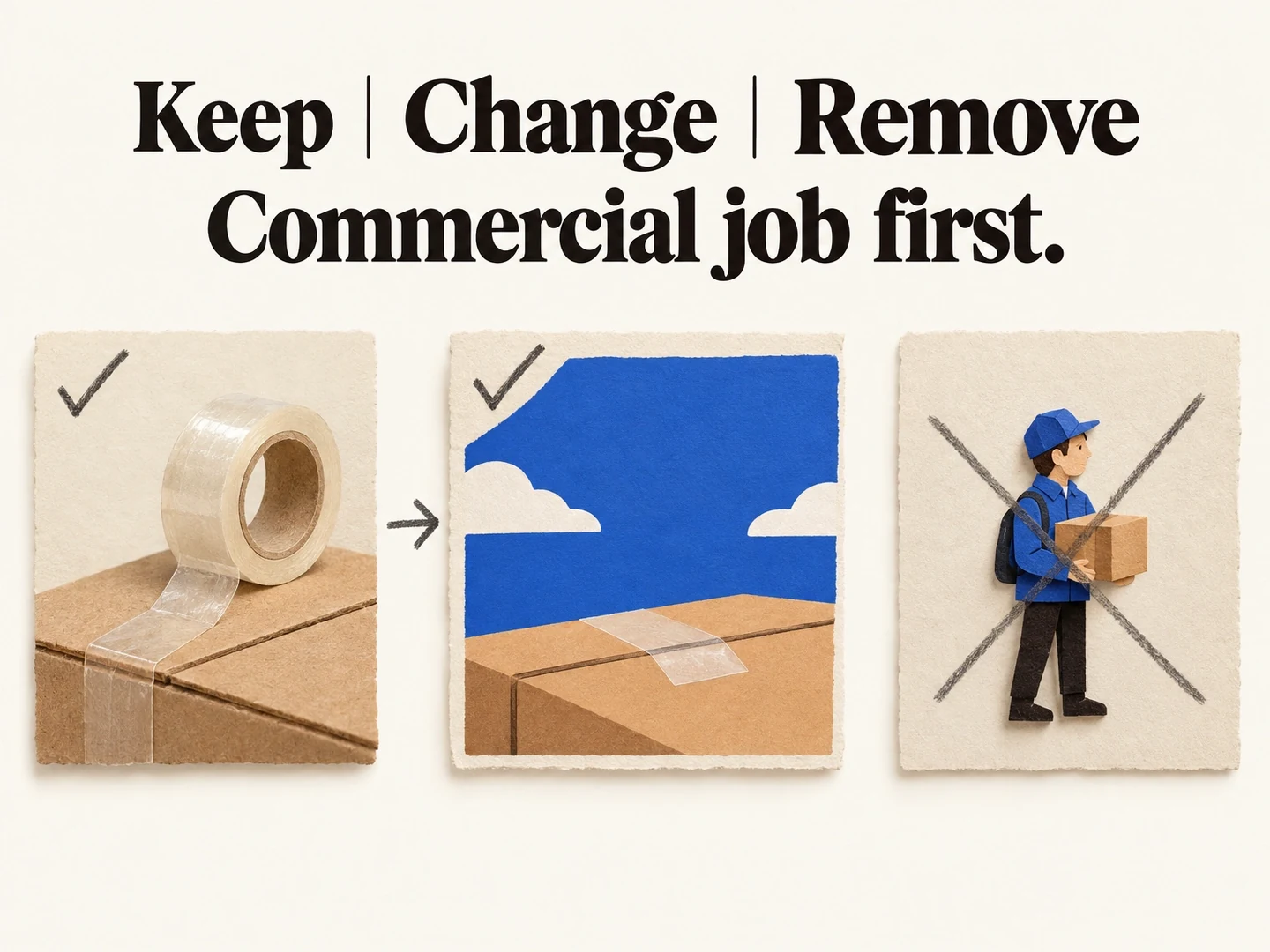
This fictional commercial plan keeps the sealing, simplifies the sky and drops the separate courier introduction.
View full-size (opens in a new tab)Image explanation
- Keep the parcel-sealing function, simplify the impossible sky and remove the separate courier introduction from this commercial plan.
- These decisions weigh the commercial's communication jobs and available material. They report no observations of an existing adaptation.
Treat vertical adaptation as composition work
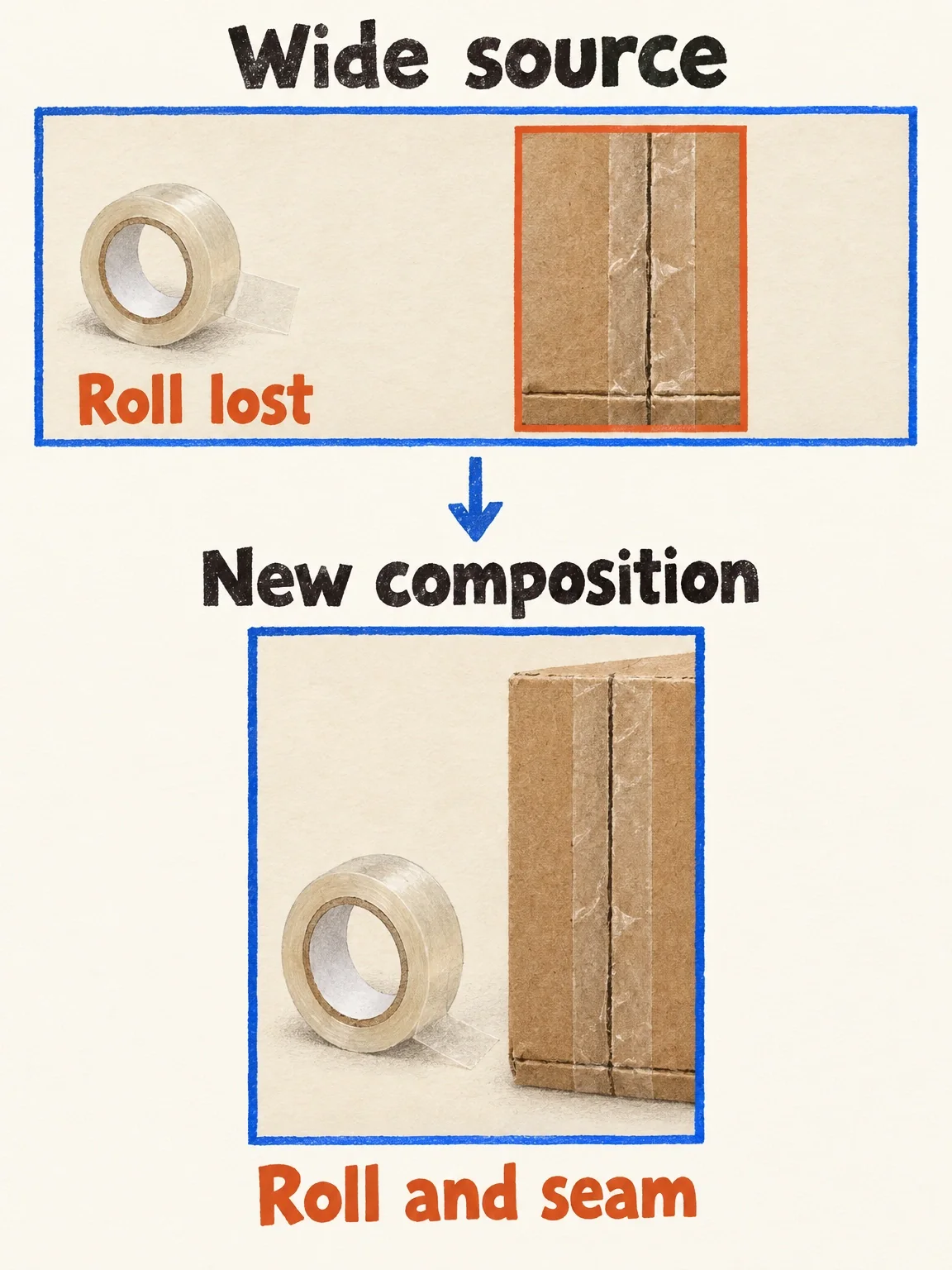
A centre crop can lose what a shot explains. If a wide scene puts the roll and parcel seam on opposite sides of the frame, the crop may leave the result visible while cutting out the action that caused it.
For each retained beat, check the product, relevant action, and necessary text together at the intended viewing size. Use the mobile caption-hierarchy audit to find text competing with the newly cropped demonstration. If the product, action, or text disappears, assess whether reframing can restore it. You may need another view.
Record what changed. "Changed" might mean a new composition, shorter narration, or newly produced coverage, each requiring different work. Identify newly made footage as new footage so the record doesn't mistake it for a crop of the source film.
The crop that loses the cause
The fictional parcel scene loses its explanation when the tape roll disappears. A useful vertical version needs the roll and its action together.
View full-size (opens in a new tab)Image explanation
- A narrow crop can keep the parcel seam while removing the tape roll that explains it.
- Restore both in a clear composition. Check whether the available material allows a reframe, another supplied take or new coverage.
Copy this complete adaptation assignment
Adapt the selected fictional packing-tape film into a separate 15-second vertical commercial. Begin from the commercial assignment, not the film's scene order: recognize the clear tape roll, understand cardboard parcel sealing, and carry one distinctive image from the impossible departure world.
Assess the source using the decision map above. Preserve usable sealing footage and the ordinary product view. Simplify world-building and omit the separate courier introduction. Retain a cosmic departure image only if it reads clearly in vertical format and does not imply a strength demonstration. Request missing product coverage rather than hiding the gap with narration.
Close with "Ready for the next parcel" and "Make your own version in Fablo." Keep the fictional-product-demo label clear. The real invitation is to adapt the brief to the viewer's product; the editorial continuation is /login. Return the assembled commercial, final script, poster, and an actual adaptation log.
Review the adaptation without its parent film
Watch the commercial on its own. Before showing someone the film, ask them to describe the product, its visible action, and the invitation. This checks what the ad communicates. It doesn't measure sales performance.
If they need the parent story to understand the ad, revisit the commercial assignment or supply the missing coverage. Keep the actual production dossier with the source project.
Bring your source, approved facts, and decision map to the product-ad workflow, then open Fablo to produce the adapted commercial. Fablo's recurring monthly credits support continued production. Before proceeding, ask for an estimate that distinguishes reusable footage from new coverage, assembly, and correction work.
The lore has to wait outside
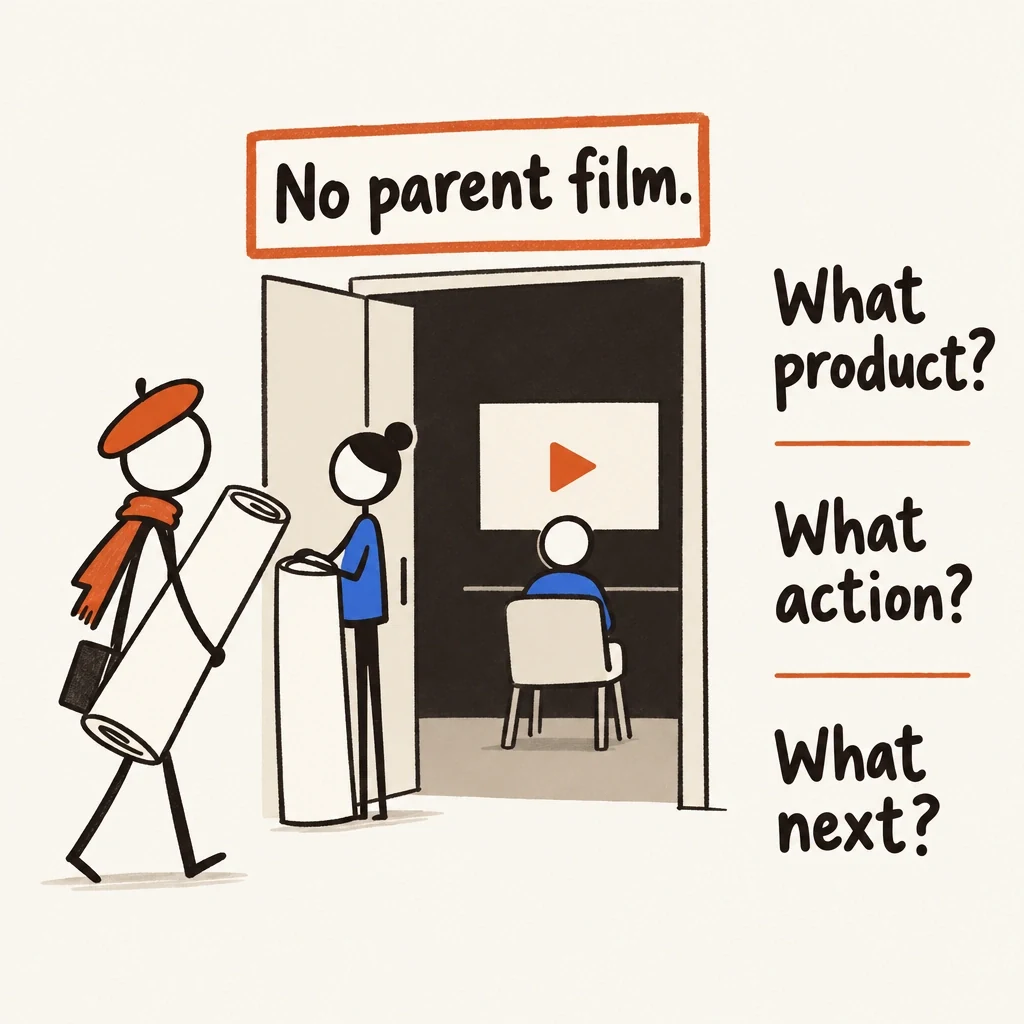
The parent story waits outside while the viewer meets the commercial on its own. Ask what product they saw, what happened and what comes next.
View full-size (opens in a new tab)Image explanation
- Show the commercial by itself and ask the viewer to describe the product, visible action and invitation before showing the parent film or its script.
- If the answer needs that missing story, revise the assignment or request coverage. The viewer's description checks communication and supplies no sales evidence.
- Both productions remain proposed; this cartoon records no screening result. For the fictional tape premise, keep ordinary parcel sealing and a distinct real Fablo invitation, without presenting the prop as a product for sale.