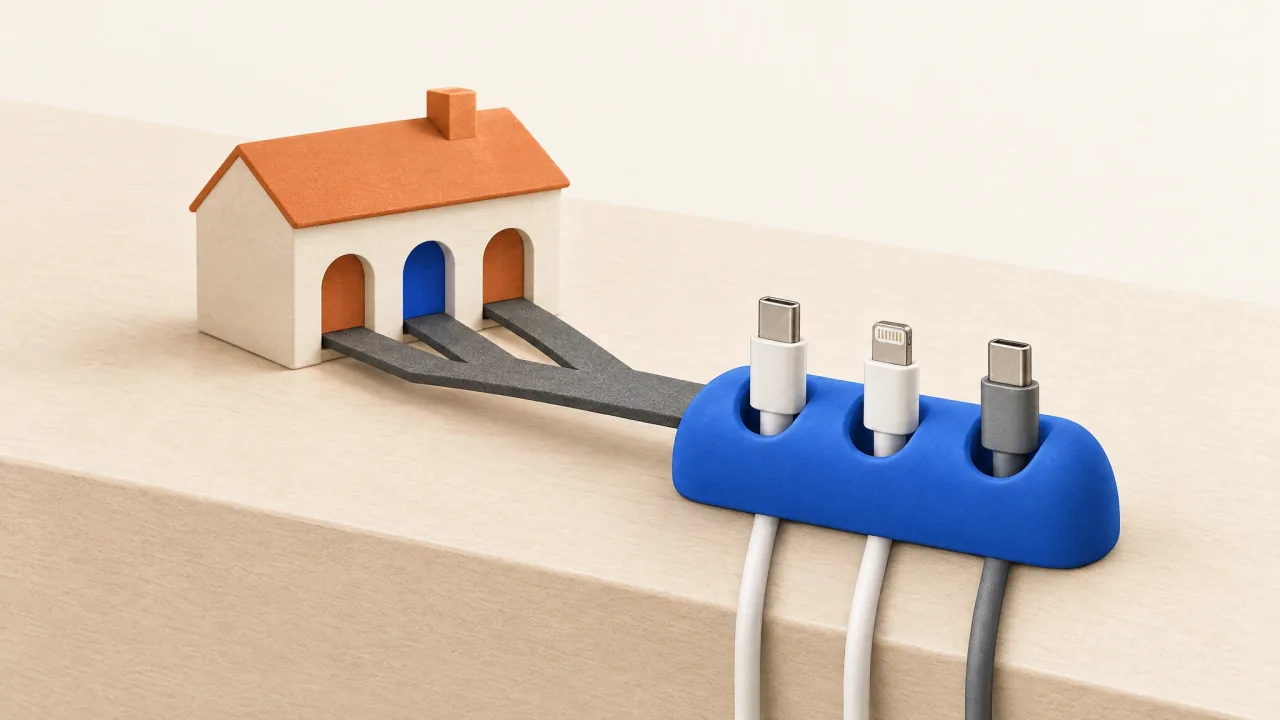
Before you commission a fantasy scene, plan how it will lead to the product's actual job. The viewer needs to recognize the ordinary object and understand a relationship the brief supports. Build the transition to prevent the most likely false interpretation.
For a cable keeper, “a home for loose ends” can express a preference for an organized desk, but leaves the cable's relationship to the slot unexplained. A heroic departure can make parcel preparation feel dramatic in a packing-tape ad. You'll still need evidence for any claim of exceptional strength.
Look for claims in the imagery as well as the words. If a small object appears to perform an extraordinary feat, a sober caption won't undo that implication.
Decide what the metaphor is allowed to express
Choose one idea for the metaphor: displacement, order, repetition, complexity, or a feeling about a use situation. Keep the idea separate from how the product physically works.
In the six-angle planning lesson, tiny travellers find a place of their own. The proposed scene expresses an assumed preference for organizing small things. The fictional cobalt-blue keeper has exactly three slots, with a defined job of keeping loose charging-cable ends at a desk edge.
Treat the traveller idea as something to explore creatively. It supplies no evidence about customers, and the requested demonstration ads are still in pre-production. This article plans a bridge from that idea to the product; there isn't an existing edit here to assess.
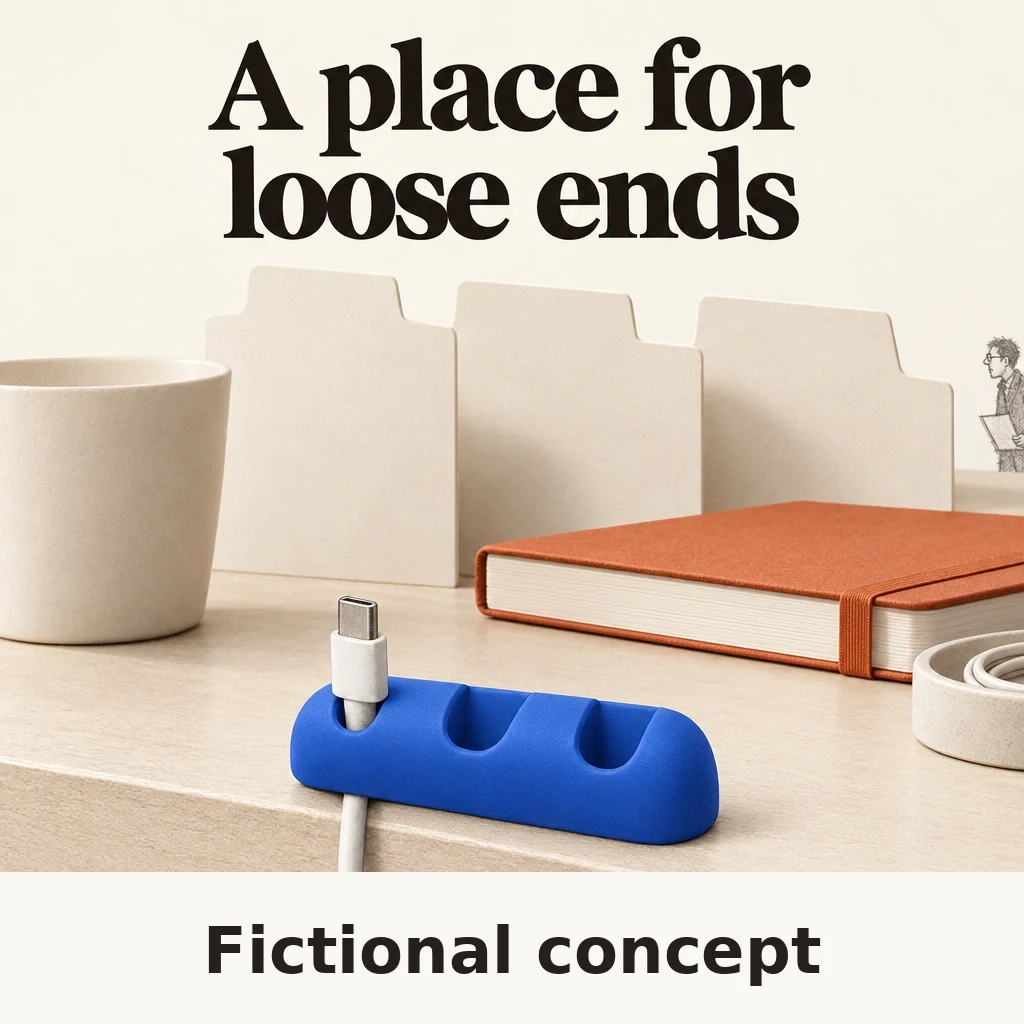
Assigned places without imaginary forces
Paper architecture gives the fictional concept its assigned-places idea. The cable resting in the keeper supplies the everyday product anchor.
View full-size (opens in a new tab)Image explanation
- The oversized dividers express an assumed preference for small desk objects to have deliberate places. The paper architecture remains scenery rather than a technical component.
- Keep the matte cobalt-blue silicone keeper at an ordinary desk edge, with exactly three slots and one already-resting cable. Show no movement or imaginary physics explaining its arrival, and imply no attraction, fastening or charging.
- This hypothetical concept still contains no traveller sequence, customer research, complete Fablo ad or evidence that viewers understood the intended relationship.
Do not invent a mechanism to explain the mechanism
“Mechanism” here can mean a visible relationship that helps the viewer understand the product. You don't need a microscopic cross-section or a technical explanation you can't support.
For this keeper, the known relationship is a loose cable resting in one of three slots at the desk edge. The brief doesn't establish adhesion, magnetic attraction, a clamp, or universal cable compatibility. Show the cable snapping into place and you've added a claim, even if the narration only says “keep things organized.”
If the physical reason is unconfirmed, show the object and its placement using the facts you have. Ask for missing details before depicting a fastening system. The angle examples help distinguish a buying question about how the product works from a metaphor about identity.
Use this metaphor-to-literal bridge card
Use this filled card as a starting point. Rewrite each sentence around your approved facts, keeping the idea, visible action, and limits on what the scene can imply separate.
Literal object and job. A matte cobalt-blue, three-slot desk cable keeper gives loose charging-cable ends a place at the desk edge.
Human situation. A desk user prefers small objects to have a deliberate resting place. That preference is an assumed motivation for this fictional demonstration.
Metaphorical relationship. Tiny travellers arriving home express the idea of loose ends having a place. They represent the organizational thought; they do not represent a technical component.
Boundary. The product does not summon cables, charge devices, or rearrange the desk. The fantasy must not make any of those actions appear to be its benefit.
Connecting image. Match the position of three resting cable ends in the miniature scene to their positions in an ordinary desk view. Keep the keeper's shape and colour consistent. Remove the fictional neighbourhood through an edit rather than making it appear to operate the object. The impossible-shot brief helps specify that transition's entry, exit, and identity constraints.
Bridge line. “For the loose ends at your desk.” This line names the real situation as the image becomes literal. It avoids claiming a hidden retention force.
Literal confirmation. Show the whole keeper, its three slots, and a cable resting in a slot at the desk edge. Give the relationship enough visual space to remain readable without the miniature scenery.
False interpretation to check. Could someone reasonably conclude that the keeper pulls cables toward it or improves charging? If so, revise the action or transition, not just the narration.
Turn the card into a complete illustrative sequence
The proposed opening shows tiny travellers arriving at a desk-edge neighbourhood built around the recognizable three-slot keeper. The camera favours the keeper and cable positions rather than unrelated miniature activity. The proposed line is “A place for everything. Even your cables.”
The connecting image cuts to an ordinary desk with the same keeper orientation and cable-resting relationship. The fictional scenery disappears between views. No cable flies across the table, no slot closes around it, and no connector lights up to suggest charging. The proposed bridge line is “For the loose ends at your desk.”
The confirmation view shows the product plainly. A cable already resting in a slot makes the relationship inspectable without adding an unsupported insertion mechanism. A wider view establishes its desk-edge placement. The closing line is “Give your cables a place.”
The final invitation is distinct: “Make your own version in Fablo,” with a fictional-product-demo label. The prop is not for sale. This article's next action is to adapt the brief to a real product and continue through /login.
The sequence is a complete pre-production plan. It isn't a transcript or a description of footage produced for this article. Production may need a simpler transition or a different connecting view.
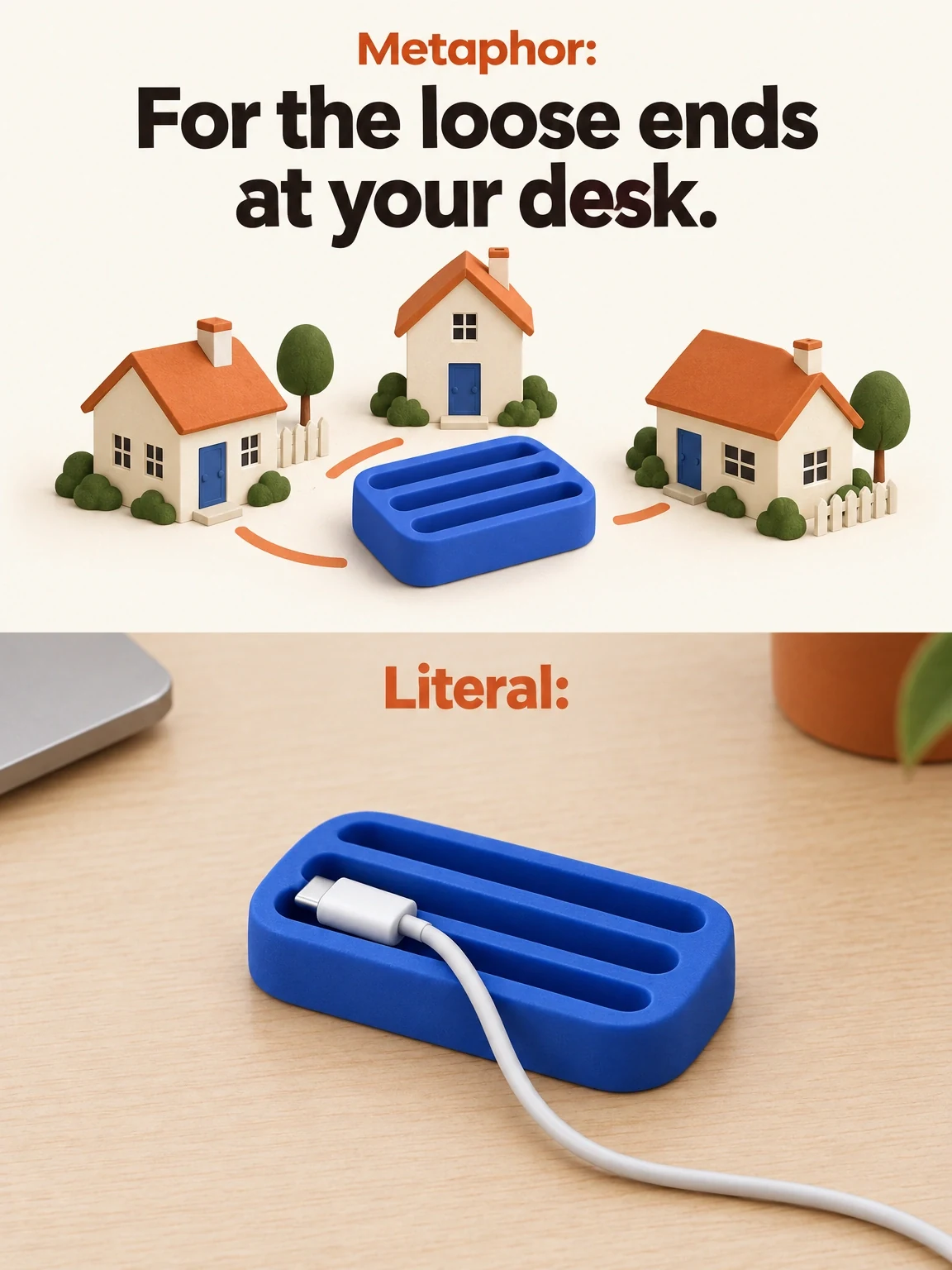
Let the travellers disappear, not operate the product
The fictional neighbourhood suggests organization. The return to an ordinary desk explains where the cable rests.
View full-size (opens in a new tab)Image explanation
- The tiny neighbourhood suggests organization. Its travellers supply no technical product mechanism.
- Cut to the same three-slot keeper at an ordinary desk, with one loose cable already resting and two slots empty. The scene implies no summoning, fastening or charging.
Test the inferred claim, not only the written claim
Check the planned or assembled sequence in three ways.
First, mute it. Use the sound-off inspection sequence to describe what the images suggest the product does. If you describe a power the brief doesn't support, revise the images.
Second, leave the fantasy out of your explanation. Can the literal view still show what the object is and what it does? If it can't, move that information into the demonstration.
Third, watch the join. Matching shapes can make an imaginary action seem to continue into reality. If you show a traveller being pulled into a home, then a cable moving into a slot, the cut could imply attraction. Showing a cable already resting after the cut makes a different claim.
Ask a reviewer what they understood before you explain your intention, and record their actual answer. That gives you a focused comprehension check. It doesn't supply customer research or establish campaign effectiveness.
Carry the bridge to other products carefully
For tape, a monumental parcel journey can dramatize preparing a delivery before you show ordinary seam sealing. Keep the cosmic voyage from implying load-bearing strength.
For an adjustable lamp, theatrical light can set the mood before a literal arm view. Don't show chaos turning into perfect work as though the lamp caused productivity. Use the light for atmosphere and the arm view to explain the lamp itself.
Use cinematic ad structure to place the bridge in the full ad. Write the literal sentence and false-interpretation check first, then open Fablo to produce the metaphor and literal demonstration together. Fablo's recurring monthly credits support ongoing production. Review the estimate for the fantasy, connecting view, checks, and any corrections before commissioning the sequence.