
Choose one question, one productive constraint, and a small deliverable limit. “Explain an adjustable desk lamp without a presenter” is a useful challenge. “Make a boring lamp go viral” is an aspiration with no clear review decision.
Aim for an answer your team can use again: which view explains adjustment, which detail needs a close-up, or which words the image needs alongside it. A spectacular candidate is welcome if it also answers the question you set.
Below is a complete proposed exercise for a fictional warm-white adjustable-arm lamp with a round base and one simple hinge design. The exercise hasn't been run; the reference images and challenge footage still need to be obtained. The separate lamp-reveal revision guide gives an illustrative request for making the product category clearer. It doesn't document a challenge entry or provide an experimental control.
Give the constraint a reason
Without a presenter, the product views and their sequence have to explain the job. That's a useful constraint if you want to find out whether a studio-led direction can show adjustment clearly. Use the creator-versus-studio format guide to decide whether removing the speaker helps answer your question.
This exercise won't tell you much about presenter delivery. Keep automatic movement out of it, too: removing the person from the shot doesn't give the lamp a way to reposition itself.
Keep the objective narrow. A viewer should recognize an adjustable desk lamp and understand how its arm can be positioned for a working area. Leave brightness, energy, comfort, and productivity promises out of the exercise.
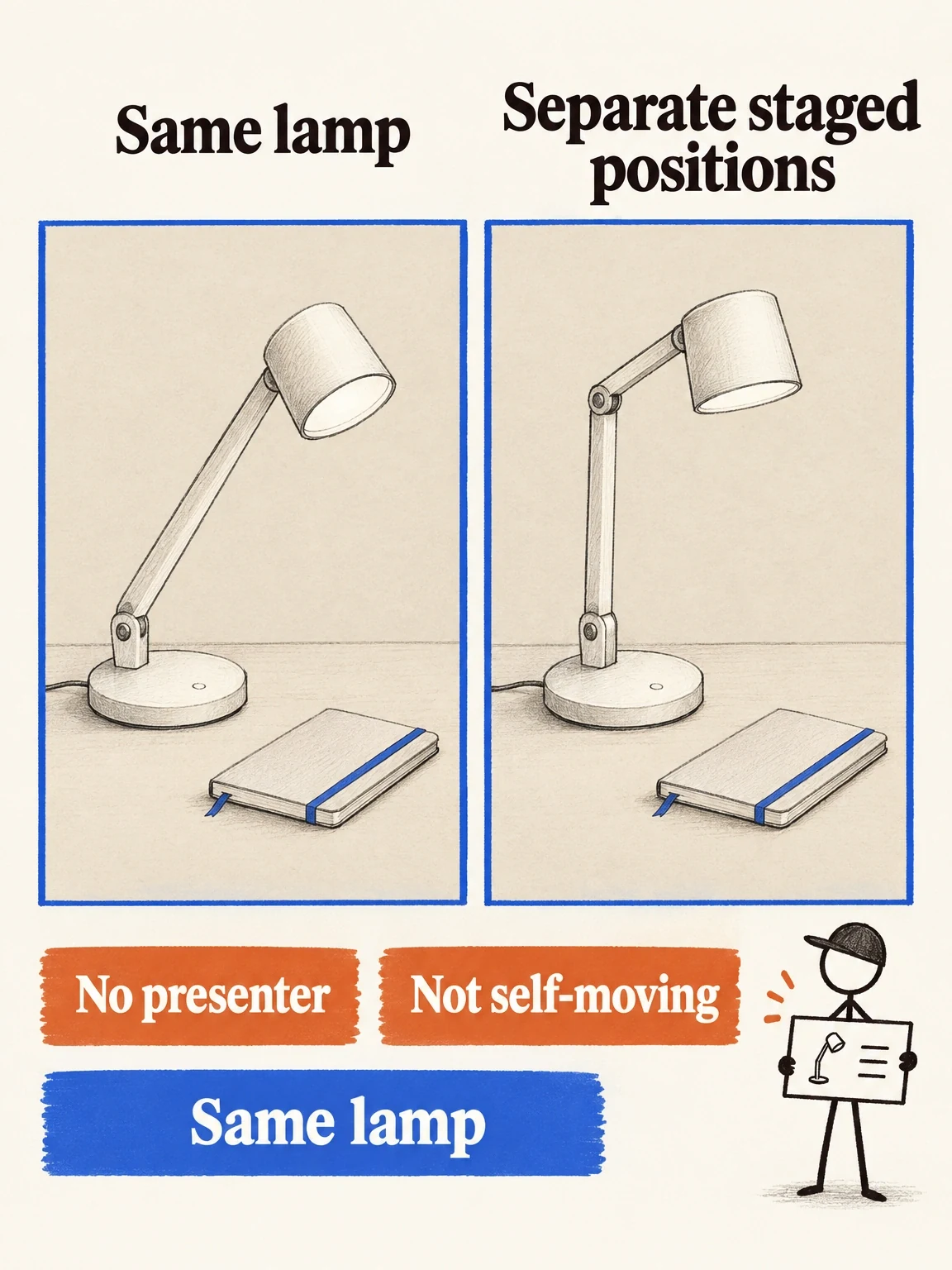
No presenter does not mean a self-moving lamp
Two staged positions explain adjustment in the fictional lamp challenge. Leaving the presenter out needn't make the lamp move by itself.
View full-size (opens in a new tab)Image explanation
- Two separately staged fictional lamp positions can explain adjustment without a person in the ad frame.
- Actual position references are still required. The plan permits no automatic movement, brightness change or invented hinge range.
Set a boundary that a reviewer can actually enforce
Request two storyboard treatments before producing footage. Set out the factual inputs and assembled deliverable with the product-ad workflow. Approve at most two assembled candidates and allow one focused revision to the selected candidate. Decide separately whether to authorize any further production.
These proposed limits let you make a selection and finish the exercise. They don't estimate time, cost, or included subscription capacity.
Keep the product, supported action, duration, format, copy, and invitation fixed while varying the framing and sequence. You're trying two ways to explain the same thing. A different lighting treatment doesn't create another reason to buy it.
Copy this bounded challenge brief
Develop two storyboard treatments for a 15-second vertical fictional desk-lamp demonstration. The question is whether the adjustable arm can be explained without an on-screen presenter. Use the supplied warm-white lamp references, preserving the round base and single hinge design.
Work in one ordinary desk setting with no visible person. Make the lamp recognizable from the opening composition. Show only arm positions supported by the supplied references and confirmed product facts. If those inputs do not establish useful positions, resolve that gap before production.
Keep the proposed spoken line “An adjustable desk lamp for your working corner” and the closing line “Light your next task” in both treatments. Request readable captions and a distinct end card: “Make your own version in Fablo.” Label the object as a fictional product demo. It is not for sale; the editorial continuation is /login.
The two treatments may change framing and sequencing. They may not change product geometry, invent a second hinge, add automatic movement, or claim brightness, energy, health, or work-performance benefits. Supply each storyboard's explanation of how the viewer will understand adjustment.
After storyboard selection, request no more than two assembled candidates with posters and final scripts. Review against the gates below. Allow one focused revision to the selected candidate, preserving the useful product views. Record the actual selection and unresolved limits.
You can use this brief to discuss the work, but first check that the product inputs support every position the sequence will show.
Two proposed treatments, evaluated before footage exists
Treatment one: the side-view change
Open on the whole lamp in profile beside a notebook. Show the arm in one approved position, then cut to another separately staged, approved position. Keep the round base and desk context stable so the change is easy to compare.
The cut represents manual repositioning between setups; it does not show the lamp moving automatically. Keep the explanatory line over the product view, then finish with the shared closing and invitation.
Planning advantage: the relationship between arm, hinge, and base can remain visible. Planning risk: a very wide profile may make the hinge too small. The reviewer should ask for a readable detail if the geometry cannot carry the explanation.
Treatment two: the working-area connection
Begin with a recognizable three-quarter lamp view beside the notebook. Follow with a view showing the arm's orientation toward that working area, then a wider confirmation of the whole lamp in its approved pose.
Maintain the same lighting state rather than presenting an unverified brightness change. The notebook supplies context, not evidence of improved reading or concentration. Use the same copy and invitation as treatment one.
Planning advantage: the product's position is connected to a concrete task. Planning risk: the context may explain where the lamp sits without explaining adjustment. If the arm relationship is absent, atmosphere alone does not satisfy the challenge.
Neither treatment has been produced or selected. These are two reasoned proposals, not a disguised before-and-after result.
Evaluate in gates, then make a judgment
Start with the factual requirements and exercise limits. Is the correct lamp present? Are the arm positions supported? Is there one hinge? Is the no-presenter constraint met? Are the approved copy, fictional-demo label, and real invitation intact? Correct any failure before selecting a candidate.
Use the sound-off inspection sequence to check the explanation. Can someone identify the lamp and explain how its arm relates to the working area? Turn sound back on and check that the line reinforces what's visible. Speech shouldn't have to supply evidence the image is missing.
Then compare the visual direction. Which candidate has more deliberate composition, clearer progression, and less distracting decoration? Keep that judgment separate from the factual checks. Good art direction can't make an unsupported movement acceptable.
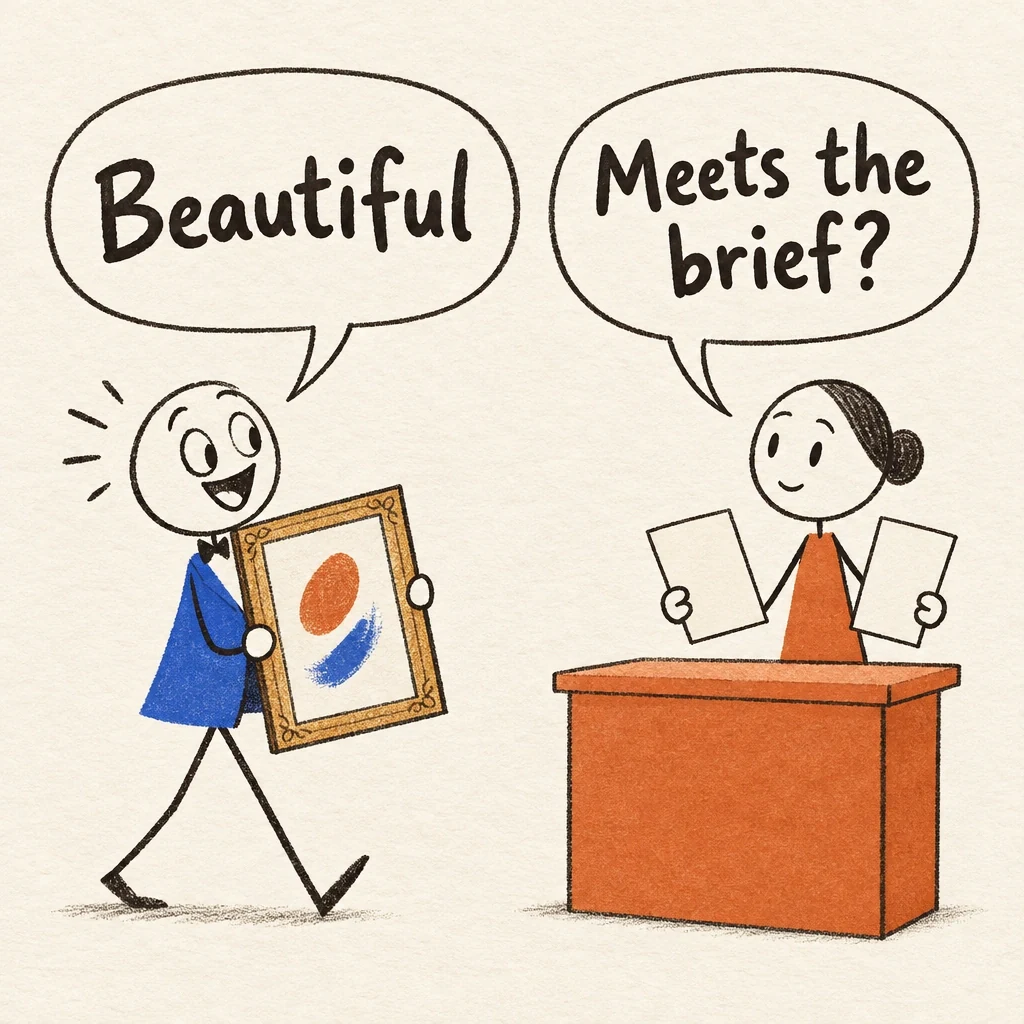
Beauty still has to meet the brief
The art judge likes the look. Product facts, the challenge's constraints and clear communication still come before choosing the visual direction.
View full-size (opens in a new tab)Image explanation
- For the proposed no-presenter lamp challenge, check identity, supported positions, one hinge, the no-presenter condition and the intact approved wording and invitation.
- Then ask whether the lamp and arm relationship are understandable before comparing composition and progression. Attractive direction cannot authorize unsupported movement.
- The cartoon depicts no lamp mechanics, inspected candidate, selected winner or automatic pass.
Keep a decision record, not a victory announcement
Record the question, fixed inputs, selected candidate, reason for choosing it, requested correction, and unresolved issues. Define the correction with the revision workflow. Only record that a view explains hinge placement once you've inspected that view.
The separate lamp-reveal revision brief addresses recognition through one specific change. This challenge asks how to explain adjustment without a presenter. Keep the source media and conclusions for each exercise distinct if you produce them later.
Apply what you learn to another product only if it has the same communication problem. Pick a constraint worth testing and open Fablo to produce the challenge. Monthly plans provide recurring credits for continued production. Review the estimate for the selected candidates and permitted correction before starting. The exercise's candidate limit isn't an included allowance.