
Hide the style descriptions and write each ad's argument in one sentence. Several ads might all argue for a resting place for loose cable ends at the desk edge. Clay, cinema, and a presenter can express that same buying reason.
Those variants can still be useful. Count concept families, treatments, and exports separately so the team can see whether it has new arguments, new ways to express an argument, or more delivery formats.
The audit describes what's in the creative packet. Customer motivations and campaign performance still need their own evidence.
Establish the unit you are counting
A concept connects a viewer situation, buying reason, and supporting product explanation. Identify it by its argument, regardless of how many files express it.
A treatment expresses that argument through casting, setting, visual style, delivery, music, or other execution choices. Two treatments can need very different production work and still belong to the same concept family.
An export is a delivered file. A vertical and square version may be two exports of one treatment. Count a requested crop only once its file exists.
Record those distinctions in the creative asset manifest. “Eight directions planned” and “eight accepted ads delivered” describe different stages. Briefs show intended coverage; actual files show what the production communicates.
Use the ad-angle examples to develop new arguments, then audit the plan or finished packet to check whether those differences survived.
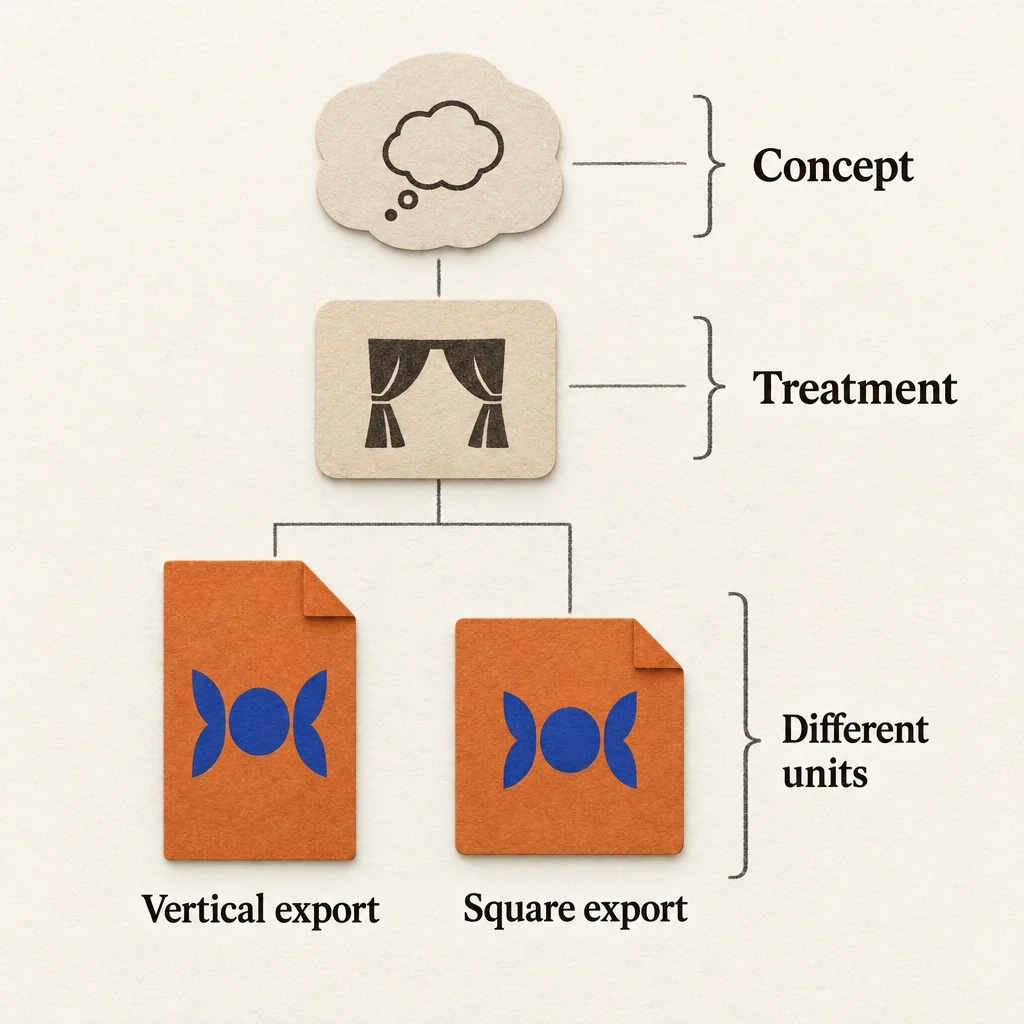
One concept, one treatment, sibling delivery files
Concepts, treatments and files count different things. One creative family can contain a single treatment and several delivery files.
View full-size (opens in a new tab)Image explanation
- A concept combines a viewer situation, buying reason and supporting explanation. A treatment is how it is executed.
- Vertical and square exports can be separate delivered files of that same treatment. Name the counting unit so delivery formats don't inflate concept counts.
Worked audit: eight proposed directions, four argument families
This invented packet uses the fictional matte cobalt-blue cable keeper with exactly three slots. Its defined job is keeping loose charging-cable ends at a desk edge. The exercise supplies its audience motivations as creative assumptions. Customer research would be needed to establish them.
P1-P8 are labels for the illustrative plan. No returned videos, accepted assets, or campaign results are attached to them.
P1-P4: the disappearing cable, expressed four ways
P1 proposes a cinematic fall beneath the desk. P2 tells the same story in clay. P3 uses a fictional presenter pointing out the dropped cable. P4 requests a square treatment of P1's idea.
All four lead to the same argument: a loose cable end needs a resting place at the desk edge. Their proposed demonstration is a cable resting in the keeper after the retrieval problem is established.
Group these under one problem-led concept. Clay changes the look, the presenter changes the introduction, and square framing changes the delivery requirement. A new buying reason would need a different argument.
P4 also needs a production decision: does the action fit the new frame, or must it be recomposed? The demonstration still needs to be readable in a format variant.
P5-P6: explaining the unfamiliar object
P5 proposes a plain close demonstration of the three slots. P6 puts the same explanation inside a miniature inspection theatre.
The argument is now “understand where the loose end goes and how the keeper fits the desk.” Both versions answer a mechanism question with the same defined action, without needing a disappearing cable to introduce it.
These form a second concept family with two treatments. The miniature world changes the presentation while leaving the mechanism unchanged. It supplies no evidence of better function.
P7: making room for another desk object
P7 opens with the illustrative question, “Does it earn the space beside your notebook?” It then shows the keeper's single defined job in an uncluttered desk composition.
The proposed objection is whether another object is worth adding to the desk. That differs from retrieving a fallen cable or understanding the keeper's shape. Group it as an objection-led concept, then check that the final script addresses usefulness instead of returning to the lost-cable joke.
P8: a place for small things
P8 proposes a deliberately arranged desk, with the keeper as an assigned place for loose cable ends. Its argument addresses a supplied organized-desk persona: “I want small objects to have a deliberate place.”
The warm setting is the treatment; wanting an assigned place is the proposed buying reason. A label like “premium lifestyle” hides that difference.
This illustrative packet has eight proposed entries across four argument families. Those counts describe the plan; they aren't a score or minimum diversity target. The six-angle planning exercise offers more candidate reasons to consider, with no required six-concept quota.
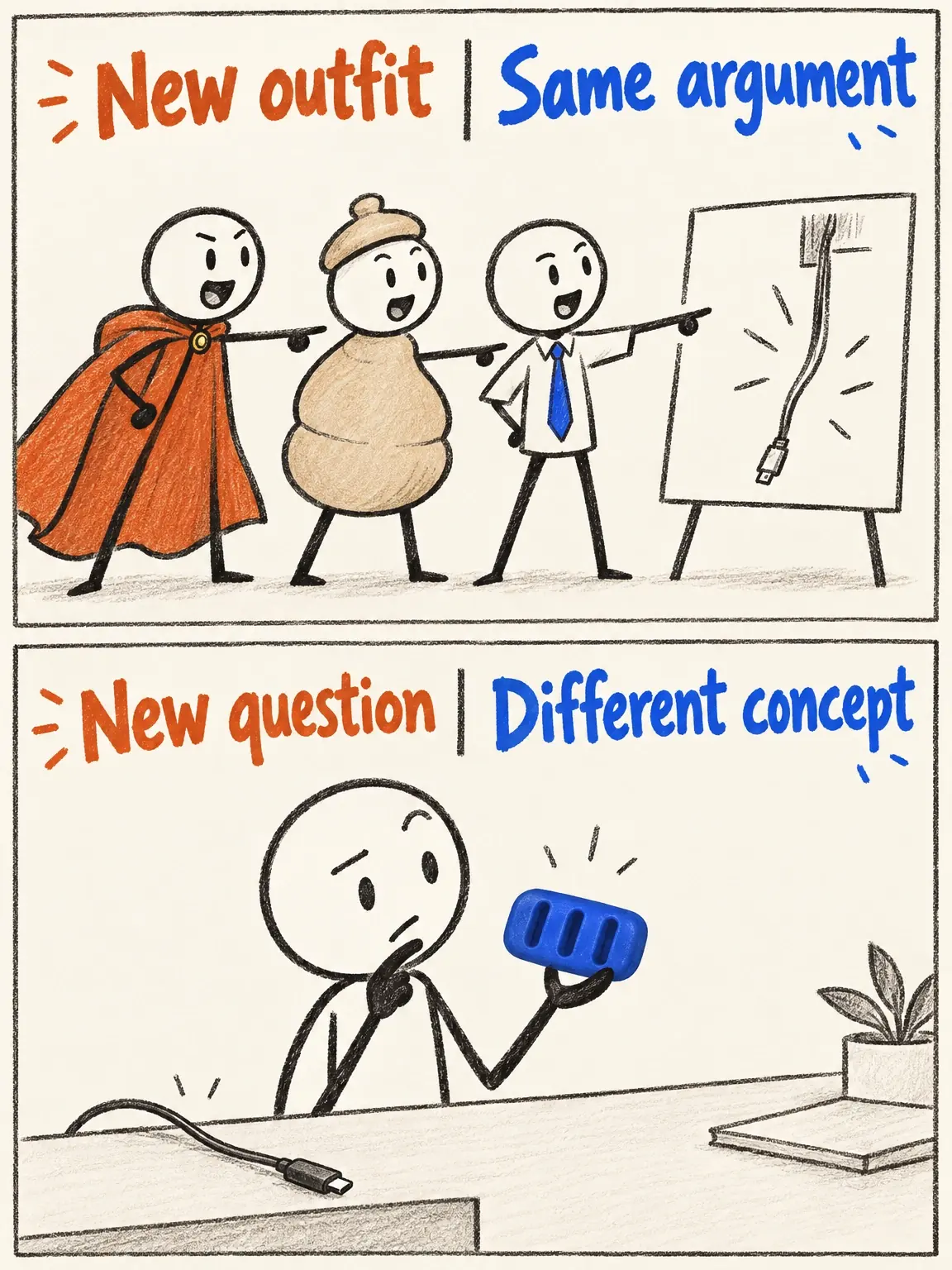
A new costume is not a new argument
The fictional keeper can wear several visual styles while making the same argument. A different buying question needs its own explanation.
View full-size (opens in a new tab)Image explanation
- Different costumes, rendering styles or crops can express the same falling-cable argument.
- Explaining the keeper's job asks a different buying question. This is a supplied concept idea, with no customer motivation proven by the drawing.
Copy this concept-versus-treatment audit card
Complete one card per entry, using actual files when available. Keep the argument sentence free of camera, style, and presenter language.
Entry: [brief ID, or actual file/version]
Stage: [planned, returned, accepted, rejected]
Viewer situation: [the specific context]
Argument: [why this viewer might want the product]
Supporting explanation: [what the scene shows or copy establishes]
Evidence status: [approved fact, creative assumption, unconfirmed claim]
Treatment: [style, cast, setting, delivery]
Format: [requested or actual aspect ratio/duration]
Closest other entry: [which argument overlaps]
Material difference: [what changes in the reason or explanation]
Classification: [new concept, treatment, format, unresolved]
Next action: [keep, merge labels, rewrite, inspect media]
For each proposed new concept, explain the difference without saying “different actor,” “different colour,” or “different hook.” An opening can change while the argument stays the same. A new presenter may supply a different explanation; check that explanation before counting a new concept.
Handle ambiguous cases without inflating the count
Some ads combine several jobs. A reset ritual may also express an organized-desk preference. Identify the dominant argument and note the overlap so you don't count the same asset twice.
If two entries share a buying reason but show different use situations, ask whether that difference matters to the production question. Alternating devices may warrant a separate use-case concept when the script and action establish that situation. A second device sitting in the background isn't enough.
Summarize the concept families, treatments per family, actual exports, and unresolved entries. Use the production-matrix guide to commission missing arguments before adding more cosmetic versions of a well-covered one. Set the next packet's scope with the variation-budget decision sheet before paid production.
Bring one clearly differentiated argument into the creative-variations workflow and open Fablo to produce the missing concept from your audited packet. Monthly plans provide recurring credits for that ongoing work. Estimate the selected concept and correction headroom before rendering a larger set. Judge the packet by the arguments it covers, as well as its file count.
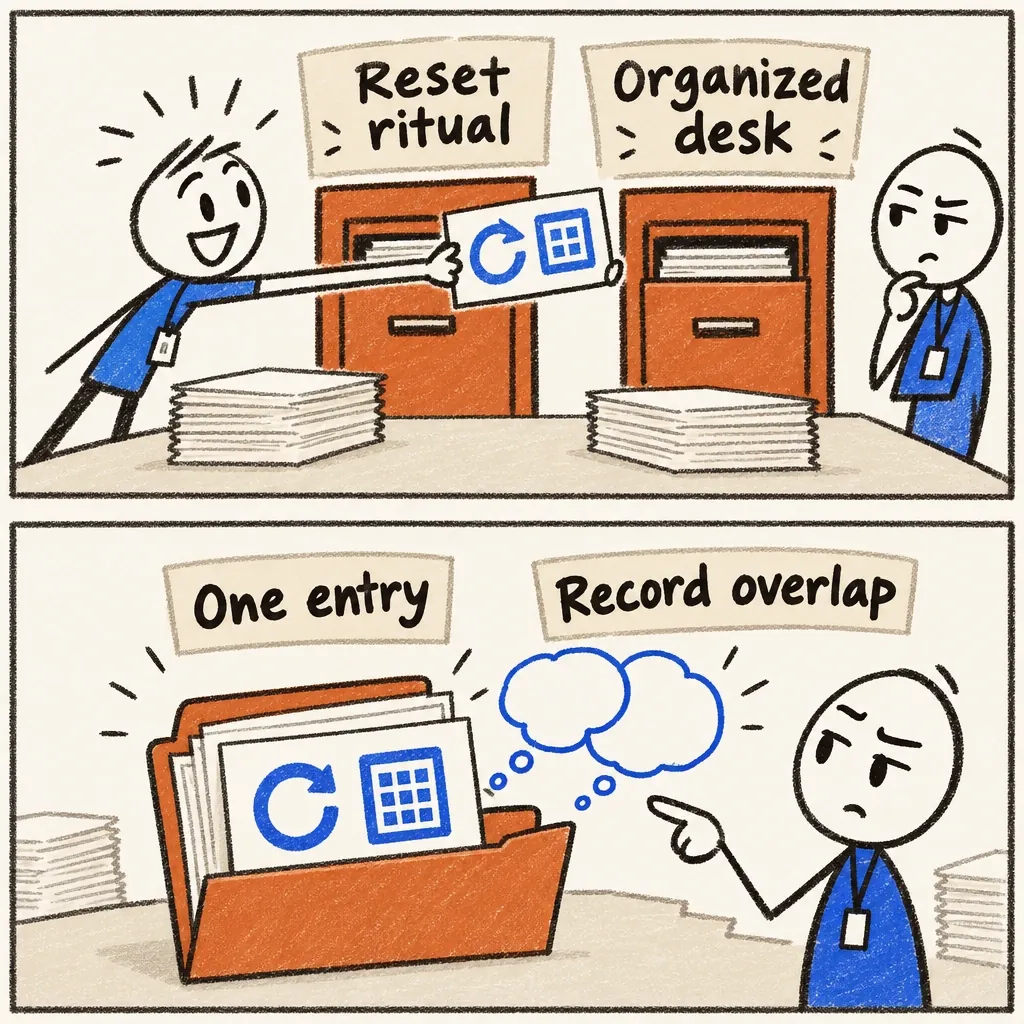
One entry with two ideas is still one entry
The hypothetical entry can link a reset ritual with an organized-desk preference. Record the overlap without filing it twice.
View full-size (opens in a new tab)Image explanation
- Identify the proposed entry's dominant argument and record any overlap. One entry can connect a reset ritual with an organized-desk preference.
- The drawing contains no accepted file or researched customer motive. Different use situations can warrant separate concepts when the script and action show a meaningful distinction; an added prop alone cannot settle it.
- Keep ambiguous entries explicit until the production question and actual communication are understood.