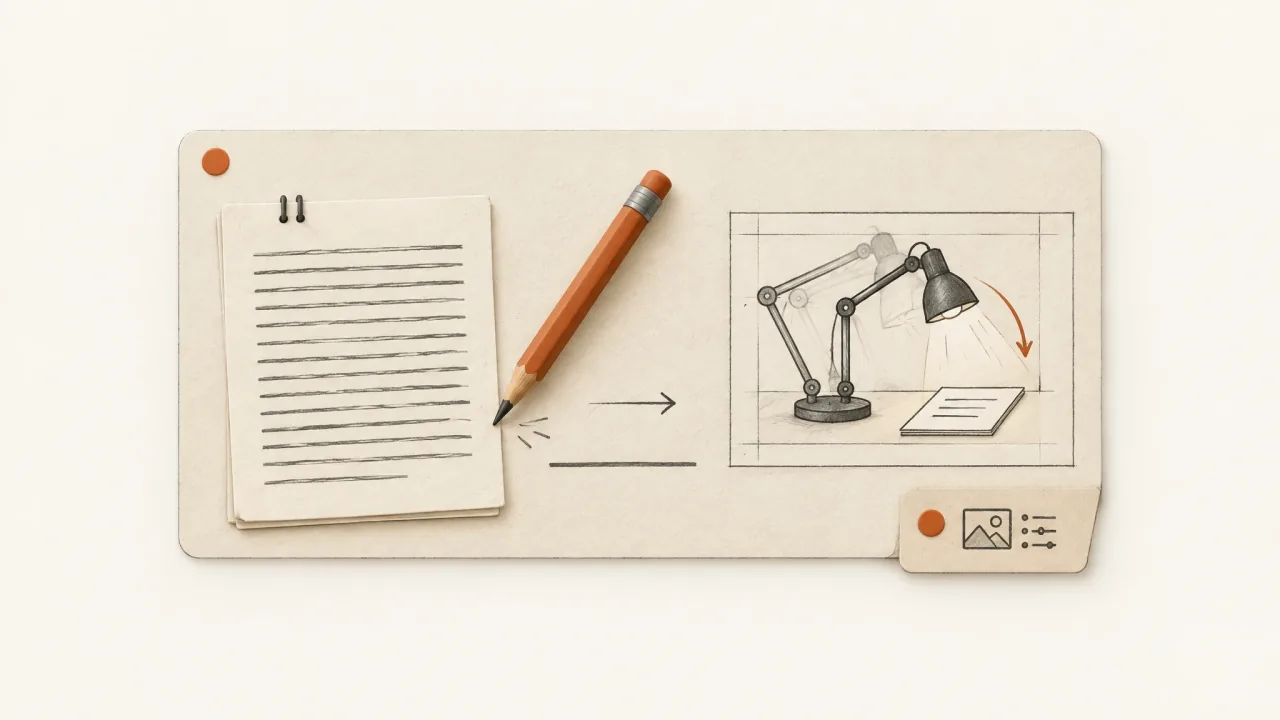
Replace “Transform your workspace” with an action the product brief supports. For an adjustable-arm desk lamp, “Move the arm toward the page” gives the team something specific to demonstrate and tells the viewer what change the ad means.
Write from the product, the situation, and an approved fact. Adjectives won't connect them for you. “Premium, powerful, beautifully innovative lighting” is still vague, with claims that may need evidence.
Ask what the next shot could show to make the sentence understandable. If the only answer is “a happy person,” the line probably needs another pass.
Put a fact sheet beside the script
Before you edit individual words, collect the facts the writer can use. For a real product, attach approved specifications, relevant product-page copy, and evidence for any claimed benefit. Write down unanswered questions; don't fill them with plausible details.
This article's fictional example uses an unbranded warm-white desk lamp with an adjustable arm, one simple hinge design, and a round base. The lamp is a demonstration prop and isn't for sale. The brief supplies no brightness measurements, energy consumption, eye-health effects, or productivity improvements.
You still have room to write an original script. Identify the lamp, show its adjustable arm beside a notebook, and invite viewers to adapt the brief for their own product. Any mood the scene creates remains separate from a measured benefit.
If the fact sheet is incomplete, use the customer creative-brief template first. Confirm what the product does before writing copy about it.
Diagnose the sentence before rewriting it
Generic lines can fail for different reasons. Name the problem in each one before you write its replacement.
No identifiable subject: “Designed for more.” More what, and what object? Name the category or use situation.
No observable action: “Elevate every moment.” Select the specific task the product supports instead of increasing the emotional language.
An unsupported outcome: “Your most productive evenings start here.” A lamp scene does not establish productivity. Remove the outcome or supply appropriate evidence and context before using it.
An unearned absolute: “Perfect light, anywhere.” The words make promises about quality and use conditions that the product brief has not established.
A floating invitation: “Discover the difference.” Name what the viewer can actually do next, and provide the approved destination.
You don't need every detail in every line. One sentence may name the object and another describe the action. Keep each sentence focused on its job in the sequence.
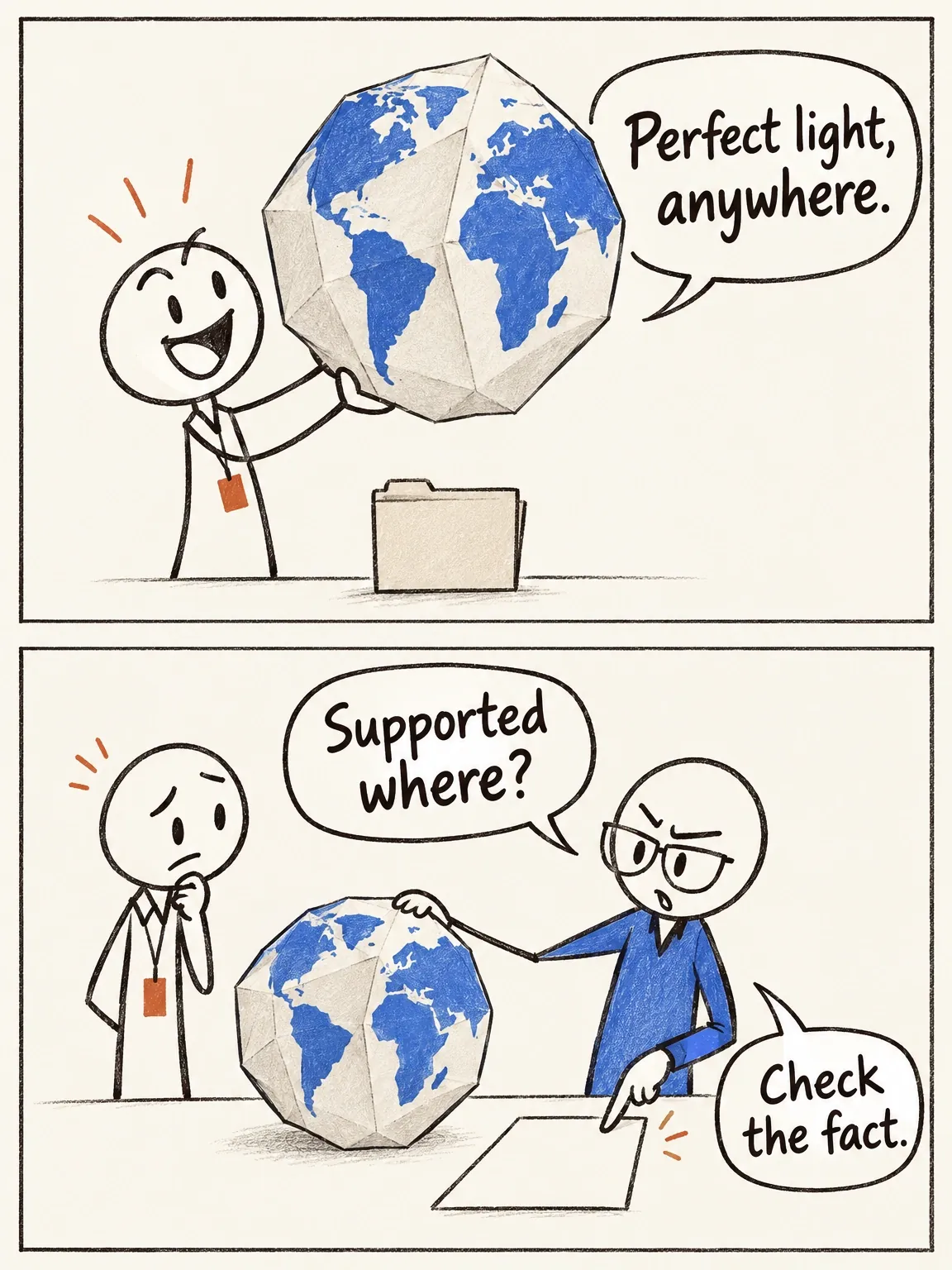
Where did 'anywhere' come from?
The sample line 'Perfect light, anywhere' makes unsupported promises about quality and use conditions. Its factual gap needs attention before its style.
View full-size (opens in a new tab)Image explanation
- Perfect light, anywhere is an unearned absolute in the fictional lamp brief. Diagnose the unsupported quality and use-condition promises rather than treating the line as merely generic.
- Use approved facts to narrow the line, or obtain appropriate evidence and context before making the promise. Polished adjectives add no missing support.
- The globe is a joke about overbroad copy, with no worldwide availability or lighting demonstration. The cartoon reports no real script, campaign outcome, produced lamp footage or Fablo correction.
Worked rewrite: three lines for the fictional lamp
Consider this deliberately generic sample script:
“Transform your space. Experience effortless performance. Discover a brighter tomorrow.”
The sample was written for this exercise. It isn't a customer script, final transcript, or quotation from a produced ad. Beyond sounding familiar, it leaves the product unnamed, omits the central action, and gives the viewer no concrete next step.
Opening: identify the object in its setting
Replace “Transform your space” with:
“An adjustable desk lamp beside your notebook.”
The line names the category and places it in a setting. Show enough of the lamp to recognize the arm and base, with the notebook establishing the working corner. A patch of atmospheric light won't let the viewer identify the object you've named. Use the visual-and-spoken hook exercise if the opening line and image still seem to tell different stories.
Middle: make one action pictureable
Replace “Experience effortless performance” with:
“Move the arm toward the page.”
The supplied adjustable-arm design supports this action without confirming a hinge range, installation method, or lighting output. Use the product-demonstration shot-list guide to plan the view. Preserve the hinge and show the movement clearly. You'll need to inspect the produced shot; a supported sentence alone doesn't establish convincing handling.
Ending: connect the demonstration to a real action
Replace “Discover a brighter tomorrow” with:
“Make your own product-ad version in Fablo.”
The showcase invites viewers to make an ad in Fablo. It doesn't offer the fictional lamp for sale. Pair the invitation with the Fablo destination and a visible fictional-demo label. For a real customer product, replace this ending with its approved action and exact URL.
Each sentence now has a distinct purpose, making the sample sequence more concrete. You still need to produce and inspect the draft, and any claim of better campaign results needs its own evidence.
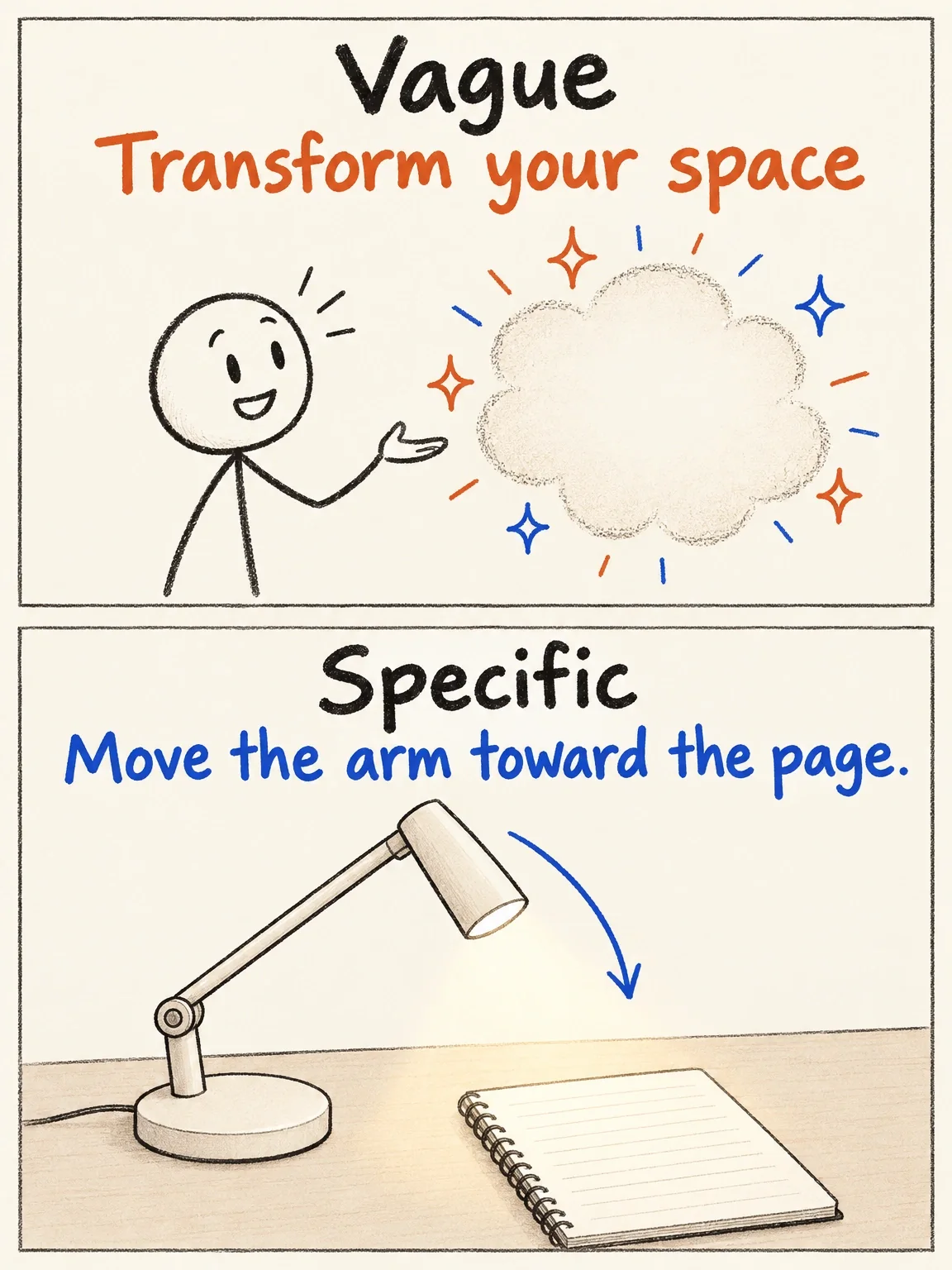
Give the sentence a noun and a verb
The fictional lamp line gives the viewer an object and an action. It stays within the brief's supported arm relationship.
View full-size (opens in a new tab)Image explanation
- Transform your space names no object or observable action. Move the arm toward the page directs a supported lamp relationship.
- Keep the supplied lamp identity and actual invitation. The drawing supplies no handling evidence, productivity promise or brighter-lighting result.
Copy this specific-line rewrite worksheet
Work on one sentence at a time, and keep rejected versions so the reviewer can see which factual problem you resolved.
Original line: [exact draft wording]
Job in the sequence: [identify, demonstrate, answer, invite]
Diagnosis: [missing subject/action, unsupported outcome, other]
Approved fact behind it: [fact plus source, or defined demo fact]
Concrete noun: [product, component, object, or use situation]
Observable verb: [the action the scene can show]
Illustrative replacement: [a speakable line]
Proposed matching shot: [what makes the words understandable]
Claim left out: [what remains unconfirmed]
Read-aloud adjustment: [shorten or clarify without changing meaning]
Reviewer decision: [accept for production, revise, confirm fact]
Read the replacement aloud while describing the proposed shot. Listen for awkward lists of specifications, unexplained terms, or a word such as “this” that refers to an object the viewer hasn't seen. Include details that help the sentence make sense without turning the narration into a catalogue.
Try swapping the product, too. If the line works just as well for a storage box as for the lamp, ask whether it tells the viewer enough. You may deliberately reuse a closing brand invitation, but check that the main argument actually explains this product.
Keep words and production accountable to each other
Even a supported script can end up beside an inaccurate image. Review the assembled ad and check that the visible action matches the words. Don't describe an adjustment the video never shows, or keep an attractive scene that suggests a different mechanism.
The scene-revision planning guide works through a sample lamp-reveal brief. Use its planned category view to check whether your image supports the object named in the opening line. The example is written teaching material; it doesn't document a real customer failure or a completed correction.
Choose the least informative line in your draft, complete the worksheet, and take the revision into the product-ad workflow. Open Fablo to turn your approved lines into an assembled ad. Fablo's recurring monthly credits fund ongoing production, including the media and checks needed to make the words and images agree. Review the estimate before producing the revised script.