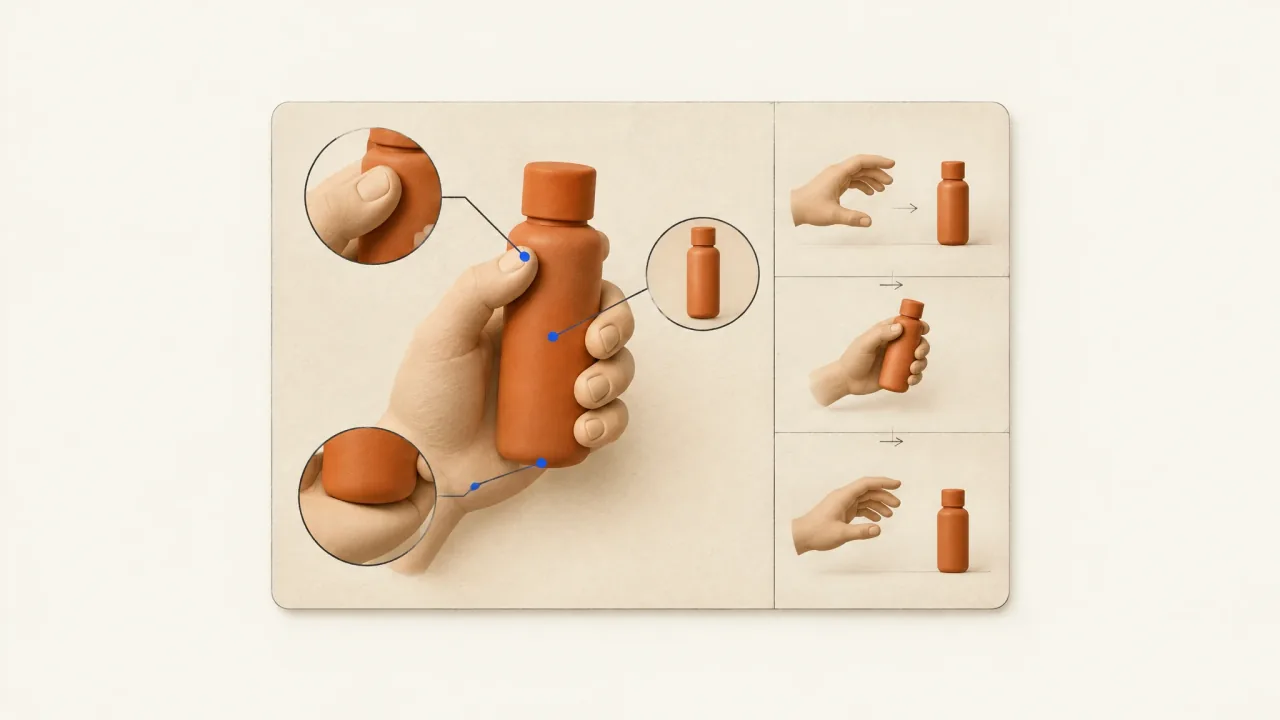
In a product-in-hand shot, check how the hand contacts the object as well as how they look together. The product needs to keep its identity and scale through movement, and that movement needs to explain the action you commissioned.
Watch the full interaction, including approach and release. A poster can look excellent while the product slides through fingers during playback. Use the checklist to record what you can establish from the clip and what you still can't assess.
The worked example is an illustration; no handling result matching this task has been returned for the article. These checks tell you about production quality. They don't establish whether the presenter or ad will improve campaign results.
Define what the hands must actually do
Name the action: hold the sealed package for identification, pick it up from a table, turn it toward the camera, open it, or demonstrate an approved use. Each asks for something different from the hands. A successful hold doesn't establish successful opening or dispensing.
Supply a real-product reference pack, the intended variant, exact dimensions if scale matters, and approved instructions for any use shown. Explain which parts can move or detach. An attractive front photograph won't tell production how a hinge, closure, or mechanism operates.
Choose the simplest action that communicates the required fact. Set out the necessary views and entry and exit states with the demonstration shot-list guide. A simpler action can be easier to inspect, but if it replaces a required demonstration, the brief needs to change. If the claim depends on opening the package, a static hold leaves the explanation unfinished.
Check contact through approach, hold, and release
Watch where the fingertips and palm meet the object. Do they wrap around its surface or pass through it? Is the product supported, or does it appear to hover? As the hand turns, does an edge pass naturally behind a finger?
Inspect how contact changes, not just the stable pose. A believable hold doesn't excuse an object snapping into place afterward. During release, look for another support or a visible movement that explains what happens when the hand lets go.
Mark an action “cannot assess” if a cut or a hand hides it. Still frames from before and after won't establish successful contact in between. If the contact matters to the demonstration, request a view that lets you inspect it.
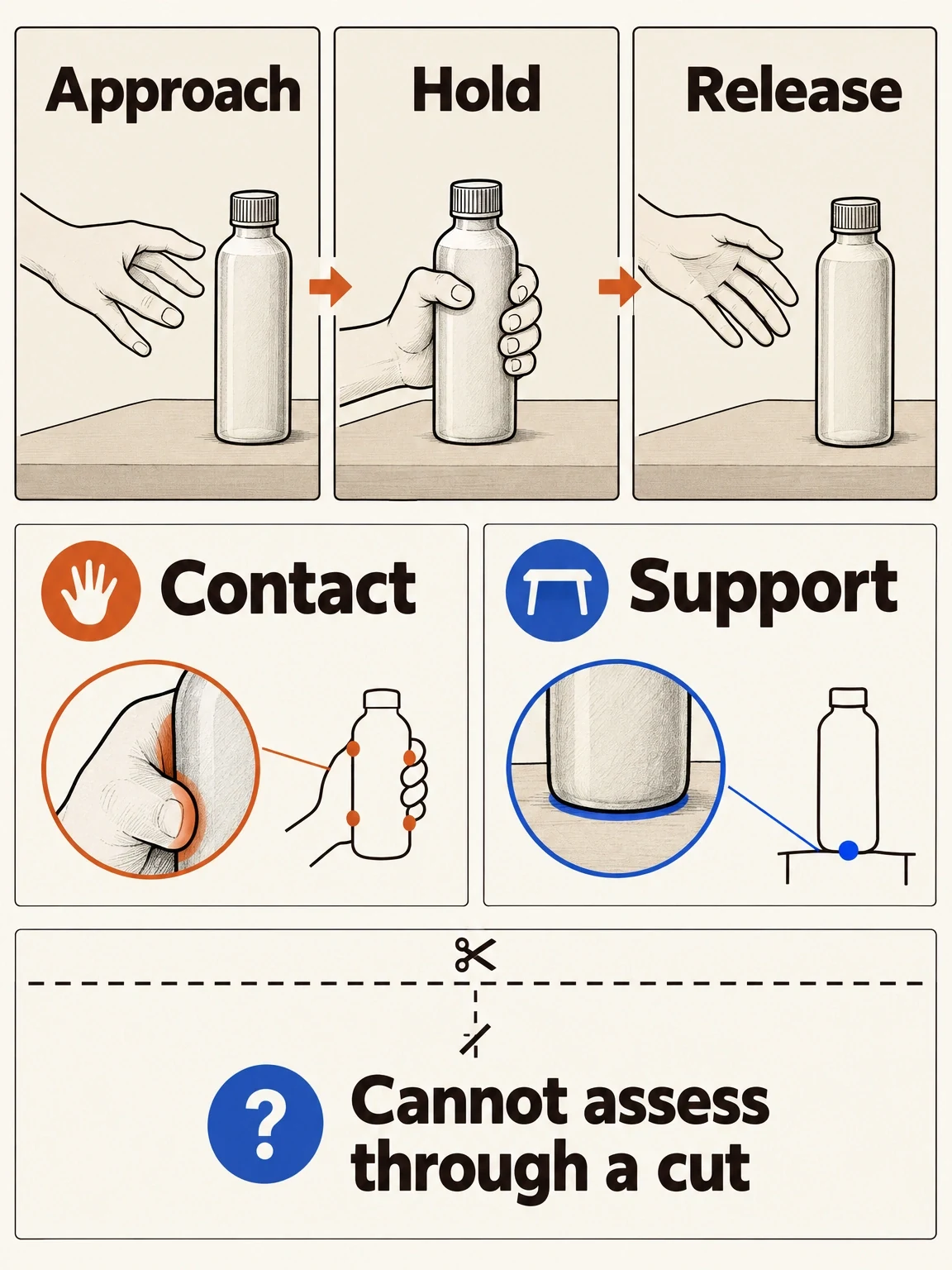
Follow support through the interaction
Follow the hypothetical sealed bottle through approach, hold and release. An obscuring cut can leave the required interaction unassessed.
View full-size (opens in a new tab)Image explanation
- Inspect support and contact throughout approach, hold and release. A convincing stable pose covers only that moment.
- A cut hiding the required action leaves it unassessed. Supplied references must establish the real dimensions and what handling the task permits.
Check scale against the actual product
Compare the product's dimensions with the supplied references and check its size relative to the hand and nearby objects. Products and hands vary, so a universal bottle-to-hand ratio won't help.
Follow recognizable features through the movement. Does the object expand as the fingers close or suddenly become smaller at the next cut? Moving toward the camera can change its apparent size through perspective. Look for a scale defect when its size changes relative to the same hand or other stable features without a corresponding camera or depth change.
If size is central to the selling message, use measured facts and a visual relationship those facts support. A generated handling shot alone can't prove exact dimensions or carrying capacity.
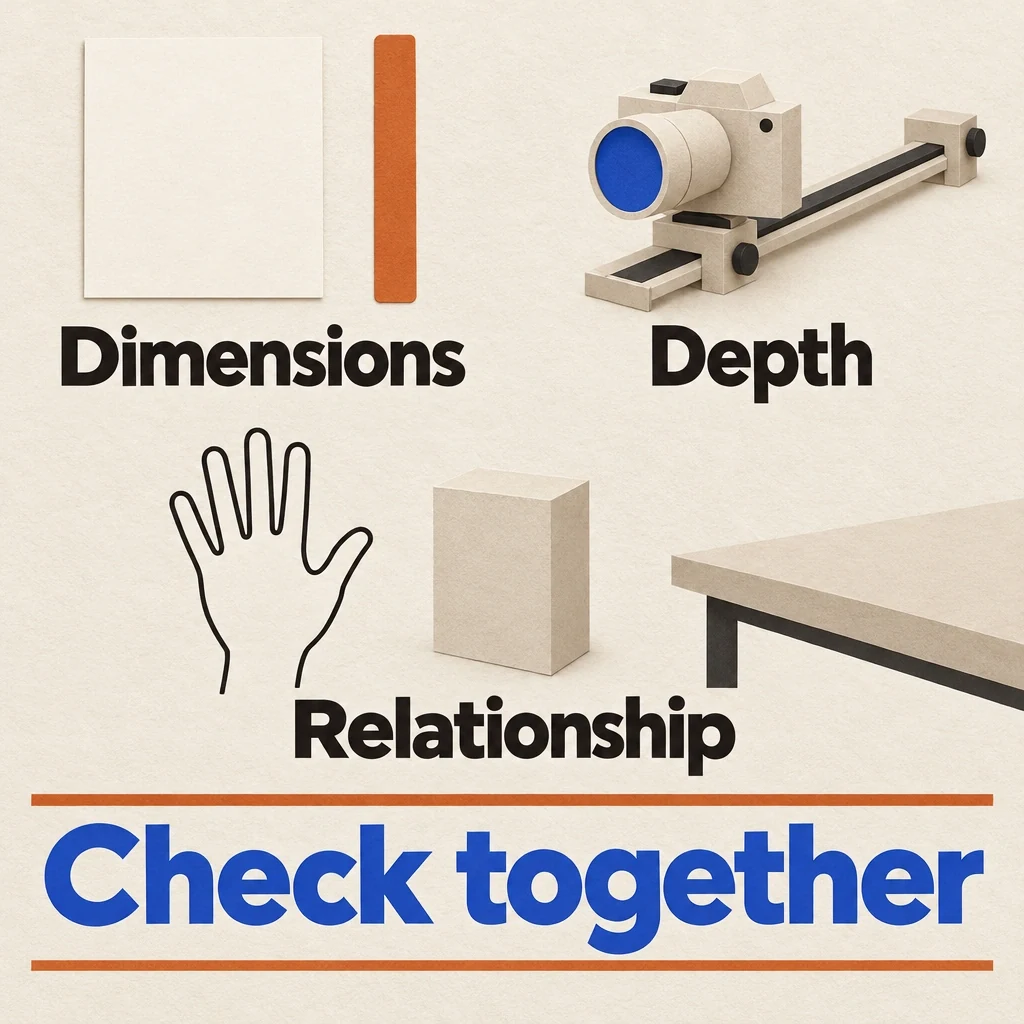
Scale needs source dimensions and scene context
Scale needs the actual dimensions, the hand and nearby objects, and the camera's changing depth. Check those relationships together.
View full-size (opens in a new tab)Image explanation
- Assess scale from supplied product dimensions, the actual hand, nearby stable objects and camera or depth changes. Perspective can explain a coherent size change; an unexplained size change against those same stable features needs investigation.
- The separate hand and block are schematic symbols, with no calibrated pose or universal bottle-to-hand ratio. A generated handling shot alone supplies no exact dimensions, weight or carrying-capacity evidence.
- Use source references and the complete candidate movement, especially when size is central to the message. This kit records no task-matched handling result or verified Fablo interaction.
Check grip and motion as separate questions
For grip, check whether the hold makes sense for the action and would support the item. Look at finger count and visible anatomy where relevant, too. A hand covering the entire label might be physically plausible while failing the identification job.
For motion, watch whether the object responds coherently to the hand. Hand and product should travel together during a hold. Turns should preserve the product's geometry, and release shouldn't leave an unexplained floating object.
Check consistency you can observe. Synthetic movement can't establish accurate weight or real-world physical performance. For a moving mechanism, compare its range and action with the actual product references, even if the animation looks smooth.
Copy the handling inspection checklist
Keep one record for each task and candidate. Watch at normal speed, inspect suspicious moments more closely, then return to the assembled ad.
Candidate/version and actual interval: [video and location]
Product authority: [real SKU/variant; approved reference revision]
Required action: [hold / pick up / rotate / open / approved use]
Required visible information: [name, closure, mechanism, etc.]

Contact: [approach, support, occlusion, release make sense?]
Scale: [consistent with supplied dimensions and scene relationships?]
Grip: [plausible hold; anatomy; required details remain visible?]
Motion: [hand/object move together; no jumps or unexplained drift?]
Handling: [the required action is shown completely and correctly?]
Product identity: [shape, variant, logo, packaging text remain faithful?]
Scene joins: [product state and action match neighbouring shots?]

For each check: [pass / hold for correction / cannot assess]
Evidence: [actual locations and frames; observed finding]
Correction request: [one bounded change; what to preserve]
Recheck: [actual new candidate and finding, not planned outcome]
Reviewer decision: [accept / revise / stop; unresolved limits]
A pass applies to the footage you've inspected. Future shots still need their own identity and continuity checks.
Illustrative diagnosis: the grip hides the identification
Suppose a hypothetical bottle shot is commissioned to show the sealed pack turning toward the camera. The hand moves coherently, but the palm covers the approved product name for the entire turn.
That is not automatically a contact failure. The specific problem is that the interaction conceals information needed for identification. An illustrative correction request would ask for a different grip or orientation that reveals the label while retaining the same product and sealed state. Use the one-scene revision brief to name that change and what should survive. Acceptance would require readable identification and coherent contact throughout the revised turn.
If the product instead changes cap design while turning, record an identity defect separately with the product-fidelity ledger. A request to “fix the hand” would not describe that problem accurately. Neither scenario is a reported Fablo finding.
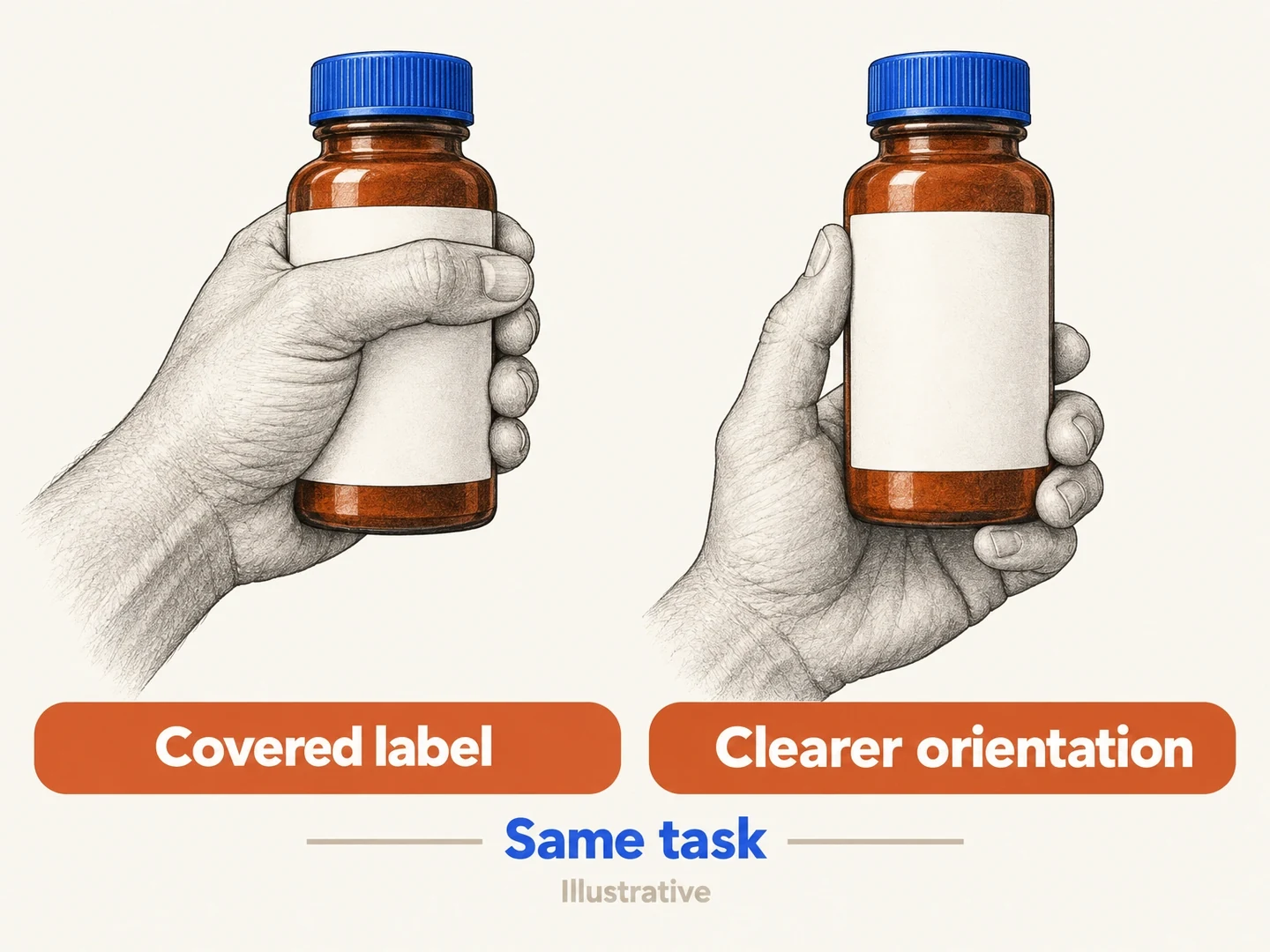
Plausible contact can still hide the required information
A plausible grip can hide the hypothetical bottle's name. Fix the visibility while preserving support and the sealed state.
View full-size (opens in a new tab)Image explanation
- The hypothetical sealed bottle can move coherently while a palm hides its identification region throughout the turn.
- Request a grip or orientation that reveals the approved name without losing contact or the sealed state. Actual readability needs real footage and text.
Do not let a cutaway become interaction proof
The six-angle planning lesson includes a fictional presenter brief about switching devices. It's a written plan with no established handling result. If you replace a requested interaction with a separate close product shot, record the substitution. A presenter followed by a cable-keeper cutaway doesn't demonstrate the presenter handling the product.
For your own ad, decide whether you need a studio identification view or evidence of an interaction. If a cutaway meets the revised brief, record that substitution. If the buying decision or claim requires product-in-hand quality, obtain footage showing the required contact and action with the real product references.
Bring the real references, required action, and completed checklist, then open Fablo to commission a product-handling candidate. Fablo's recurring monthly credits support production and paid corrections. Review the estimate for this interaction before adding more shots, and check the result against the checklist before accepting it.