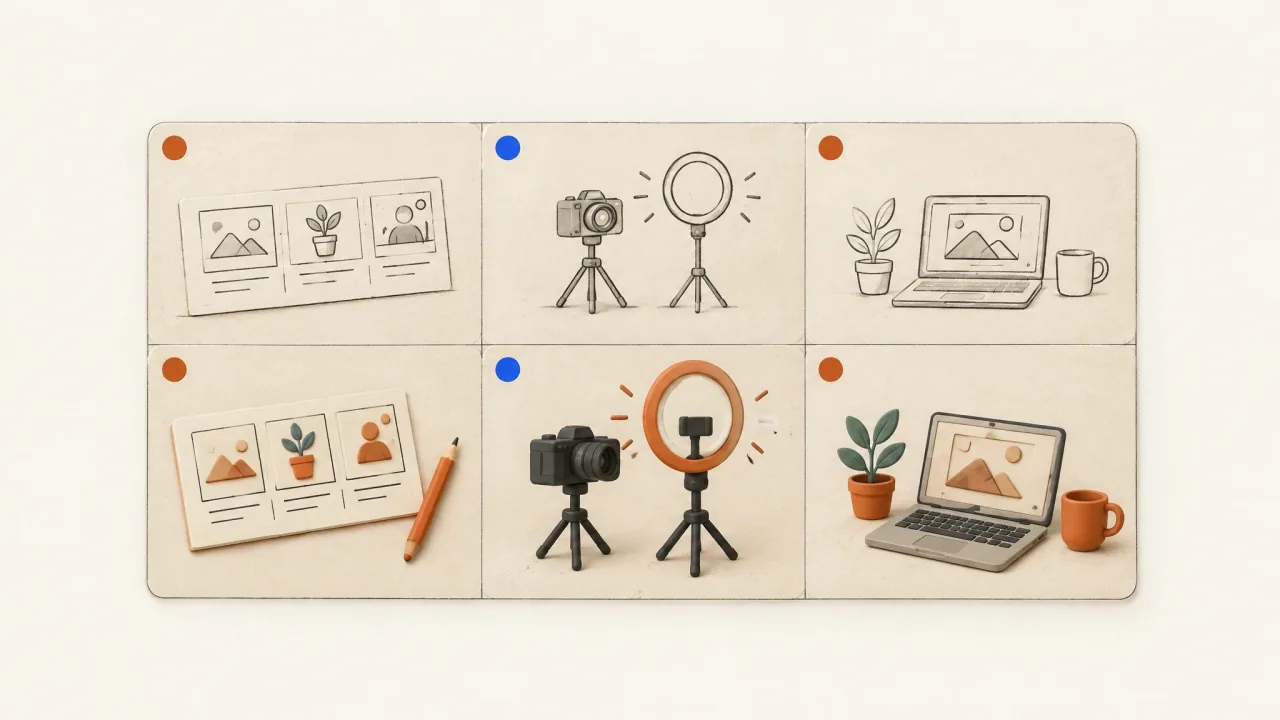
Before you describe how a reference beat looks, write down what it does for the viewer. “Show an interrupted task” gives you a job to use in another ad. “Recreate the same person, desk, joke, camera move, and wording” asks the team to reproduce the original execution.
Build the adaptation with your own product facts, situation, demonstration, and invitation. The reference can suggest an order: perhaps interruption, reveal, explanation, return to task. You'll still need your own evidence for any product claims.
You can use that order even when the reference's visual world, brand identity, or product mechanism wouldn't fit your ad.
Watch for jobs, not just memorable shots
Take notes in two passes. First, record what the ad says and visibly shows. Then suggest a job for each beat, keeping your interpretation separate from what you observed.
For another source to practise on, the reference-ad recipe showcase includes credited examples and a proposed way to adapt them. Start with their structure, then build the message around your own facts.
A close-up might identify the product, explain how it works, or add texture. “Close-up” alone doesn't tell the production team which of those jobs matters. A presenter can introduce a question, too, but their appearance doesn't supply customer evidence.
When you review a real source, record its location and exact wording. Unless you have evidence beyond your reading of the ad, don't call its opening a successful hook or claim to know the buyer's motive. You can learn from a reference without knowing whether it won in a campaign.
Try removing each beat. If the viewer can still understand everything important, you may be able to change or drop that beat.
A self-authored reference to practice on
The storyboard below was invented for this exercise. It isn't an actual ad transcript, a video produced in Fablo, or an account of someone else's campaign.
The fictional product is a matte cobalt-blue cable keeper with three slots. Its defined job is to give loose charging-cable ends a place at a desk edge. Imagine this sequence:
- A cable end slips below the desk. The scene establishes the location of a small interruption.
- The keeper appears at that edge. The object enters as a possible answer, with its shape readable.
- A loose end rests in one slot. A literal product action explains the relationship between cable and keeper.
- The view returns to the working desk. Context shows where the object belongs without claiming measured time savings.
- A fictional-demo label accompanies a Fablo invitation. The viewer can adapt the brief; the prop is not being sold.
The structure you can reuse is “situation → object → action → context → invitation.” The falling cable, cobalt colour, slots, and desk-edge position belong to this product example. Replace those details when you adapt the structure to an unrelated product.
The six-angle planning lesson explores possible reasons someone might want the cable keeper. Both resources are written planning exercises. They don't include produced ads or records of observed edits.
Adapt the jobs to an adjustable desk lamp
For the adaptation, use the supplied fictional warm-white lamp with an adjustable arm, simple hinge, and round base. You can plan a clear view of the arm being adjusted in a working corner. The brief supplies no evidence about brightness, energy, health, or productivity.
Situation: open on a notebook at one side of a desk while the lamp is directed elsewhere. This establishes a spatial relationship, not a claim that real customers suffer from inadequate lighting.
Object: reveal the complete lamp beside the notebook. Use an illustrative line such as “Set the lamp for the task in front of you.” The category should remain recognizable rather than hidden behind an atmospheric crop.
Action: show the arm being adjusted toward the page, preserving the supplied hinge design. This takes the explanatory job of the cable-in-slot shot; it does not imitate its composition or invent a new lamp mechanism.
Context: return to the desk view with the notebook and lamp in a coherent arrangement. Avoid staging a before-and-after brightness test when the brief supplies no measurement or comparison conditions.
Invitation: request a fictional-demo label and a real invitation to make a product-ad version in Fablo. A customer-product adaptation would instead use that customer's approved action and destination.
A calm setup may suit the lamp better than the reference's suspenseful interruption. Keep the order only while it helps explain the lamp, and change any joke, pace, or mood that doesn't fit.
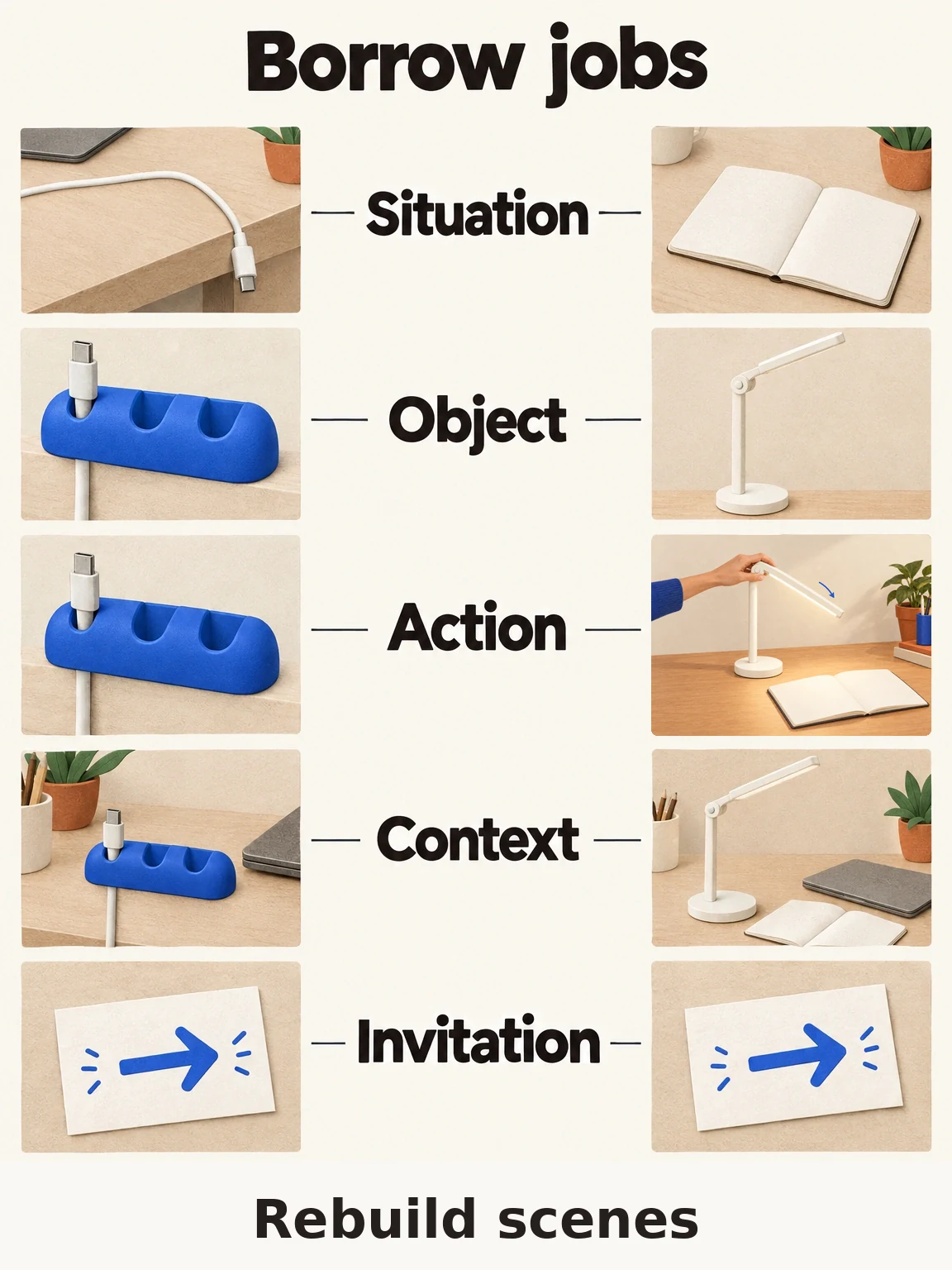
Borrow the job, rebuild the scene
The invented keeper reference lends its communication structure. The lamp brief still needs the lamp's own facts, scene and invitation.
View full-size (opens in a new tab)Image explanation
- Extract the situation, object, action, context and invitation jobs from the invented cable-keeper reference.
- Rebuild those jobs with the lamp's own facts and scene. Leave source claims, cast, slogans and product mechanisms with their original product.
Copy this reference beat/job map
Fill one block for each beat that matters. You don't need a giant shot-by-shot spreadsheet. If you're using a real source, attach your observation notes separately.
Reference identity: [source URL/file, or self-authored exercise]
Beat location: [actual timestamp; planned beat label if unproduced]
Observed or proposed content: [what is said/shown; label its status]
Communication job: [what becomes understandable here]
Reference-specific details: [wording, branding, cast, visual motif]
Our approved product fact: [fact and its source]
Our replacement scene: [a new way to perform the job]
Our illustrative line: [original wording, not copied dialogue]
Reason to keep/change/remove the job: [fit for this product]
Unsupported transfer to prevent: [source claim we cannot adopt]
Once the map is complete, draft from the job descriptions and your fact sheet. Put the reference's distinctive wording aside. Choose scenes that explain your product instead of swapping nouns in someone else's script.
Make the brief understandable without the source
An editor should understand the requested ad from the final brief alone. Name the product, approved facts, required action, identity constraints, viewer invitation, and deliverable. Attach the reference for context; the brief still needs to specify the work.
Check for claims you've carried over by habit. A customer quotation, comparison, promise, or offer from the source needs its own support before you can use it for your brand. The specific-line worksheet helps remove unsupported language. If a visual analogy could look like a literal capability, use the metaphor-to-mechanism guide.
Take the completed map into the product-ad workflow. Choose one job worth borrowing, rebuild it around your approved facts, and open Fablo to produce an original ad. Fablo's monthly plans provide recurring production credits. Agree on the scenes that need new work and review the estimate before commissioning the adaptation.
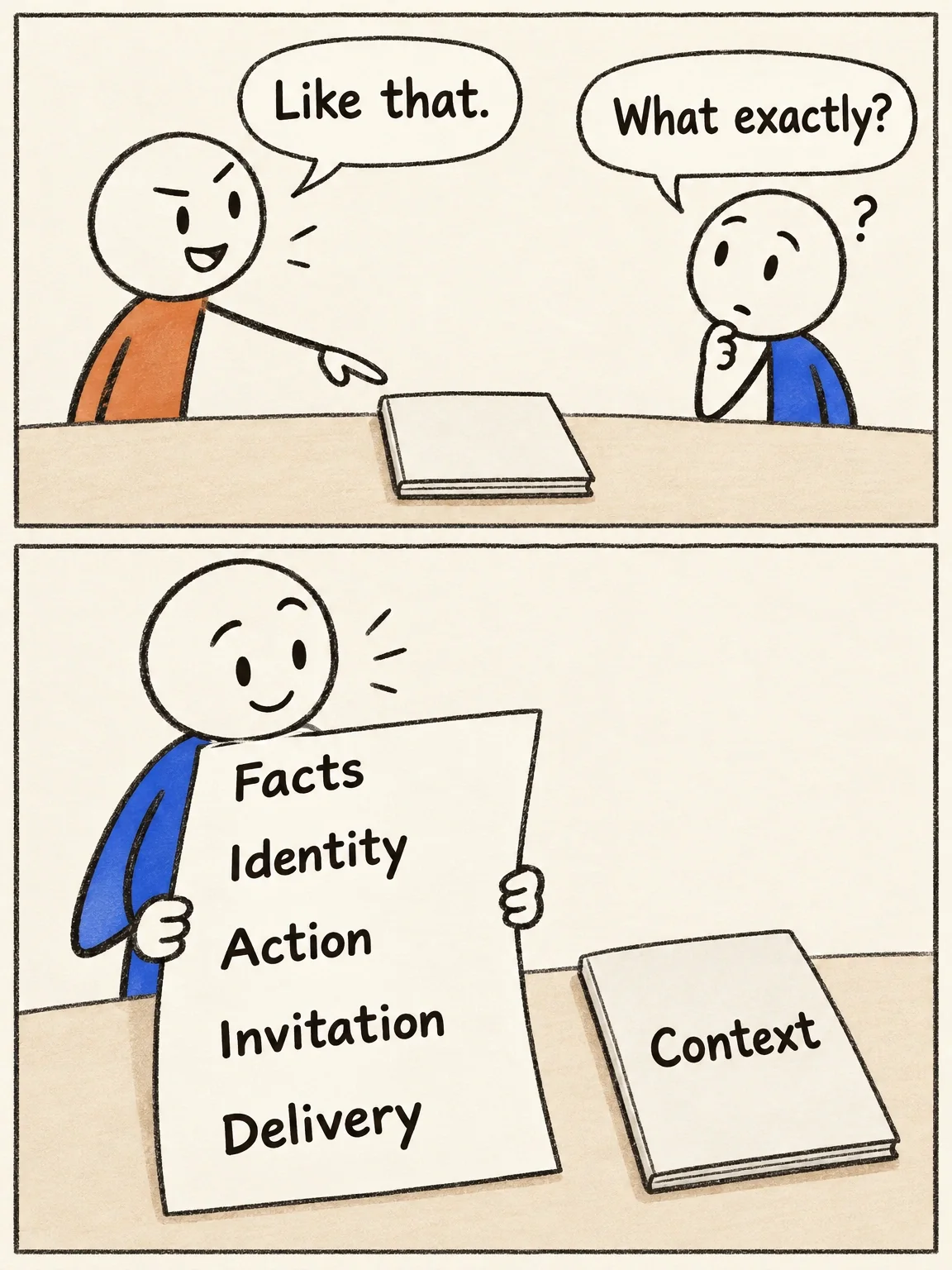
The reference can close; the brief should still work
The reference can supply useful context. The final brief still needs enough of its own detail for an editor to understand the assignment without watching it.
View full-size (opens in a new tab)Image explanation
- Specify the new product's approved facts, identity constraints, required action, invitation and delivery in the final brief.
- Borrow communication structure while leaving the reference's distinctive wording, customer quotation, comparison, promise and offer with their original source. They cannot become true for another product through adaptation.
- The labels mark empty document sections. This hypothetical exchange contains no completed specification, adaptation log, reproduced source ad or observed Fablo workflow.