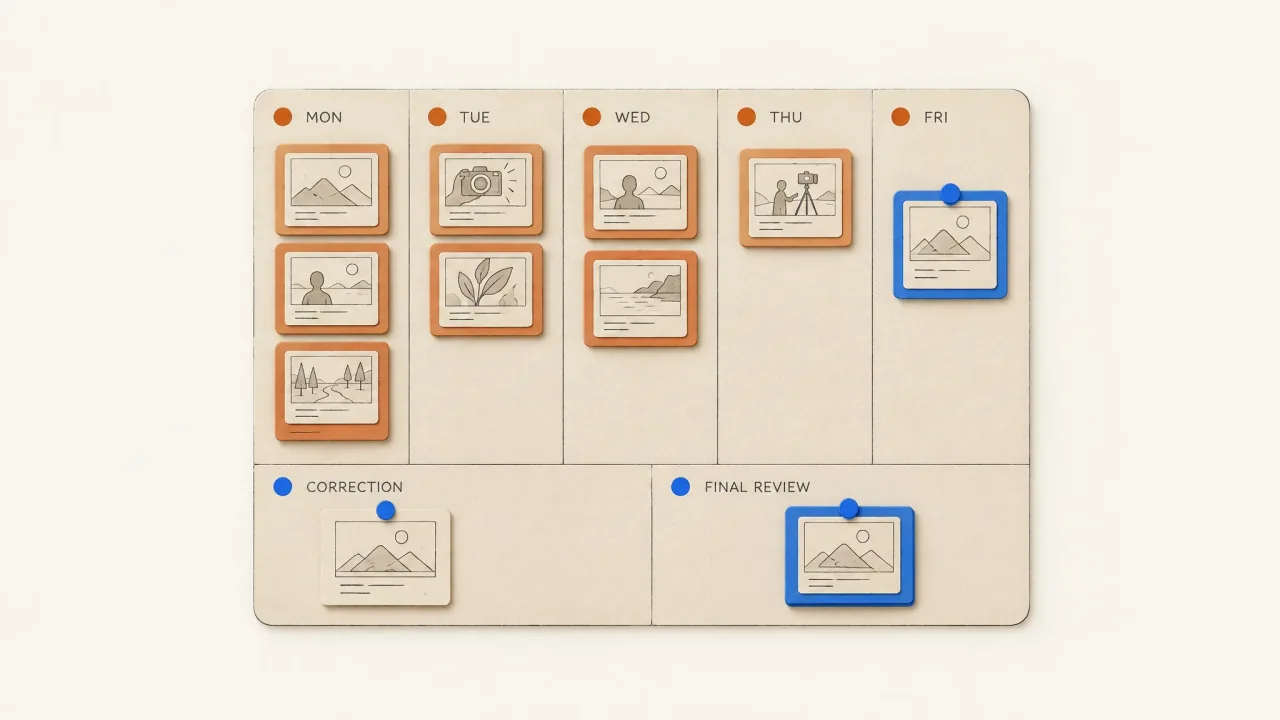
Before setting a weekly video target, decide which creative question deserves production, what your resources can support, and who has time to review the result. A video count alone won't answer those questions.
Commit to a defined work packet that includes rendering, correction, inspection, handoff, and a decision on acceptance. If the reviewer can't examine the result, the task is still unfinished, however many files you've generated.
Start with a priority that changes a decision
Write down why each proposed task needs production. “More vertical ads” only describes an output category. “Make the product's cable-holding action understandable before exploring a second buying reason” gives the team a priority.
Rank requests by the decision they unblock, whether their inputs are ready, and what other work they depend on. A ready mechanism demonstration might come before an objection-led concept whose claim still needs evidence. Use the factual-input checklist in the product-ad workflow to check that the first task is ready. Hold the second until you have the missing facts.
Plan separately for concept exploration, opening variants, corrections, and format exports. They take different effort and answer different questions. A resized export helps with delivery, but doesn't explore another reason someone might buy.
Use complete runs as capacity evidence
Look for records of runs with similar product constraints, format, assembly requirements, and reviewer expectations. Use the accepted-output cost ledger to build those records, keeping rejected candidates and correction work. If you record only successful exports, you lose sight of the resources it took to get them.
For each completed packet, record:
- Active human work on inputs, direction, inspection, correction, and handoff.
- Elapsed production time, including waits and dependencies.
- Actual production usage, where recorded, and missing measurements.
- Candidate and revision IDs, plus the exact accepted output, if any.
- Assistance required and the reasons work was paused or rejected.
Keep active work and elapsed time separate. Someone waiting for a candidate may be free to work on another task, but review still has to wait for the file. One measure can't stand in for the other.
Use the observed range from comparable runs rather than picking the most convenient result. Note where the new brief needs more work, such as faithful packaging text or an unfamiliar handling shot. A simple unbranded close-up won't tell you your capacity for those tasks.
If you have no comparable history, schedule a limited pilot to collect it and leave the other requests uncommitted. The pilot defines what you'll try; it doesn't establish a weekly output rate you can achieve.
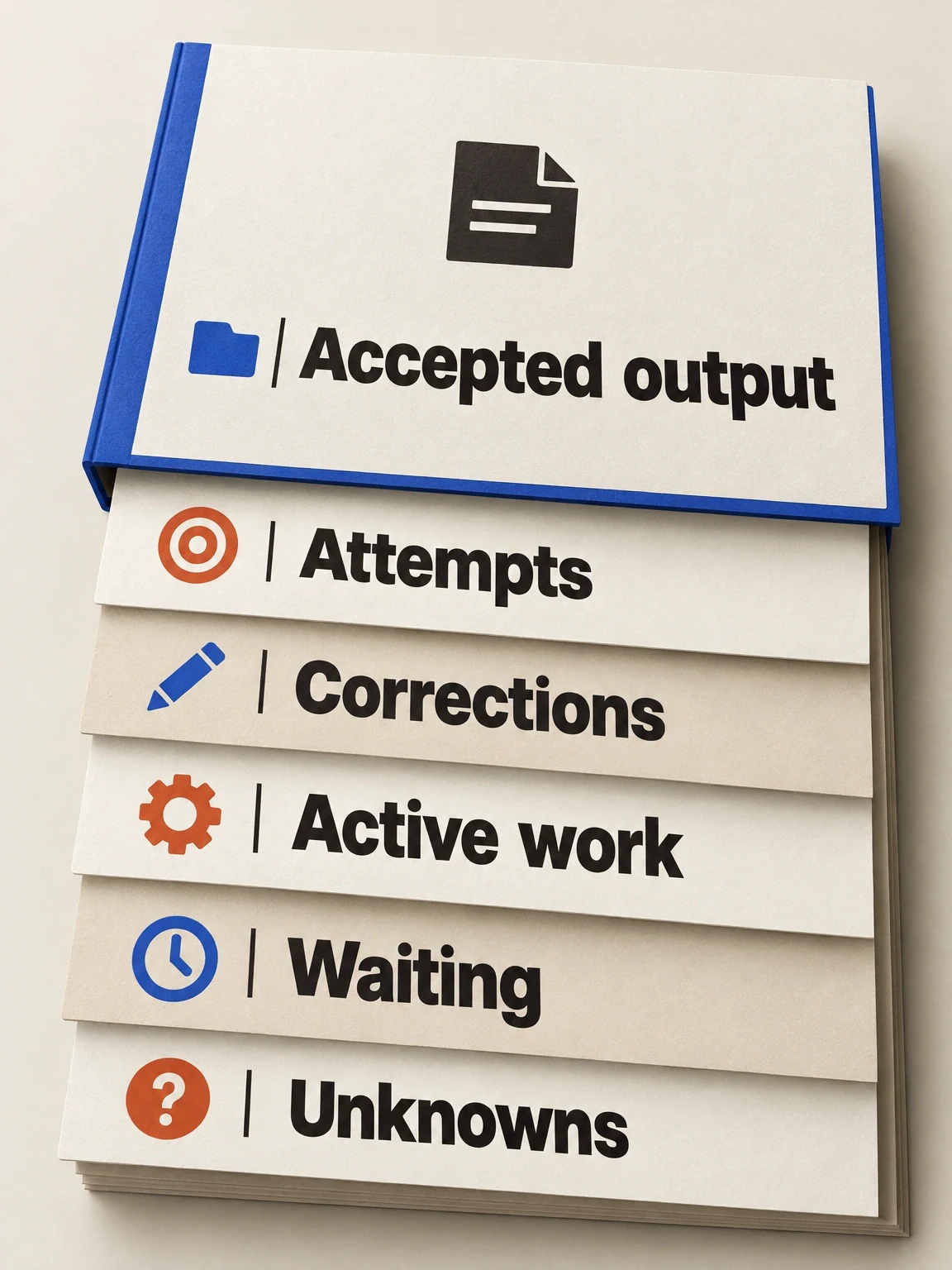
The showcase is only the cover
The accepted export is the cover story. A capacity estimate needs the attempts, corrections, assistance and other work behind it.
View full-size (opens in a new tab)Image explanation
- Use comparable complete runs with similar product constraints, formats, assembly and review expectations. Retain rejected work, corrections, actual usage, candidate identities and assistance alongside the accepted output.
- Record active input, direction, inspection and handoff effort separately from elapsed waiting. Leave missing measurements marked unavailable.
- A showcase file cannot establish typical throughput. Without comparable history, admit a limited pilot and leave other requests uncommitted. The dossier supplies no measured weekly output rate or subscription allowance.
Admit work against the bottleneck
Check how much time is available this week for input preparation, production supervision, and review, after existing commitments. Confirm when the reviewer can inspect the candidate. Naming them in the plan doesn't reserve their time.
Estimate each packet against those separate limits. Include a visible correction allowance based on observed rework, checking that the full-packet estimate hasn't already counted it. Where the evidence is thin, mark the estimate as uncertain and schedule less work. Don't assume every first candidate will pass.
For each work category, the packet's estimated demand must fit the availability left after existing commitments. Extra production budget won't create more reviewer time. Attach the source records to the estimates so the team can challenge the assumptions before scheduling the work.
Record the current estimate and authorized spending limit in the packet. Permission to spend doesn't establish how many finished ads you'll get. Use the variation-budget guide to define the authorization, then reconcile it with actual usage when the packet is complete.
Schedule a task only when its inputs, resources, and review time fit. If review is the bottleneck, reserve time for correction and a decision before adding another concept.
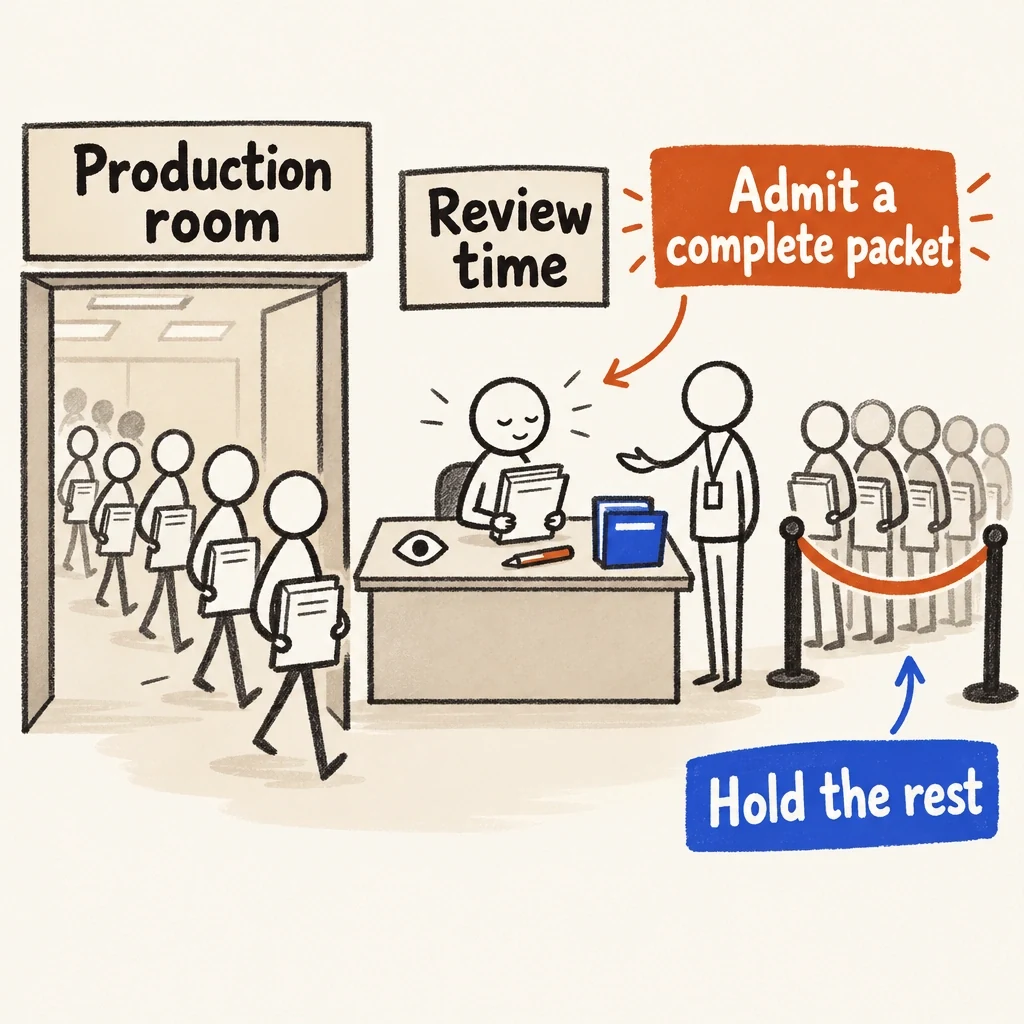
The reviewer is part of the capacity
Reviewer time belongs in the weekly plan alongside production budget. Each admitted packet needs room for correction, decisions and handoff.
View full-size (opens in a new tab)Image explanation
- Admit a clearly scoped packet only when its inputs and authorization fit the confirmed preparation, supervision and review capacity.
- Reserve correction, decision and handoff time. Hold other tasks when that capacity is full; recurring credits supply no output quota.
Copy this weekly work plan
Keep this in a document or planning system your team already uses. The people you name are responsible for process decisions. Those responsibilities are separate from product account roles.
Planning period: [week under consideration]
Priority decision: [what this week's creative work should unblock]
Coordinator and reviewer: [named people; confirmed availability]

Capacity evidence: [complete comparable run IDs; differences; unknowns]
Available active work: [inputs; supervision; inspection; handoff]
Elapsed-time constraints: [waits and dependencies that affect sequencing]
Production authorization: [current estimate; agreed limit; stop condition]
Correction allowance: [basis in observed rework; uncertainty]

Admitted packet: [ID; one bounded production task]
Required inputs: [approved facts; references; offer; destination]
Requested output: [candidate scope; formats; supporting materials]
Acceptance criteria: [communication; product identity; delivery]
Review opportunity: [availability agreed with reviewer]
Decision required: [accept exact export; request change; hold]

Hold list: [unadmitted tasks; what would make each ready]
Scope-change rule: [what existing work must move before adding work]
Stop rules: [missing inputs; exhausted authorization; unresolved defect]
Closeout: [actual files; decisions; usage; work; carry-forward reason]
Worked scope: one demonstration before another direction
Consider a fictional three-slot desk cable keeper whose defined job is to give loose charging-cable ends a place at a desk edge. The plan below is an illustration. It doesn't document a completed production run or measured capacity.
Schedule a candidate that explains the mechanism by showing a cable resting in a slot and the keeper's position on an ordinary desk. Supply the approved fictional facts and consistent product references. Request an assembled vertical ad for review, including its final wording.
Keep the objection-led direction on hold until you've recorded a decision on the mechanism candidate and reassessed the remaining resources. That sets the order and scope of the work without predicting how many candidates you'll accept this week.
If the references leave cable contact unclear, pause and resolve that input. If the product view is correct but the opening is confusing, request a focused correction. Agree to any larger batch separately.
Give each gate its own evidence
Have a person check whether the product, message, action, captions, and audio make sense. Run automated technical checks for critical, measurable delivery requirements on the assembled export. Record the checks that ran and their results. If a report is missing, leave that check unconfirmed.
Record acceptance as a named person's decision about an exact file for a specified use. Campaign activity supplies the metrics needed to evaluate whether the buying idea worked. Even a technically suitable, accepted ad still needs campaign evidence to support that idea.
Close each candidate with a reviewer decision brief. Then add accepted exports to the test-asset manifest, where you record their test context and delivery.
Close the week with facts that improve the next plan
Record accepted, changed, held, and rejected work separately, with actual effort and usage where available. Explain why any work carries forward. Missing facts, too little review time, unresolved defects, and changed priorities need different responses.
Add complete packets to your capacity records, including unsuccessful work. Use them to make the next plan more realistic.
Choose the highest-priority task that's ready, supply its approved facts and references, and open Fablo to produce this week's selected packet. Fablo's monthly plans provide recurring credits for ongoing creative work. Review the estimate and room for corrections alongside the time you actually have for review. A renewed credit balance doesn't establish a weekly finished-ad quota.