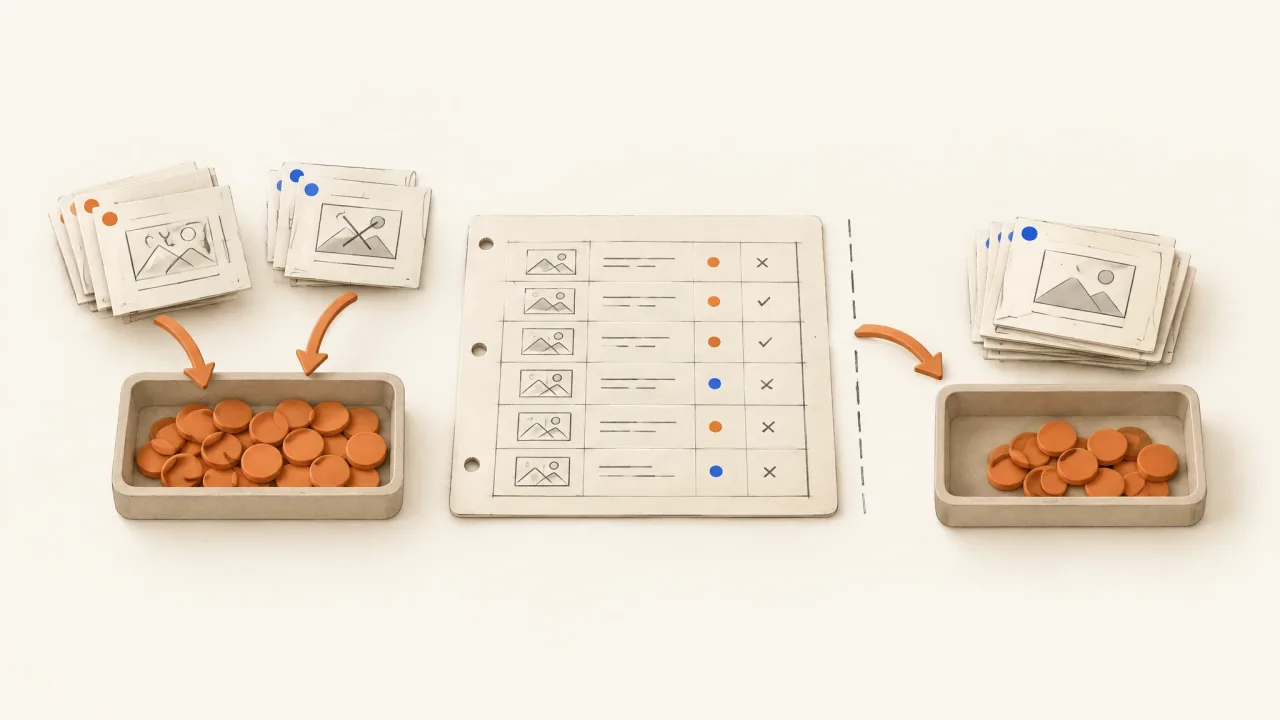
Divide the full cost of a defined production run by the number of finished ads accepted from it. Include rejected attempts, paid corrections, and shared preparation in the cost. Count only accepted finished ads in the denominator, leaving out raw scenes and unfinished previews.
Keep a run ledger and an acceptance register so you can trace both the costs and the finished outputs. A screenshot of the best output won't give you that record. Check for missing charges, and keep the approved spending ceiling separate from actual spend: it records permission to spend.
Define the output unit before doing arithmetic
An accepted ad is an assembled deliverable that meets the agreed factual, creative, technical, and delivery criteria. Record the human decision to accept it. That decision tells you whether the production met the brief; it doesn't prove campaign performance.
Decide whether your denominator counts distinct creative directions or delivery exports. One accepted concept exported vertically and square can be two delivery files but one concept. Report the chosen unit rather than switching definitions to make the cost look smaller.
A raw generated scene can become part of an accepted ad. Count it as a finished ad only if that was genuinely the commissioned deliverable. Use the finished-ad distinction to identify assembly work still needed.
Record every operation and decision
For each entry, record the run and operation identities, category, related candidate or shared purpose, charge evidence, amount and unit, outcome, and confirmed adjustments. Mark billing outcomes that are still pending.
Leave estimates and reserved amounts out of charged-usage totals until you can confirm the actual debit.
Record reasoning or chat separately from media. Include charges for reference preparation, footage, voice, music, evaluation, correction, assembly, and export, along with external services or licenses actually used. If a contractor has invoiced for work, don't count it again as internal labour.
In the acceptance register, identify each finished candidate, final export, decision, reviewer, and date. Keep rejected raw scenes in the ledger even when replacement footage later becomes part of an accepted ad.
For Fablo, check the current monthly credit plans and use account records and Terms to support billing entries. Confirm what is charged and how adjustments work from a current source. A failed job doesn't automatically mean a refund; record a reversal only when it's confirmed.
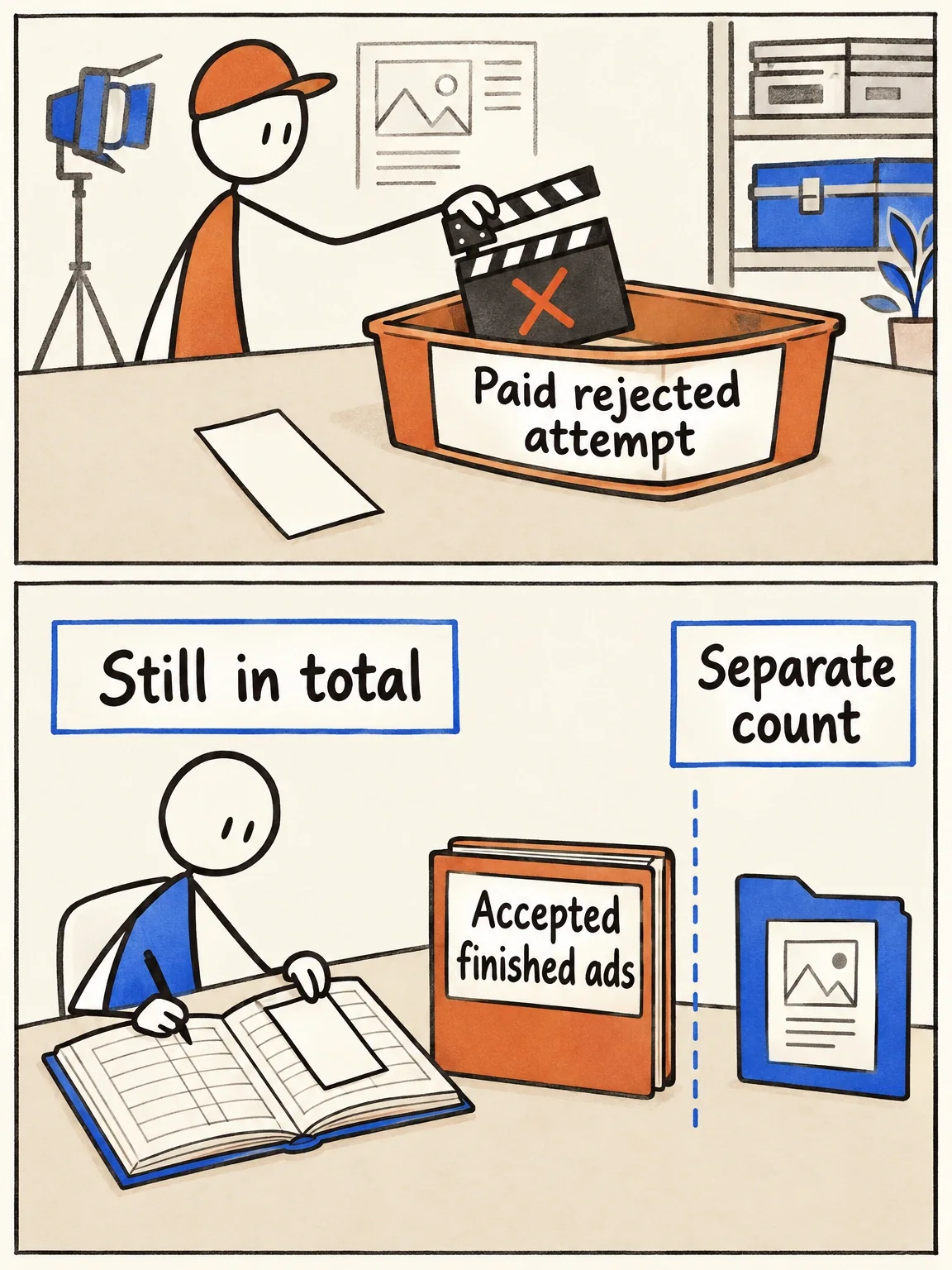
Reject the footage, keep the charge record
Discarding rejected footage leaves its confirmed charge in the run cost. The accepted-output count has a separate job.
View full-size (opens in a new tab)Image explanation
- A confirmed paid rejected attempt remains an attributable run cost after its footage is discarded.
- Count only the defined accepted finished outputs in the denominator. Deduct confirmed reversals only, and label a subtotal partial when required charges are missing.
Keep credits and money in separate calculations
For a credit-based run, calculate:
Net run credits = all attributable credit debits − confirmed credit reversals.
Credits per accepted ad = net run credits ÷ accepted finished ads.
Credits measure usage. To calculate monetary cost, you need purchase evidence and a stated method for allocating consumed credits or subscription expense. Keep the planned allowance separate from actual charges with the variation authorization sheet. Don't add credits to money or assume different vendors' units share a universal conversion.
You can use a before-and-after balance only if the account activity is isolated and you've reconciled intervening top-ups, grants, refunds, or expiry. If other work used the account at the same time, the balance difference won't reliably identify this run's usage.
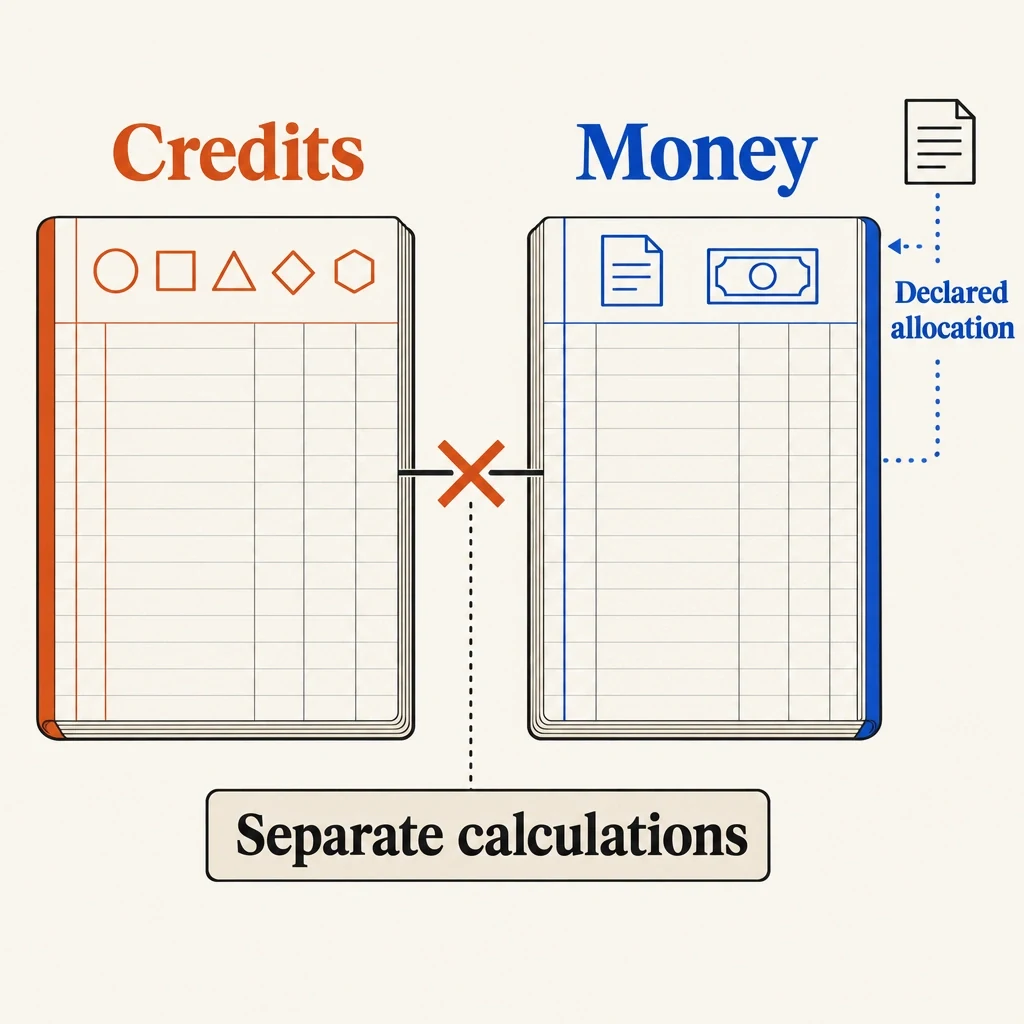
Credits and money need separate ledgers
Credit usage and monetary cost need separate records. A money figure also needs purchase evidence and a stated allocation method.
View full-size (opens in a new tab)Image explanation
- Credits per accepted ad measures usage. It supplies no monetary cost by itself.
- Use actual purchase evidence and a declared allocation method for monetary reporting. Keep credits separate from money and avoid assuming a universal conversion.
Worked ledger: explicitly FICTIONAL accounting data
Everything in this example is invented for arithmetic. It describes an imagined invoice-based studio, not a Fablo session, provider tariff, observed yield, or subscription offer. Dollar figures are fictional transaction totals, not per-generation rates. Credits are not applicable to this invented setup.
The scoped run produces two accepted finished ads, Alpha and Beta, each in one delivery format. The complete fictional paid-operation ledger is:
- L01 — reasoning, planning and scripts: $12; shared preparation used by both ads.
- L02 — reasoning, evaluation: $8; shared review work, including the rejected attempt.
- L03 — media, product references: $10; shared accepted inputs.
- L04 — media, scene attempt S1: $26; accepted raw footage used in Alpha.
- L05 — media, scene attempt S2: $18; rejected for incorrect product geometry; the charge remains.
- L06 — media, replacement S3: $14; accepted raw footage replacing S2 in Beta.
- L07 — media, voice and music: $6; accepted audio used in the assembled exports.
- L08 — media, failed operation S4: $4; charged, with a separately recorded billing resolution.
- L09 — confirmed reversal of L08: −$4; supported by the fictional adjustment record.
- L10 — assembly, captions and export: $8; delivery work for the two finished ads.
The net direct paid-operation cost is $102. The $18 rejected scene remains included; only the confirmed $4 reversal reduces the total. Neither the footage count nor the attempted-operation count determines the accepted-ad denominator.
The fictional acceptance register contains Alpha and Beta, each with its final export and recorded acceptance. S2 is rejected source footage, not a third completed ad. No other services or licenses were used in this invented scope.
The fictional shared software invoice totals $80. This run receives one-quarter of that expense because it accounts for one-quarter of the period's tracked active project hours: $20 allocated expense. Fictional active operator work is 90 minutes at an invented loaded labour rate of $40 per hour, or $60. The shared expense is additional to the listed operation invoices. Elapsed production time is unavailable in this exercise; it is not substituted for active labour.
Calculate the measures separately
Keep the definitions consistent:
Direct paid-operation cost per accepted ad = D ÷ N.
Fully allocated production cost per accepted ad = (D + S + L) ÷ N.
Here, D is net direct paid-operation cost, S is allocated shared expense, L is active labour cost, and N is accepted finished ads. If subscription expense already funds the usage represented in D, allocate it once rather than adding it again in S.
For the fictional ledger, direct cost is $102 ÷ 2 = $51. Fully allocated cost is ($102 + $20 + $60) ÷ 2 = $91. Those are two answers to different accounting questions, both with the same disclosed denominator.
If N is zero, cost per accepted ad is undefined. Report the spend and zero accepted outputs; don't report a zero cost per ad. If a required charge is unknown, label the known subtotal as partial and wait to publish a final unit cost.
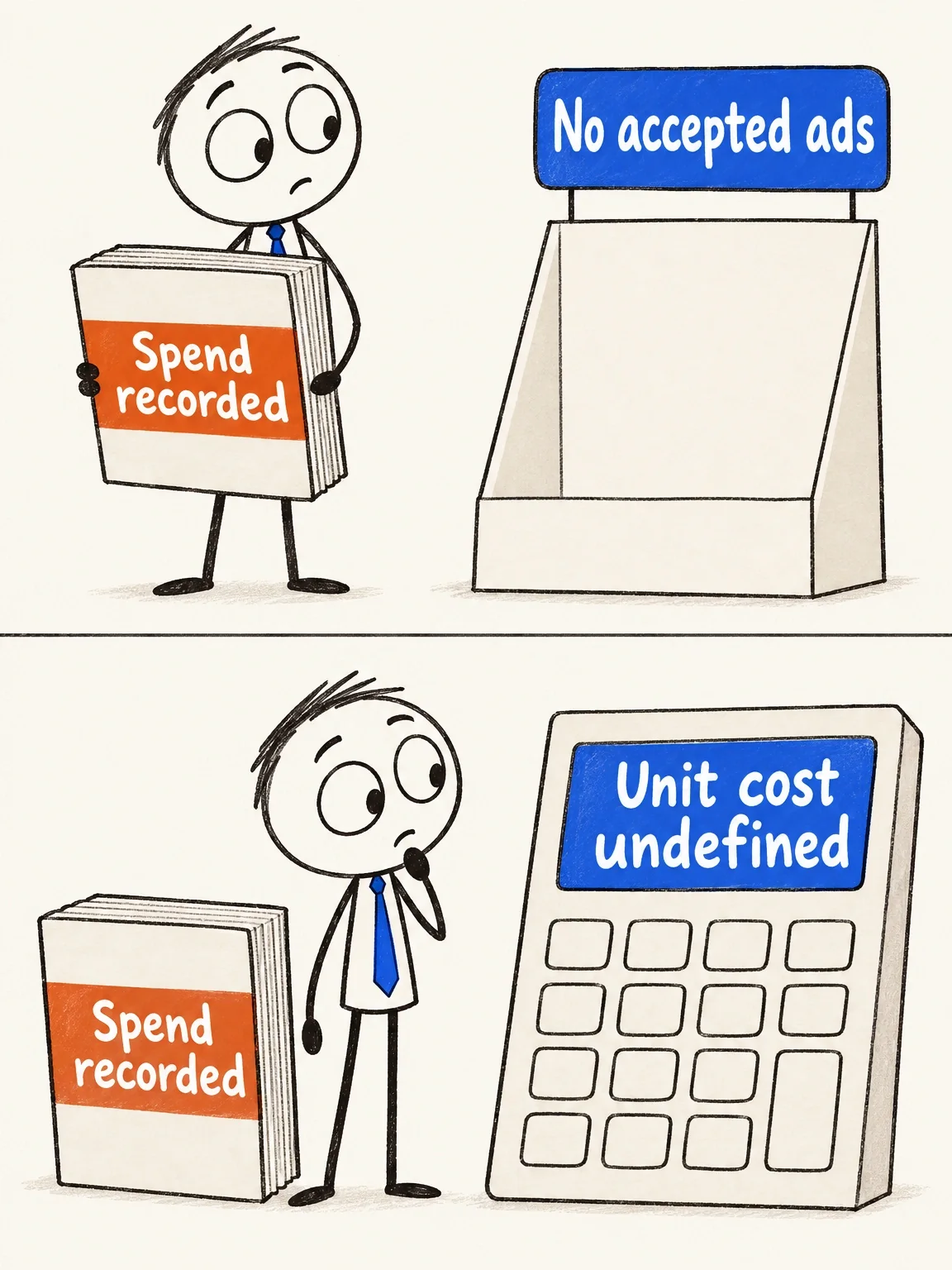
The invoice survived the empty podium
The run can have recorded spend and no accepted ads. Its cost per accepted ad is then undefined, while the spend still belongs in the report.
View full-size (opens in a new tab)Image explanation
- Define the run and support its accepted-output count with actual decisions. With no accepted finished ads, report spend and the empty count; cost per accepted ad is undefined rather than zero.
- When required charges are missing, label the known subtotal partial and leave final unit cost unpublished. Disclose the separate components of direct paid-operation and fully allocated measures without counting subscription expense twice.
- The illustration contains no transactions, rates, yields or observed production results.
Use the record to improve the next scope
Track operator work separately from elapsed time. Briefing, selection, corrections, and assistance are active work; waiting for a job adds elapsed time. Keep that distinction when comparing production methods or assessing reviewer capacity.
Explain how you allocate reused preparation across runs and whether the report covers first-time setup or repeat production. Retain every attempt. A selected showcase output alone can't establish typical production economics.
Look in the ledger for costs you can address, such as repeated product corrections, unnecessary scene families, or avoidable reassembly. Use that finding when authorizing the next run and list the selected files in the export manifest. Then open Fablo to produce a run you can document. Fablo's recurring monthly credits fund ongoing production. Assess that work from actual charges and accepted outputs rather than an assumed finished-ad yield. Review the current estimate before starting the next run.