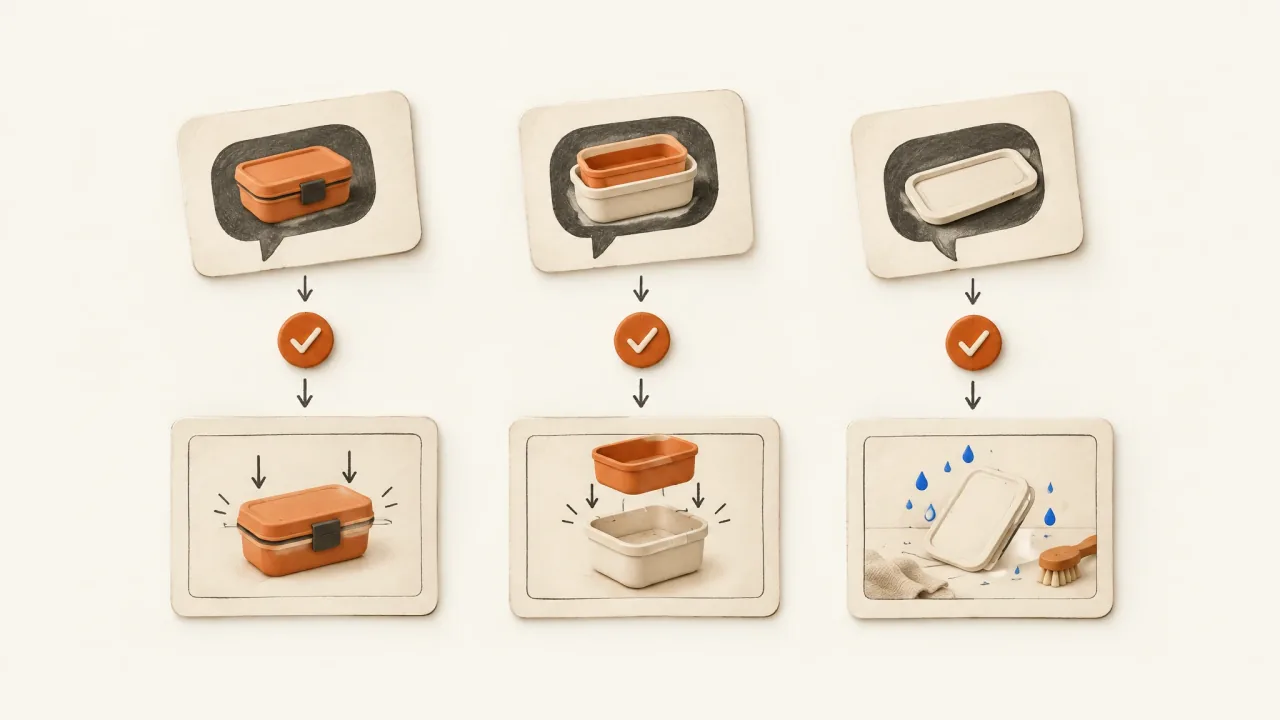
Build each short video around a product question, an approved answer, and enough evidence to explain it. Then choose another question. You get useful creative diversity from the questions themselves, without inventing more reasons people supposedly love the product.
Each answer video should make sense on its own. Someone watching only the cleaning explanation should still be able to identify the product and understand the next action.
Start with questions people actually supplied
Collect questions from your FAQ, support conversations, product-page comments, or sales notes. Save the original wording and source, and remove personal details before handing the material to production.
A support ticket asking “Does the gasket go in the dishwasher?” records a real question. The same question proposed by a copywriter is an editorial suggestion. Either can become a brief; label the source so nobody mistakes the suggestion for customer research.
Combine near-duplicates that need the same answer. Keep questions separate when the explanation differs: “How big is it?” and “Will it fit this shelf?” may overlap, but the second needs a real shelf measurement as well as product dimensions.
The ad-angle examples explore broader ideas about why someone might buy. Here, start with the specific information a person needs before choosing or using the product.
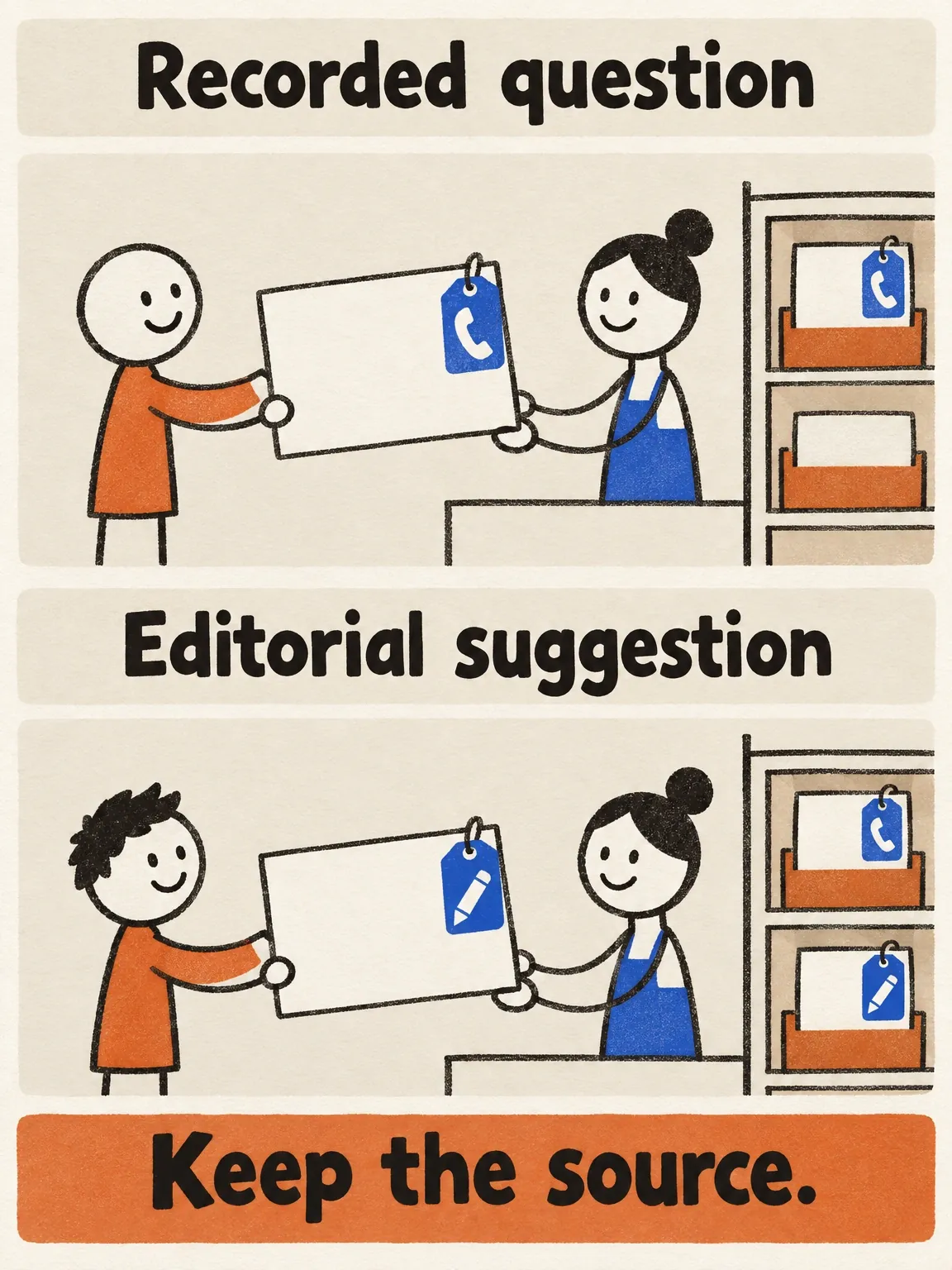
A copywriter's idea needs its own name tag
A recorded customer question and a useful editorial suggestion can lead to similar briefs. Keep each one's origin attached.
View full-size (opens in a new tab)Image explanation
- Retain the wording and source of actual questions from approved FAQs, support conversations, comments or sales notes, removing personal details from production inputs.
- A copywriter's suggestion can become an assignment, but only the sourced record establishes that a customer asked the question. The same wording can have a different origin.
- Combine near-duplicates only when their answer and evidence job match. A fit question may need measurements beyond a general size answer. No actual customer record is reproduced here.
Resolve the answer before choosing the visual
Write the approved answer in plain language and attach its source: the current product specification, care instructions, or owner-approved wording. Use the brand-input packet guide to keep every video working from the same approved information.
Use three readiness states:
- Ready: the answer is supported and the necessary material is available.
- Answer missing: an owner must resolve a fact before scripting.
- Asset missing: the fact is established, but its explanation needs a recording, photograph, or other authorized source.
If the answer is missing, set the question aside and commission one that's ready. Animation can make an unsupported answer look convincing, so resolve the fact before scripting it.
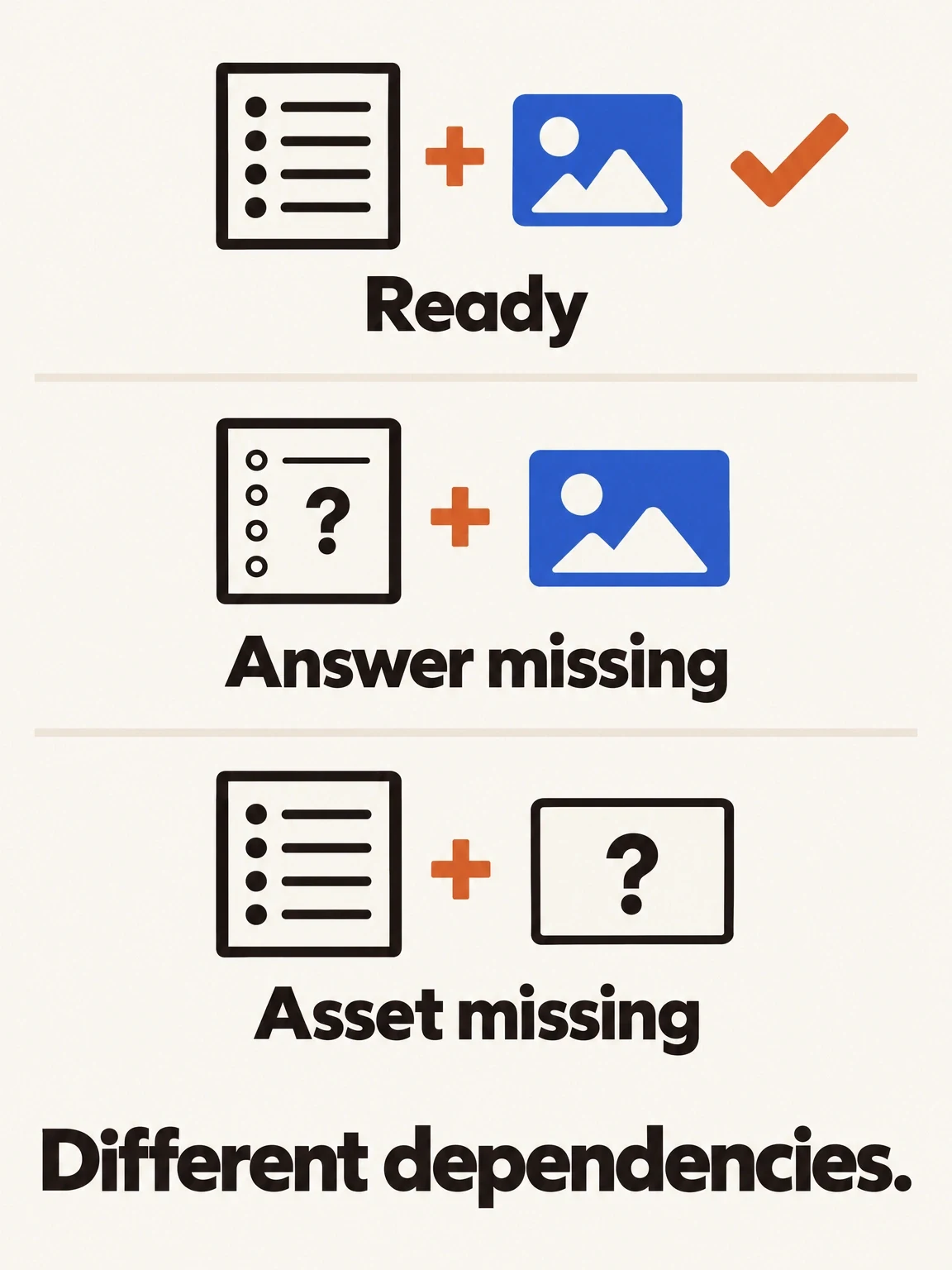
An unanswered fact and a missing asset are different holds
An unresolved answer and an unavailable recording both delay production, but they need different next steps.
View full-size (opens in a new tab)Image explanation
- Ready means the approved answer and necessary material are available.
- Answer missing needs an owner to resolve the fact. Asset missing means the answer is supported but its visual source still needs to be supplied.
Give the evidence a job the video can perform
Once the answer is approved, use the free ad hook generator to suggest factual ways to open the video. Choose an opening the available product view can answer. A more dramatic opening still needs support for any claim it adds.
Some answers need a physical demonstration; others need exact wording or a labelled product view. Let the question guide the format. A presenter testimonial won't suit every answer.
A supplied recording can show a real lid being opened, while an approved care instruction establishes how to clean it. Generated illustration can organize the explanation, but it can't serve as a recorded test of the object's performance.
The collage-explainer showcase brief suggests how to combine product assets and exact text, with credited external references. Use it to describe what you'd like to commission. It doesn't show a completed Fablo answer pack.
Worked example: three questions about one glass jar
IKEA's KORKEN product page, checked October 8, 2026, identifies the clear-glass jar as 34 oz and states that the glass jar is dishwasher-safe while the gasket needs hand washing. Keep this exercise within those facts. The questions below were selected to illustrate the method; they aren't a researched IKEA customer FAQ or a commissioned campaign.
Question one: “Which size is this?” Identify the exact 34 oz variant with a recognizable product view and that wording. An arbitrary number of biscuits won't establish capacity. If dimensions matter to the buyer, get the exact measurements before adding a ruler graphic.
Question two: “Can I put the whole jar in the dishwasher?” Keep the distinction between glass and gasket clear. Request an owner-supplied view of the parts and exact care text: the glass jar is dishwasher-safe; wash the gasket by hand. Explaining the two parts gives the viewer more useful information than a sweeping “easy to clean” promise.
Question three: “Can I see what's inside?” Clear glass answers the visibility question. Use a genuine product view with ordinary contents and a short line identifying the clear-glass body. Keep the message about visibility; the scene can't establish how long food stays fresh.
These questions give the viewer three different tasks: identify the variant, understand care, and inspect contents. Changing the background behind the same generic pitch wouldn't create those different explanations.
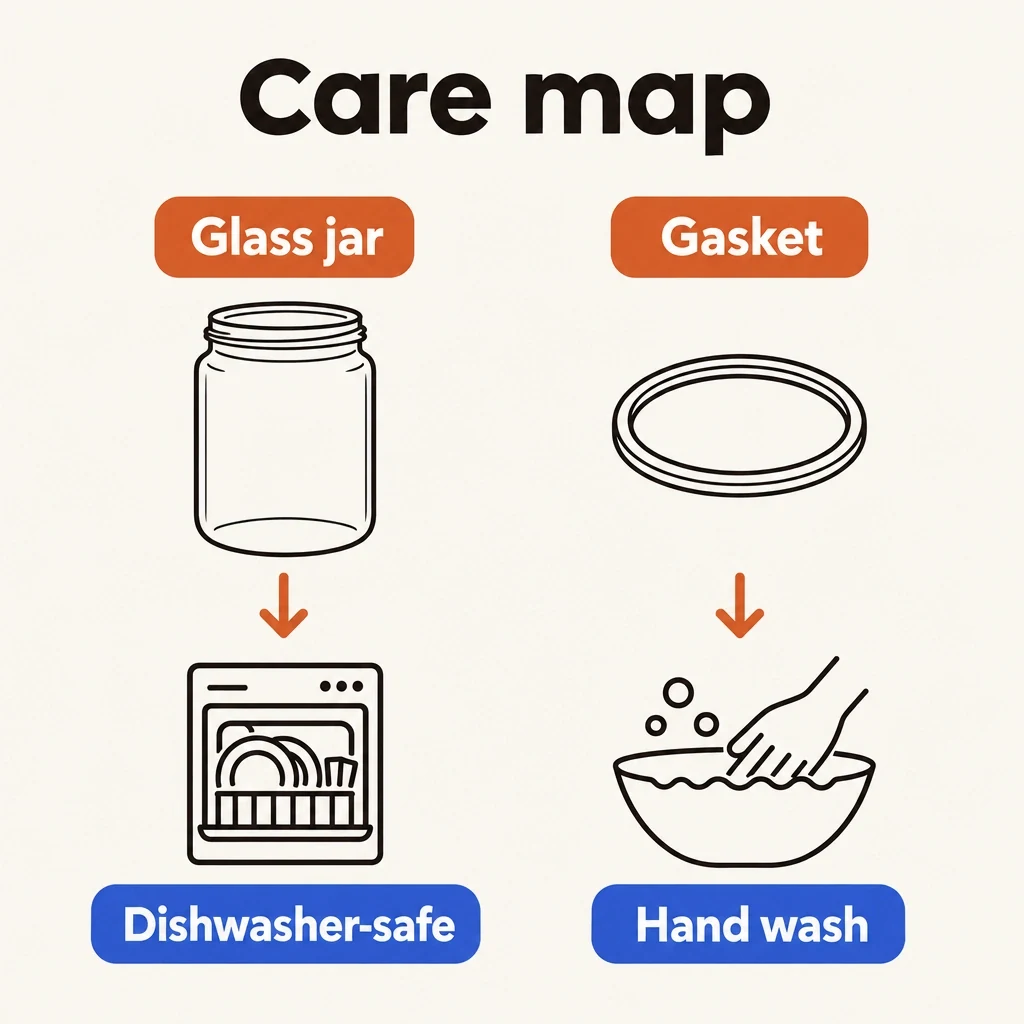
The care qualification is the answer
The article's dated KORKEN documentation gives the glass and gasket different care instructions. The answer video needs to keep that distinction.
View full-size (opens in a new tab)Image explanation
- The article's KORKEN source says the glass jar is dishwasher-safe and the gasket needs hand washing.
- This exercise uses dated documentation. It includes no teardown, cleaning test, whole-assembly instruction or researched customer FAQ.
Copy this question-to-video assignment map
Repeat the block for each question. Keep the source and readiness fields even when the packet is small.
FAQ ANSWER ASSIGNMENT
Question ID and exact wording: [one question]
Question provenance: [FAQ URL / dated support note / editorial hypothesis]
Product and exact variant: [identity]
Approved answer: [one concise answer, including qualifications]
Answer authority: [current source and owner approval]
Evidence needed: [recording / exact copy / product view / measurement]
Evidence available: [authorized files or missing dependency]
Video assignment: [the visual or spoken explanation that answers it]
Opening: [question and recognizable product]
Resolution: [the answer the viewer must understand]
Closing action and destination: [approved wording and URL]
Readiness: [ready / answer missing / asset missing]
Priority and reason: [which answer to produce first; why]
Acceptance question: [what a reviewer must be able to understand]
Cleaning is a sensible first commission for the jar exercise because you can make its qualification visible. Choose it for clarity, without treating that choice as evidence that cleaning questions have the greatest demand or will convert best.
Produce a small library of complete answers
Take the selected assignments into the product-ad workflow. Ask for a production plan and estimate for the ready videos, including narration, captions, and assembly. Check each complete candidate for an accurate answer that makes sense on its own, and correct any omissions before accepting it.
As the library grows, supply new questions and factual updates. Keep the approved context in the production conversation, and bring it with you when starting another.
Choose one ready assignment and open Fablo to make the answer video. If the library will grow regularly, use current pricing to plan recurring production around the work you authorize.