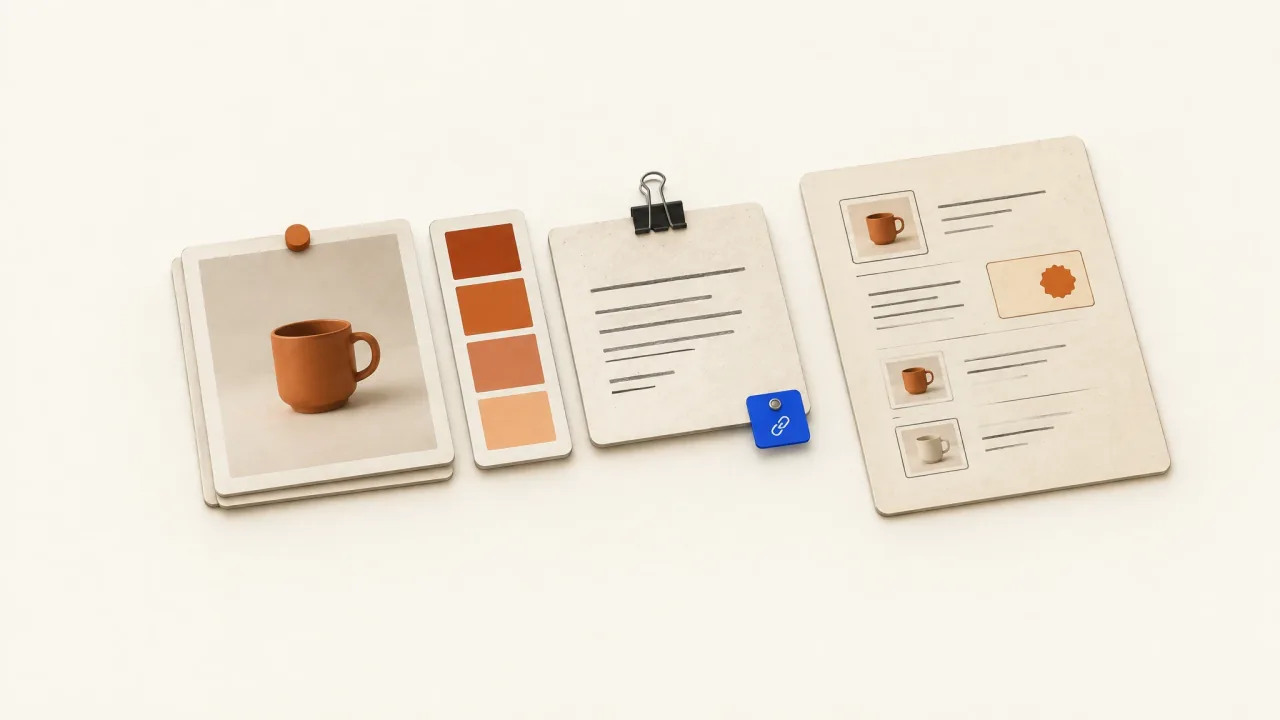
Give the agent a compact packet of approved facts, visual references, brand language, and unresolved questions. Keep the offer and viewer action in a dated campaign annex. That way, a new brief can reuse stable inputs without accidentally carrying over an expired promotion or unsupported claim.
The packet should answer "where did this come from?" as easily as "what should the ad say?" A homepage link and a folder of logos leave both questions partly unresolved.
Separate the reusable core from the campaign annex
Put product identity, approved capabilities and limits, pronunciation, owner-approved visual assets, and useful voice examples in the core. Use the annex for the current offer, audience situation, proposed buying reason, destination, requested format, and review owner.
A product's geometry may stay stable while its packaging changes, and the buying invitation may change more often still. Keeping the core and annex separate lets you update an offer without rebuilding the reference pack. Reusing that pack doesn't authorize old commercial wording. Once the sources and owners are clear, the proposed brand-starter-sheet showcase gives you a visual planning approach to discuss.
Assign a version and owner to each part. Name the core and annex versions in the production conversation so the newest-looking attachment doesn't become the source of truth by default.
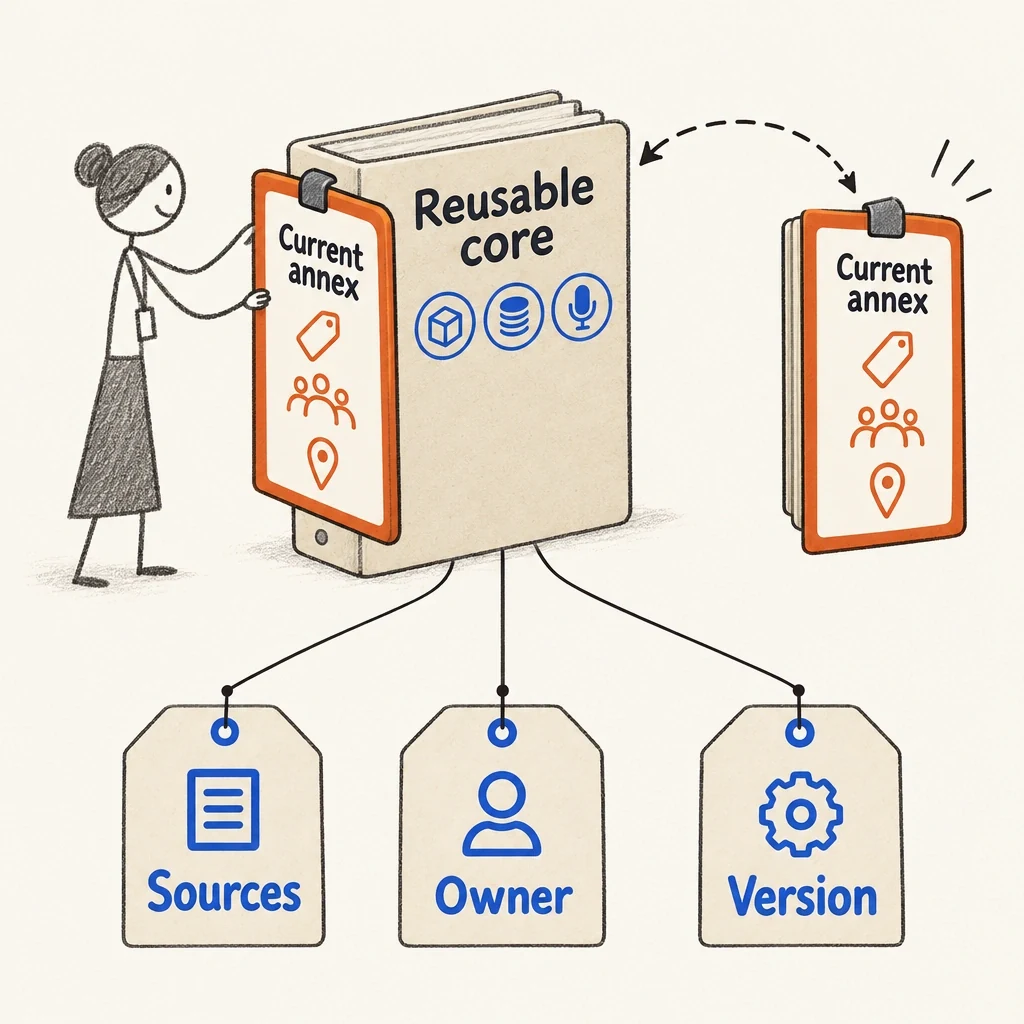
A stable core and a dated annex
Keep the reusable brand facts together and date the campaign insert. An old offer needs more than a familiar binder to become current again.
View full-size (opens in a new tab)Image explanation
- The reusable core holds sourced product identity, facts, limits and approved language. The annex holds the current campaign assignment.
- Record sources, owners and versions for both. Reusing the references cannot authorize an expired offer.
Make each factual statement traceable
Write each fact as a separate statement and link it to specific evidence. "Everything is on our website" leaves the producer to decide which page, market, and product variant to trust.
A source entry should contain:
- A source label and exact URL or supplied document title.
- The market, product variant, and relevant section or page.
- The checked date and the statement it supports.
- Whether the statement is owner-approved, source-supported but awaiting approval, or unresolved.
- The person responsible for resolving a conflict or approving commercial use.
A fact can be supported without its wording being approved. The product document may support "adjustable arm" while the brand owner prefers another phrase for customers. Keep both the fact and the approved expression in the packet.
Record where customer language came from too. A genuine interview excerpt can inform an angle. To use it as a testimonial, you'll need the actual speaker and approved use; an invented presenter can't take on that customer's experience.
Worked source excerpt: an adjustable work lamp
Consider this documentation exercise using IKEA's US TERTIAL product page, checked October 7, 2026. It shows how to extract inputs. There's no commissioned IKEA ad or Fablo customer story behind it.
Source: official US product page; dark gray TERTIAL work lamp; article 203.554.34. Supported statements: the lamp has an adjustable arm and head; the page describes a steel design; the light bulb is sold separately; IKEA recommends an LED E26 globe opal white bulb.
A possible production job is to show the arm and head being positioned for reading. The documented adjustability supports that proposed demonstration. It doesn't establish a measured improvement in concentration, universal desk fit, or a synthetic presenter's personal experience.
You'd still need owner-approved production references, brand language, the intended market, the current commercial invitation, and an approver. The official page supplies factual evidence, but those production inputs remain unresolved.
Include "not included" facts alongside features. An ad could render the lamp faithfully and still contradict the product page by presenting a bulb as part of the purchase.
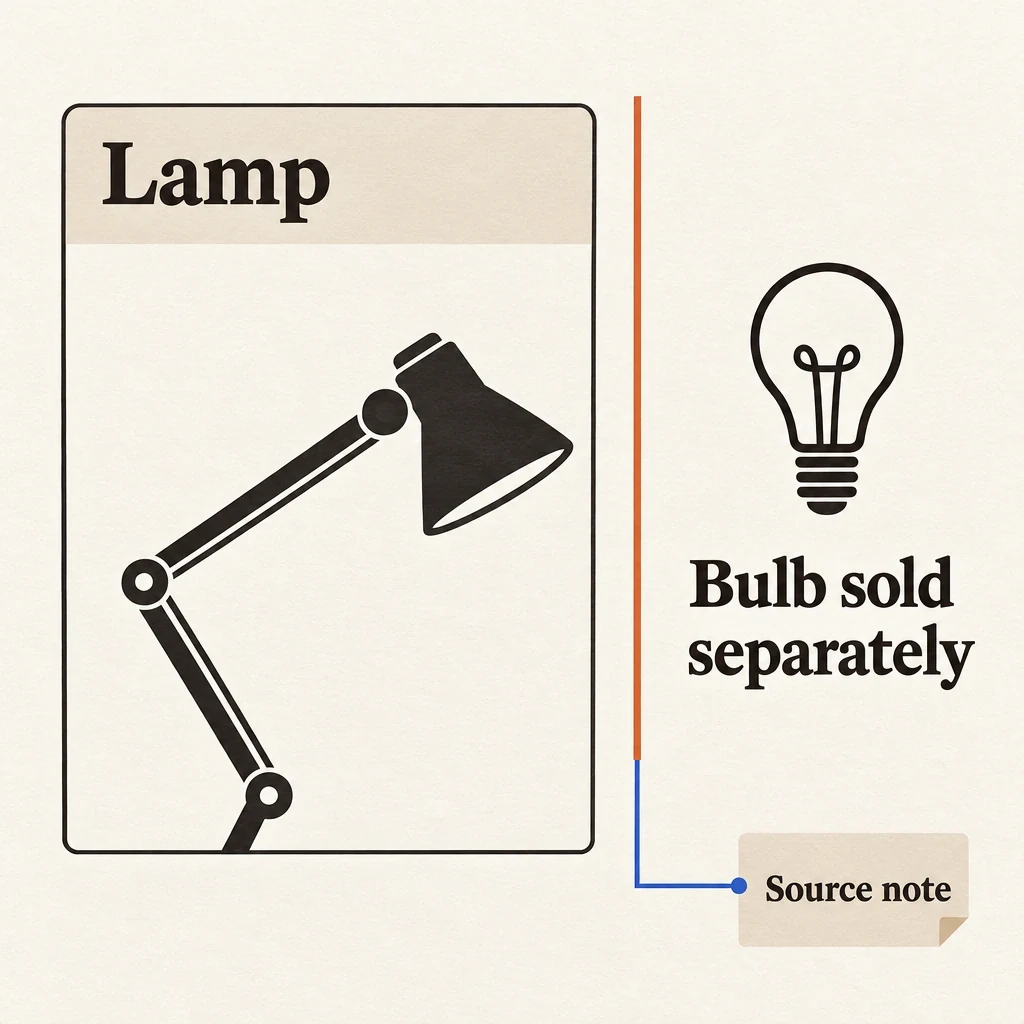
A fact packet includes what is not included
The article's dated TERTIAL source says the bulb is sold separately. That condition belongs in the brief alongside the product features.
View full-size (opens in a new tab)Image explanation
- The article's October 7, 2026 TERTIAL source says the light bulb is sold separately.
- Keep the depiction from implying bulb inclusion. The official page leaves approved references, the current offer and owner permission to be supplied separately.
The reusable brand packet
Use these sections to build a working document. Select the evidence a producer needs instead of including everything the team has collected.
Start the identity record with brand and product names, the exact variant, and pronunciation supplied or approved by the owner. Add the core version, owner, and review date. Identify discontinued or look-alike variants to exclude.
In the fact register, give each approved statement an entry with its source, important limits, and allowed wording. Include facts the visuals must respect, such as an accessory being sold separately. Keep disputed or unconfirmed statements in a separate unresolved list.
The visual reference index should contain owner-approved hero, detail, packaging, and use-context views. Build an identity-first product reference pack and say what each view establishes: geometry, exact label text, colour, scale, or supported interaction. If old packaging appears elsewhere, name the asset version that takes precedence.
Choose a few actual approved lines as voice examples. Explain what makes each useful, whether that's directness, humour, vocabulary, or sentence rhythm. Include concrete replacements for unwanted language. "Prefer 'adjust the arm' to 'transform your productivity'" gives the producer a usable instruction. The instruction "sound premium" doesn't.
Set creative boundaries by naming scenes or claims to omit, supplied demonstrations that must remain faithful, and flexible art-direction choices. Distinguish "logo geometry fixed" from "background lighting flexible."
Keep the evidence entries behind the fact register in a source catalogue, with their dates and owners. Retain the original documents so a reviewer can inspect the context around a selected statement.
Finish with the campaign annex: approved offer and conditions, exact action and destination, viewer situation, proposed buying reason, requested deliverables, decision owner, and date-sensitive details to recheck.
Resolve conflicting inputs before generation
Suppose a sales deck says an accessory is included, but the current product page says it's separate. Record the conflict and the market and version of each source. Ask the owner which applies. Combining the more attractive parts would invent a new offer.
Resolve visual conflicts the same way. If an older hero image shows different packaging from the current supplied label, establish which reference controls. Remove the old image from the active packet but keep its history.
Record when date-sensitive facts need to be checked again. A source-check date tells you when someone looked; the promotion may have changed since then.
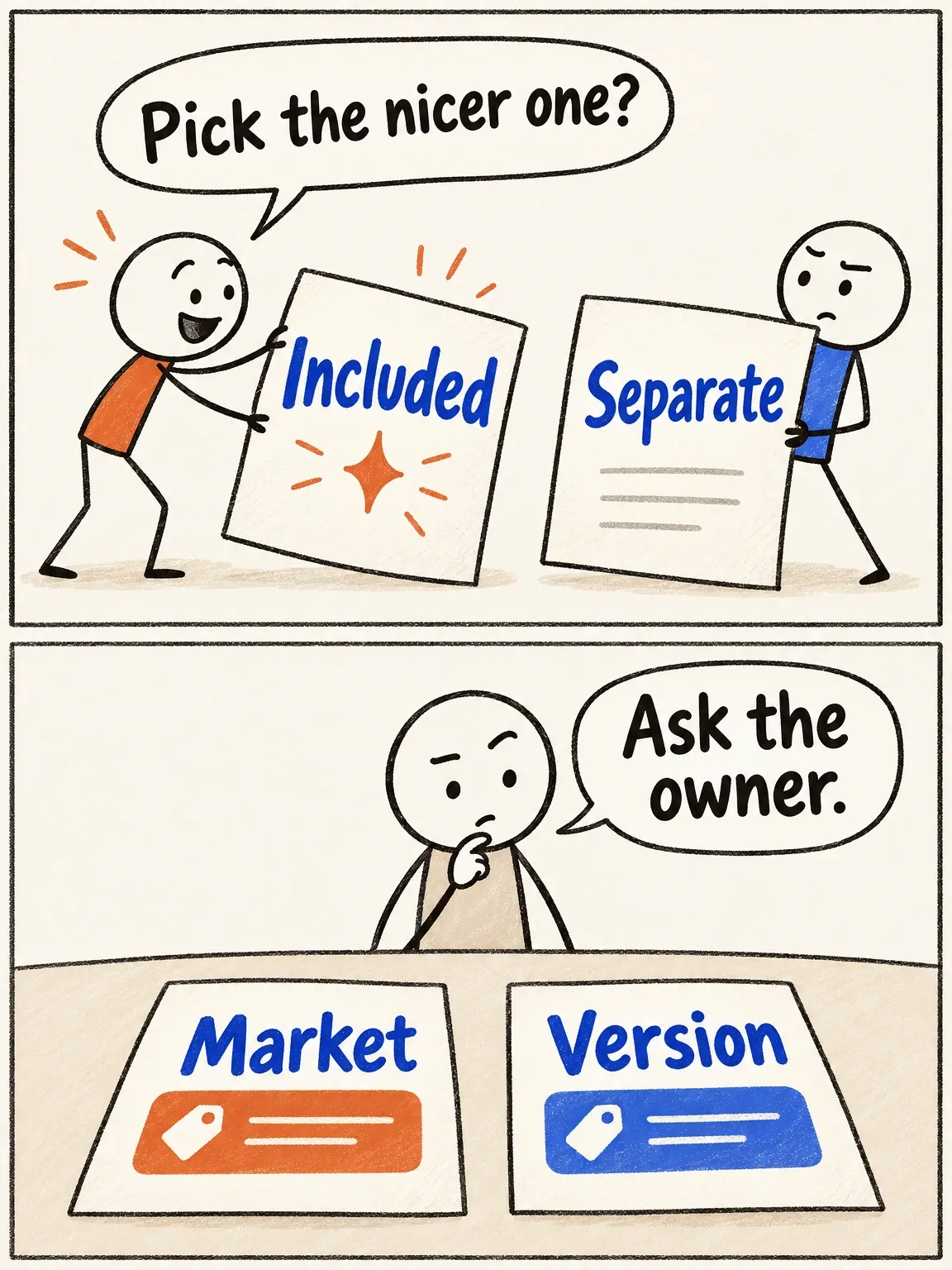
The nicest-looking half of a conflict
These hypothetical accessory records disagree. Picking the prettier answer leaves the source conflict unresolved.
View full-size (opens in a new tab)Image explanation
- A sales document can say an accessory is included while a product source says it is separate. Retain both, identify their market and version, and ask the responsible owner which applies before using commercial wording.
- Use the same check when older packaging conflicts with a current supplied label. A source-check date records an inspection; a promotion still needs current authorization.
- The cartoon makes no inclusion decision and shows no real offer or Fablo interface. Combining attractive parts of conflicting records cannot create an authorized offer.
Carry the packet into the next conversation
Attach the relevant core and campaign annex to the customer production brief and name their versions. Bring that context into each new conversation. Don't assume it will carry over between chats.
After reviewing the finished ad, add feedback to the packet only if it will be useful again. "Use the current label image" belongs in the core. "Open this concept with a wider desk shot" usually belongs in that concept's revision brief. Use the approval-handoff guide to turn those observations into a recorded decision before another production pass.
Check the assembled ad against the packet for product identity, supported action, accurate copy, current offer, and destination. Record visual mismatches in the product-fidelity ledger and keep the acceptance decision with the export. The next producer can then verify the inputs they reuse.
Choose the current core and campaign annex, then open Fablo to produce an ad from your sourced brand packet. Monthly plans provide recurring credits for ongoing production. Bring the relevant versions into each conversation. Before authorizing work, review the planned media spend, room for retries, and separately billed reasoning.