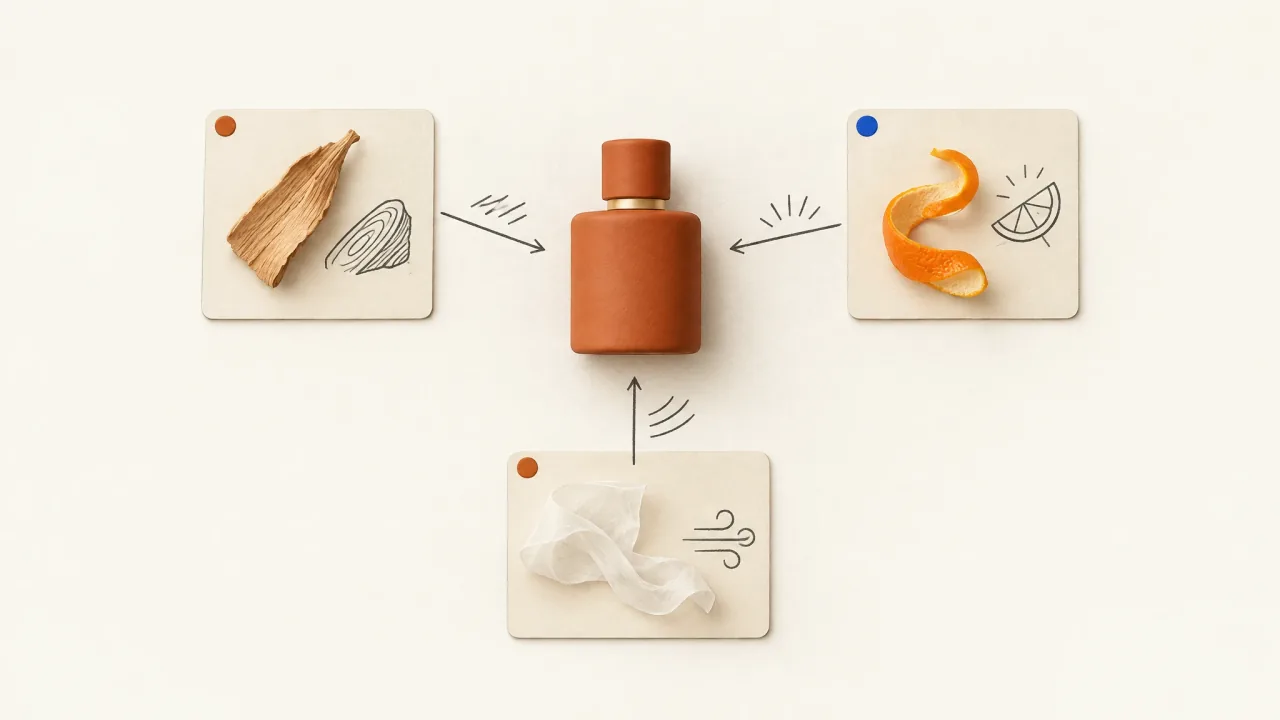
Start with the brand's approved scent description and choose a few colours, textures, movements, and sounds to express it. Keep the bottle and label true to the references. Flowers, fruit, and wood can be symbolic scenery, but they shouldn't suggest ingredient facts you haven't been given.
Connect each choice on the direction board to a supplied note or phrase. That gives production a scent description to work from. A collection of beautiful objects around a bottle won't explain why those objects belong there.
Use the scent description as your creative authority
Gather the approved fragrance name, descriptive notes, mood language, packaging references, and exact closing action. Confirm which words are for consumer copy and which are only production direction. “Cedar impression” and “made with cedar oil” are different statements; the second needs supplied formulation facts.
The International Fragrance Association describes fragrance as a mixture of ingredients, including natural and scientist-created materials. A brand's description of the smell isn't a manufacturing recipe. Base ingredient claims on the approved formulation information you've actually received.
Don't fill gaps with familiar perfume promises. Longevity, projection, concentration, sourcing, and claims about desirability each need supporting facts. A slow-moving cloud can express atmosphere without becoming a demonstration of how long the scent lasts.
Translate the notes into a coherent visual vocabulary
Choose one leading impression, with the remaining notes supporting it. A bright opening, soft middle, and dry ending can become a progression of light and movement without requiring a literal fruit basket, flower garden, and forest.
Write the translations precisely. “Bright” might mean a narrow ivory light crossing a pale green field. “Soft” might mean matte paper textures and a slower camera move. “Dry” might mean a warm, low-reflection surface and a settled final composition. These are proposed creative associations, not objective reproductions of smell.
Use the visual-metaphor guide to check for unwanted implications. For perfume, return from symbolic imagery to the actual product and approved scent language. The imagined scene doesn't establish how the fragrance performs.
Direct movement and sound without implying a result
Give movement a sensory job. A quick ribbon of light might introduce a crisp impression; a gentle lateral drift might express softness. Avoid making every note a separate effect. Too many movements can leave the product film looking like unrelated miniature commercials.
Sound can follow the same vocabulary: a light percussive entrance, a restrained sustained tone, and a quiet finish. Do not call these the sound of bergamot or cedar. They are chosen associations that should remain coherent when the viewer cannot hear them.
Give packaging its own instruction: preserve the supplied bottle silhouette, liquid appearance, cap, label artwork, and brand wording. A symbolic amber glow in the scenery should not recolour the liquid into a different product. Use the cinematic structure guide to place the actual product and invitation within the film.
Let the scent notes set the movement
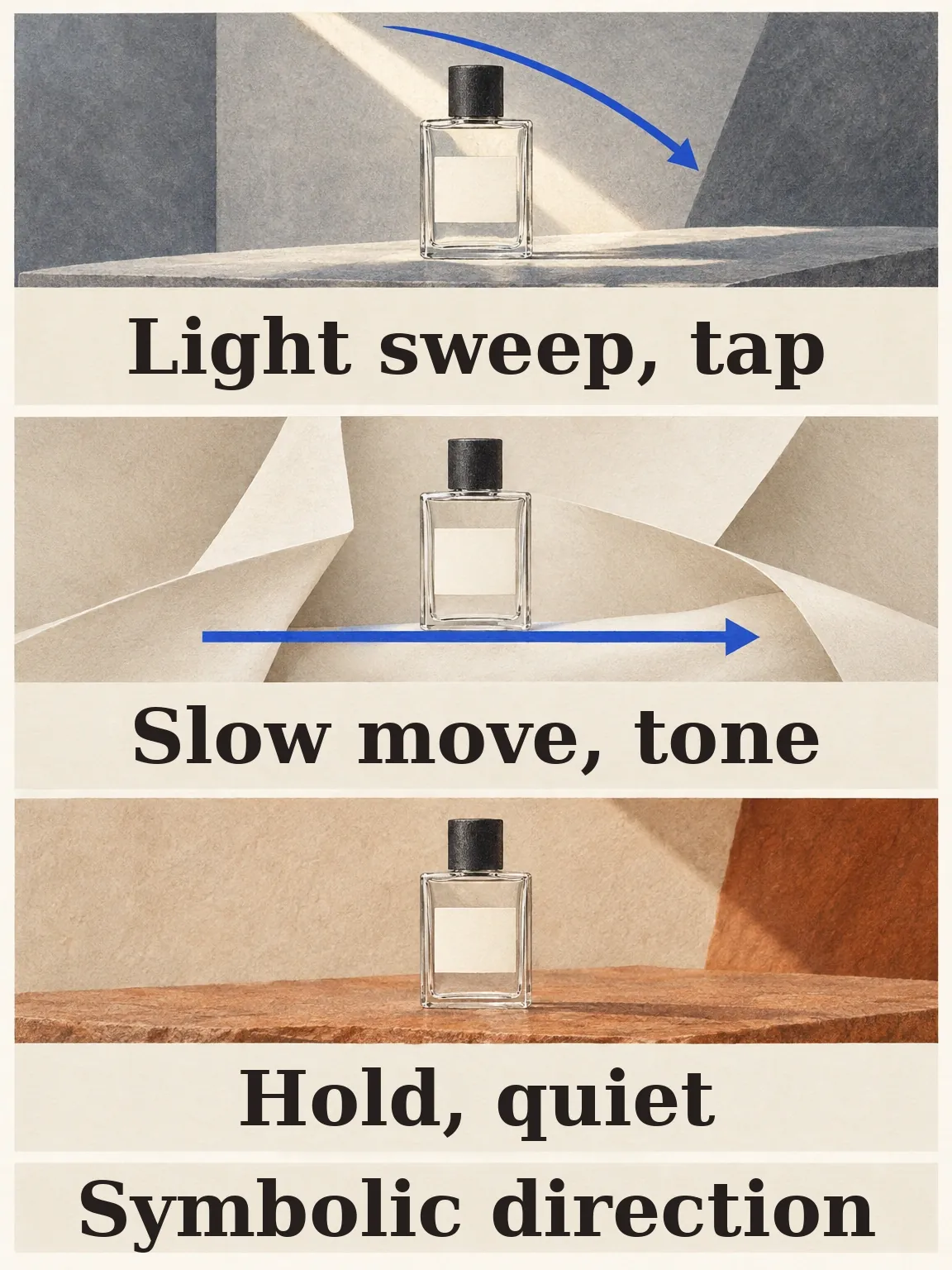
This fictional Stillwater No. 4 board pairs a light sweep with a tap, a slow move with a tone, and a held view with a quiet finish.
View full-size (opens in a new tab)Image explanation
- The fictional description gives bergamot brightness, a soft iris impression and a dry cedar finish. The board assigns a light sweep and tap, a slow lateral move and sustained tone, then a held view and quiet finish; cobalt arrows mark the first two proposed movements.
- These are creative choices, with no objective reproduction of smell or recorded fragrance sound. They supply no formulation, longevity, projection, sourcing or attraction facts.
- Keep the clear rectangular bottle, charcoal cap and ivory label fixed. A finished film needs actual approved label artwork, wording and liquid-appearance references. The board contains hypothetical direction rather than a produced perfume campaign or Fablo output.
Worked example: two directions for Stillwater No. 4
Imagine the fictional Stillwater No. 4 perfume. Its supplied description for this exercise is “bergamot brightness, a soft iris impression, and a dry cedar finish.” The assumed packaging reference is a clear rectangular bottle with a charcoal cap and an ivory label. These are illustrative inputs, not a produced fragrance campaign.
Direction one: Paper Light. Open on a pale green field crossed by a sharp ivory reflection. Introduce layered matte paper forms as the movement slows. Settle on a warm grey plane with the supplied bottle clearly visible. Sound moves from one light tap to a restrained sustained note. The ending names the perfume and repeats the approved description.
This direction uses no literal ingredient imagery. Paper softness is a metaphor for the supplied iris impression; it does not assert that paper is an ingredient or that the fragrance changes a person's skin.
Direction two: Courtyard Dusk. Use broad stone shapes, a cool green edge light, and a measured camera move toward the same bottle. A muted lavender shadow suggests the soft middle, while the final warm surface expresses the dry finish. A quiet, low musical texture gives this direction a more contemplative rhythm.
Both directions retain the same description and packaging. Neither shows raw materials pouring into the bottle, promises attraction, or claims exceptional wear. Choose between them for brand fit and clarity. The product-launch showcase supplies a proposed reference-led planning approach, rather than evidence that either Stillwater film has been made in Fablo.
Giving Paper Light a look
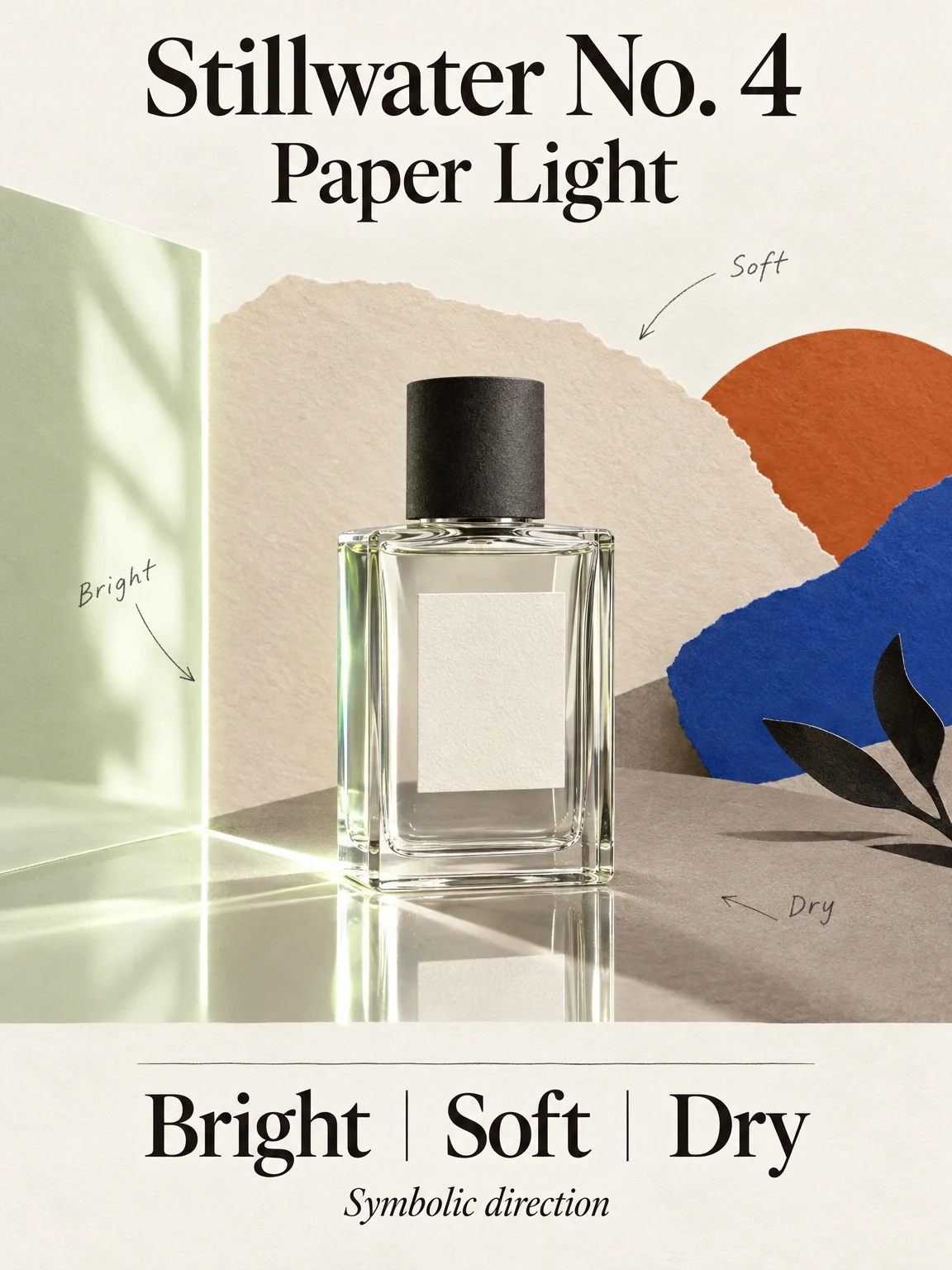
Light, paper and a settled surface give the fictional Stillwater No. 4 description a visual treatment. They suggest sensory associations.
View full-size (opens in a new tab)Image explanation
- Paper Light translates the fictional bergamot brightness, soft iris impression and dry cedar finish into light, paper and a settled surface.
- Keep the bottle and label intact. These associations supply no formulation ingredients, liquid colour or fragrance-performance facts.
Copy a scent-note direction board
Fill in the board before requesting media, with the original approved wording beside each translation.
Perfume name and description authority: [brand-approved source]
Leading impression: [one phrase from that description]
Note/phrase 1: [exact wording]
Translation: [palette → texture → movement → sound]
Note/phrase 2: [exact wording]
Translation: [supporting choices using the same visual vocabulary]
Note/phrase 3: [exact wording]
Translation: [how the film resolves]
Metaphor boundary: [symbolic scenery; no formulation inference]
Ingredient facts allowed in copy: [supplied facts, or none]
Literal product anchor: [bottle, cap, label, liquid references]
Protected packaging details: [exact features and artwork]
Sequence and target runtime: [opening → development → product]
Exact ending/action/destination: [approved wording and URL]
Excluded implications: [longevity, sourcing, attraction, other]
Create one selected film direction. Explain the production plan
and estimate first; let me review the complete assembled candidate.
Select for sensory coherence and product recognition
Check that the palette, movement, sound, and copy express the same supplied description. Follow the bottle through the assembled film, including transitions and the ending. The product still needs to be recognizable and the invitation readable, however evocative the scenery is.
Bring the board into the product-ad workflow and open Fablo to produce your selected perfume direction. Review the candidate in the production conversation, agree on any specific corrections, and make the final selection. For recurring launch films or seasonal treatments, compare the subscription options with the work you intend to commission.