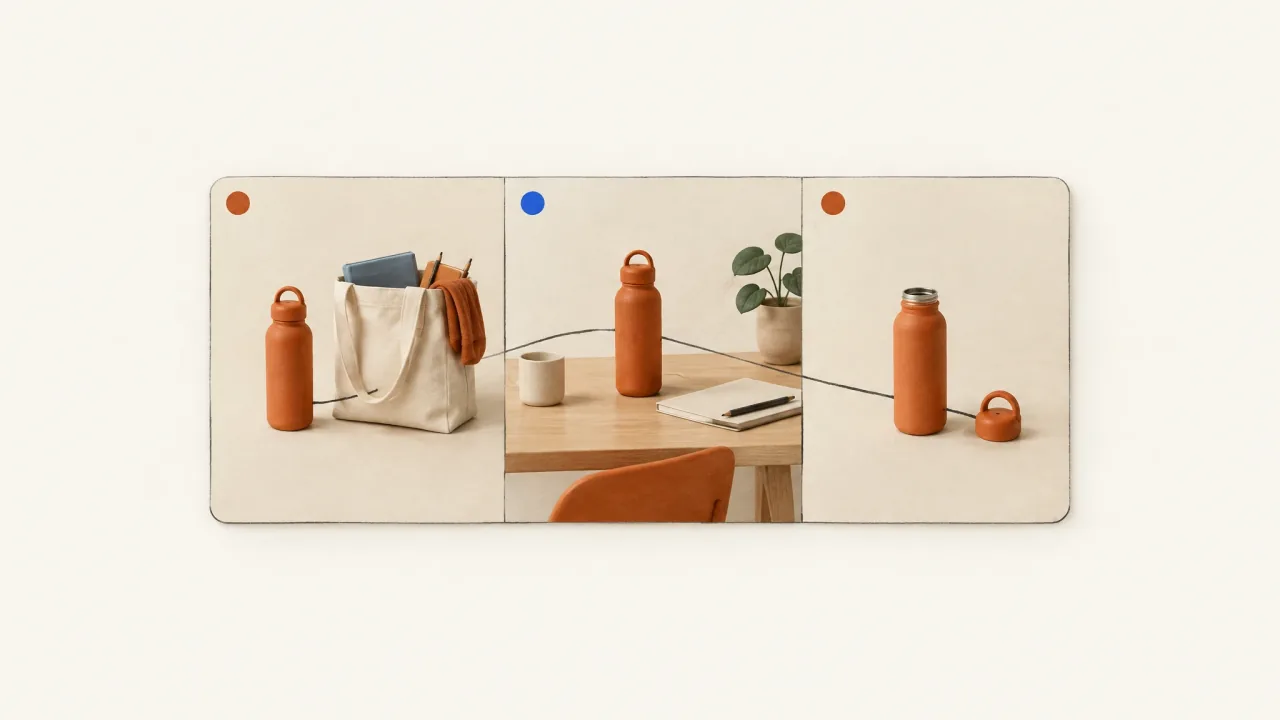
A lifestyle video places a product inside a plausible activity, such as getting ready, preparing a meal, packing a bag, or settling into a workspace. The setting and sequence show where it belongs. While an isolated demonstration concentrates on the object or mechanism, a lifestyle sequence connects that action to an everyday moment.
Start with one routine, one product interaction, and a visible exit. Give the viewer enough continuity to follow what happens; a presenter or invented customer story isn't necessary.
Define the product's role in the activity
Ask what the person does with the product here. “Enjoy a better morning” gives production a mood, while “Fill the bottle at the sink, close it, and carry it when leaving” supplies an action sequence they can plan.
Keep the sequence within approved usage facts. Calling a bottle refillable doesn't establish dishwasher safety, leak resistance, or suitability for hot drinks.
Use the creator-style versus studio-style guide to decide whether a speaker adds an explanation you need. For a simple routine, hands, objects, and clear transitions may be enough to tell the story without anyone addressing the camera.
Choose a moment small enough to finish
Choose a slice of time you can finish coherently. “A day in the life” can require many settings and explanations; “The last minute before leaving home” can have a clear beginning and end.
Base the scene on an approved use case, or label it as a creative idea. A tidy counter, canvas tote, and morning light can set the art direction, but they don't tell you who buys the product. Keep fictional preferences separate from researched customer behaviour.
For this example, use a fictional sand-coloured reusable bottle with an olive screw cap. Its defined use is filling with drinking water and carrying upright; capacity, insulation, and leak resistance are unspecified. The morning routine below is staged. It isn't a customer's journal, a genuine testimonial, or a completed Fablo video.
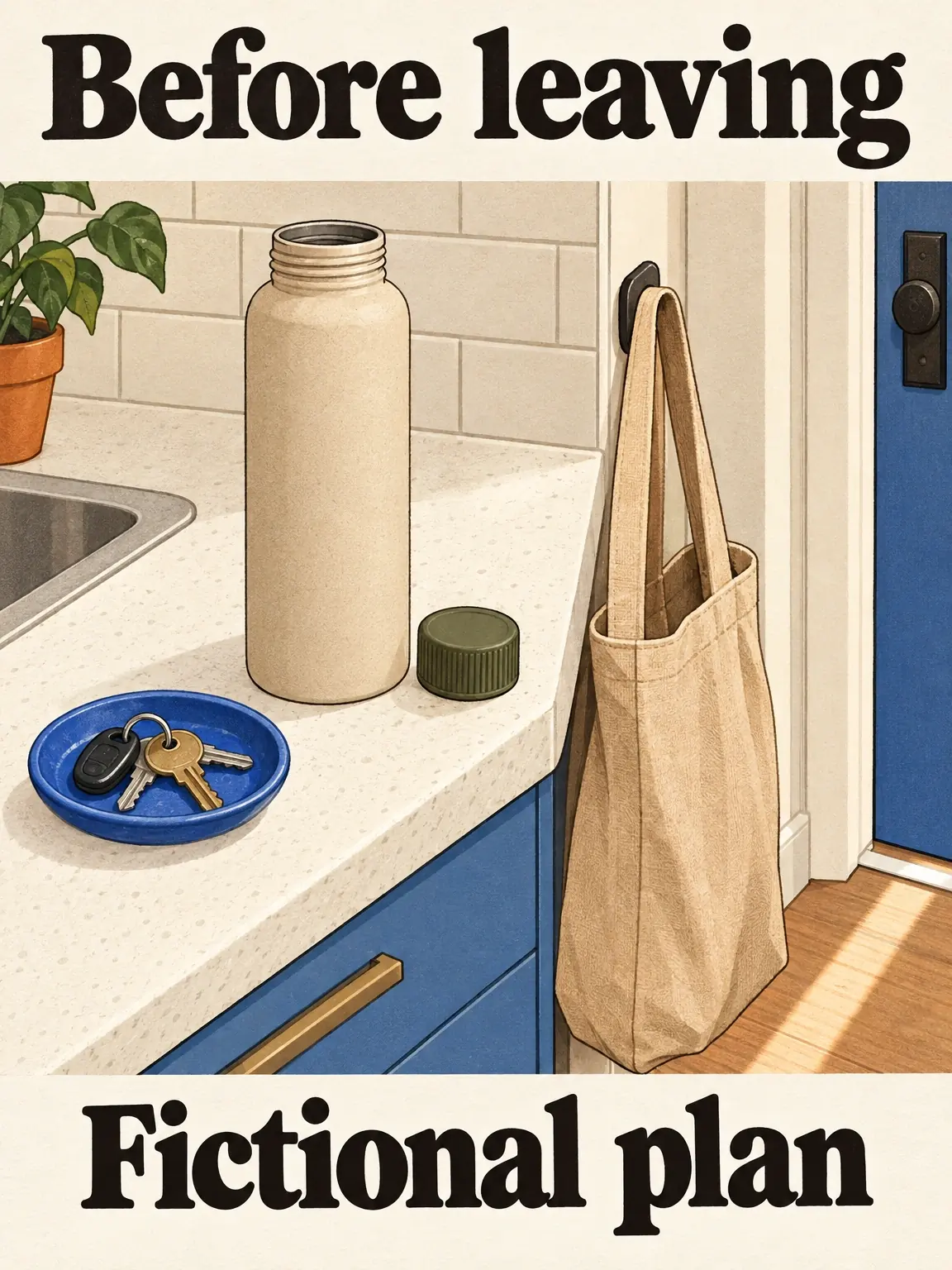
A routine small enough to fit one stage
A fictional leaving-home setup keeps the uncapped bottle, separate cap, tote and keys together by the kitchen doorway.
View full-size (opens in a new tab)Image explanation
- The kitchen close-up sets up one moment before leaving home, with an upright uncapped bottle, its separate olive cap, a tan tote and keys in a cobalt dish. Keep the routine to a coherent slice of time rather than an entire day of unrelated scenes.
- Filling with drinking water, visible closure and upright carrying still need approved references and produced coverage.
- This fictional still shows no completed interaction, customer behaviour or researched preference. It provides no evidence of leak resistance, insulation, capacity or health benefits, and is not a completed Fablo video.
Build an entry, interaction, and exit
Plan the entry so the interaction has a reason to happen, then use the exit to show how the product joins the next activity. For a short video, this could be a four-beat sequence:
Entry: the leaving-home setup. A tan tote hangs beside the counter; keys rest in a blue dish. The uncapped bottle stands at the sink with its olive cap beside it. Give the viewer a clear view of the bottle before moving to the detail shot.
Interaction: fill. Show the bottle receiving drinking water in a view supported by the approved product-use references. Keep this beat about preparation, leaving out any hot-drink demonstration or cleanliness claim.
Interaction: close. Show the cap returning to the bottle and closing according to the supplied design. If the brief calls for the closing action, keep the contact visible. Cutting from an open bottle to a closed one shows a state change, but leaves the closure action unseen.
Exit: take it along. The person lifts the tote and carries the bottle upright toward the doorway. Keep it upright so the scene doesn't imply a leak test. End with the approved product view or invitation, keeping unrelated imagery of an idealized life out of the sequence.
The proposed overlay “Fill it. Take it along.” describes the staged actions. Healthier habits, fewer missed trains, or a calmer morning would be promises this sequence can't support. For a real campaign, use the brand's approved wording and destination.
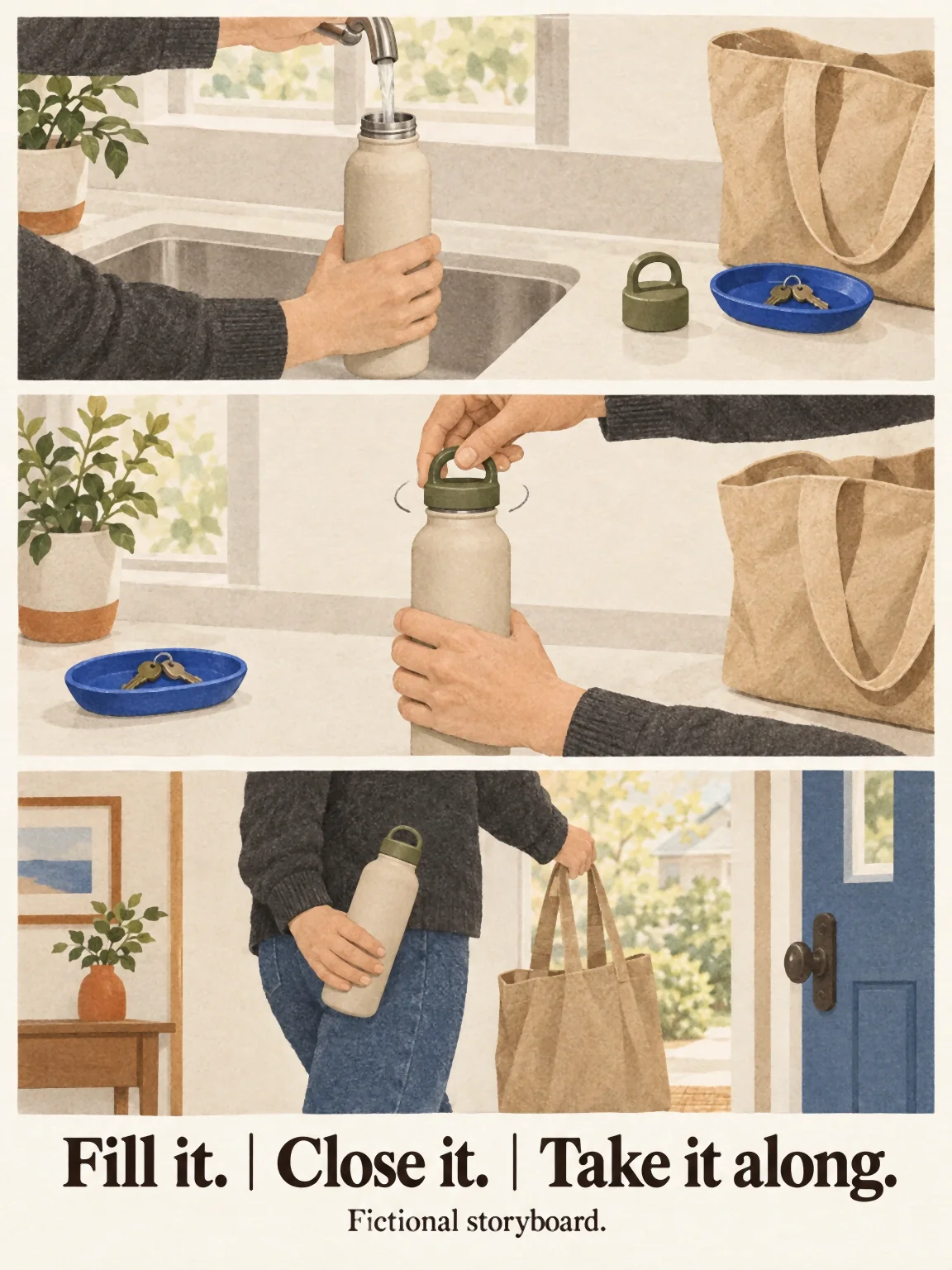
One ordinary routine, clear product states
The fictional bottle routine follows filling, closure and an upright exit. Its continuity explains the routine without promising a better life.
View full-size (opens in a new tab)Image explanation
- The staged routine fills the sand bottle with drinking water, closes the olive screw cap and carries the bottle upright.
- Keep the cap, sleeve, tote, key-dish and morning states consistent. The sequence supplies no leak, insulation, capacity or health claim.
Track the states that make the routine believable
Track objects as well as colour. The bottle starts uncapped with the cap on the counter. After closing, the cap should be on the bottle, and the filled bottle shouldn't return inexplicably to an empty preparation state during the exit.
Pick a few visible anchors and keep them stable:
- Bottle: sand body, olive cap, same supplied shape and label.
- Hands and clothing: the same person and charcoal sleeve where visible.
- Keys: remain in the blue dish until the exit requires them.
- Tote: starts beside the counter and is picked up once.
- Light and setting: one morning environment, without an unexplained jump to evening.
Keep the props that help explain the routine. With fewer objects to follow, the state changes are easier to inspect.
The proposed product-launch brief offers external references for coherent multi-scene direction. Use it to plan the sequence. It doesn't document this routine being made or guarantee exact continuity between scenes.
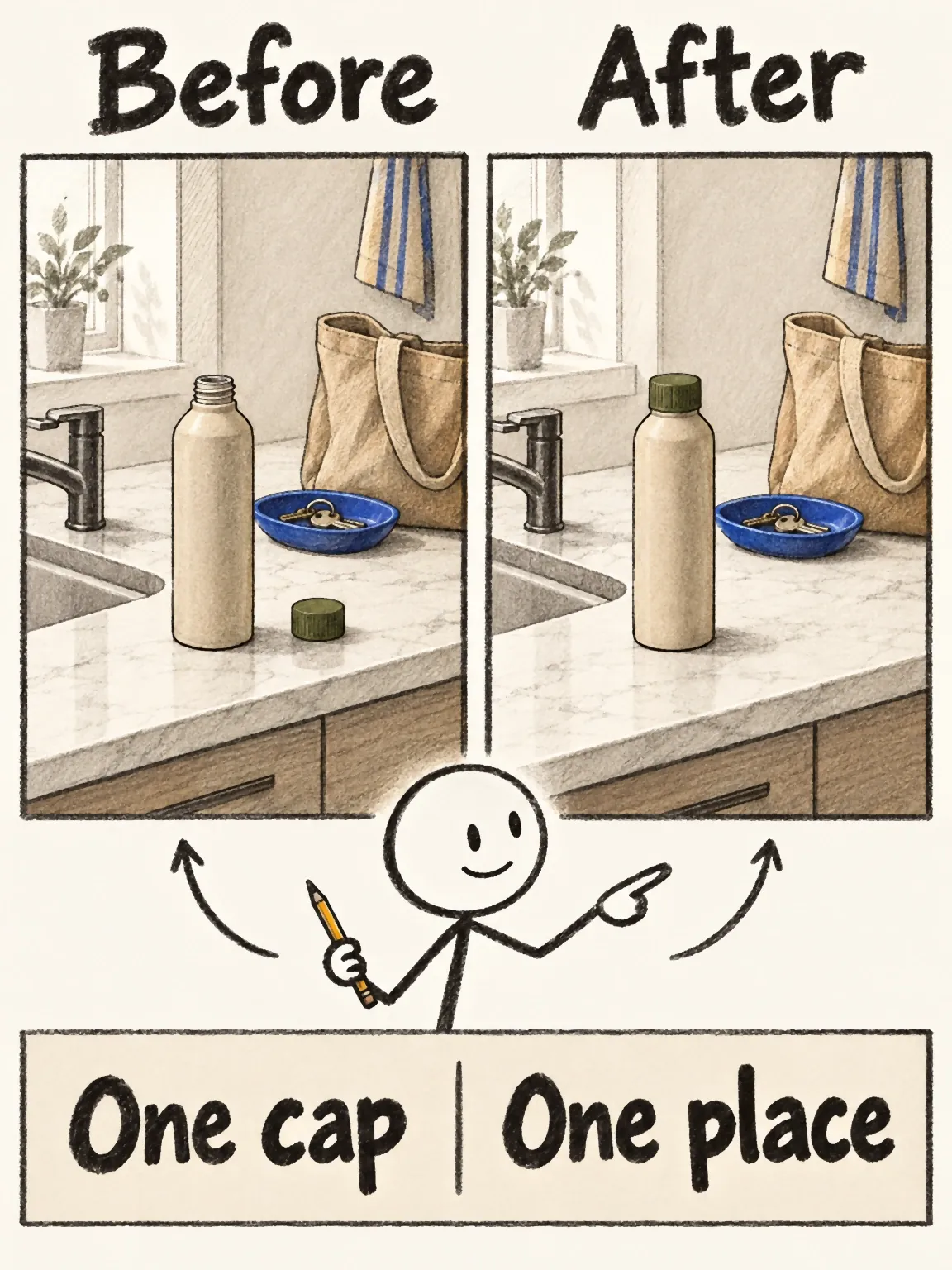
The cap has one place in each state
The fictional bottle's cap moves from the counter to the bottle. It should neither duplicate nor reset between states.
View full-size (opens in a new tab)Image explanation
- Before closing, the sand bottle is uncapped and the olive cap is on the counter.
- After closing, that same cap is on the bottle and no duplicate remains on the counter. State drawings leave the closure contact unproven.
Copy the routine timeline and scene brief
Replace the staged facts with your actual usage instructions. Attach genuine footage when the interaction needs to be shown faithfully.
Routine: The last minute before leaving home.
Basis: Staged creative hypothesis; not a customer account.
Product role: Prepare and carry the referenced reusable bottle.
Approved use: [actual instructions and supporting references]

Entry: Bottle uncapped at sink; cap nearby; tote and keys in place.
Fill: [source footage or requested illustration of approved action]
Close: Same cap and bottle; contact visible; cap leaves counter.
Exit: Person takes tote and carries bottle upright toward doorway.
Continuity anchors: Bottle variant, sleeve, tote, keys, morning light.
Exact copy: [approved lines; no invented personal experience]
Unshown properties: No leak test, heat suitability, or health outcome.
Invitation: [approved viewer action and actual destination]
Delivery request: [finished video; ratio, runtime, audio, text]
Review priority: Product role and state changes remain understandable.
Review the routine before adding more lifestyle scenes
Use the sound-off storytelling inspection to watch without narration or music. Can someone describe the product interaction and understand why it belongs between the entry and exit? If they only see attractive home imagery, make the interaction clearer before adding locations.
Check the state changes against the actual usage facts too. Let speech and music support the ordinary actions shown, without suggesting a dramatic improvement in the person's life.
Bring the timeline into the product-ad workflow and open Fablo to make a finished routine-based video through chat. Agree on the planned scenes and production estimate, then review the assembled candidate. For an ongoing series about product use, consult the current pricing information while planning the work each episode needs.