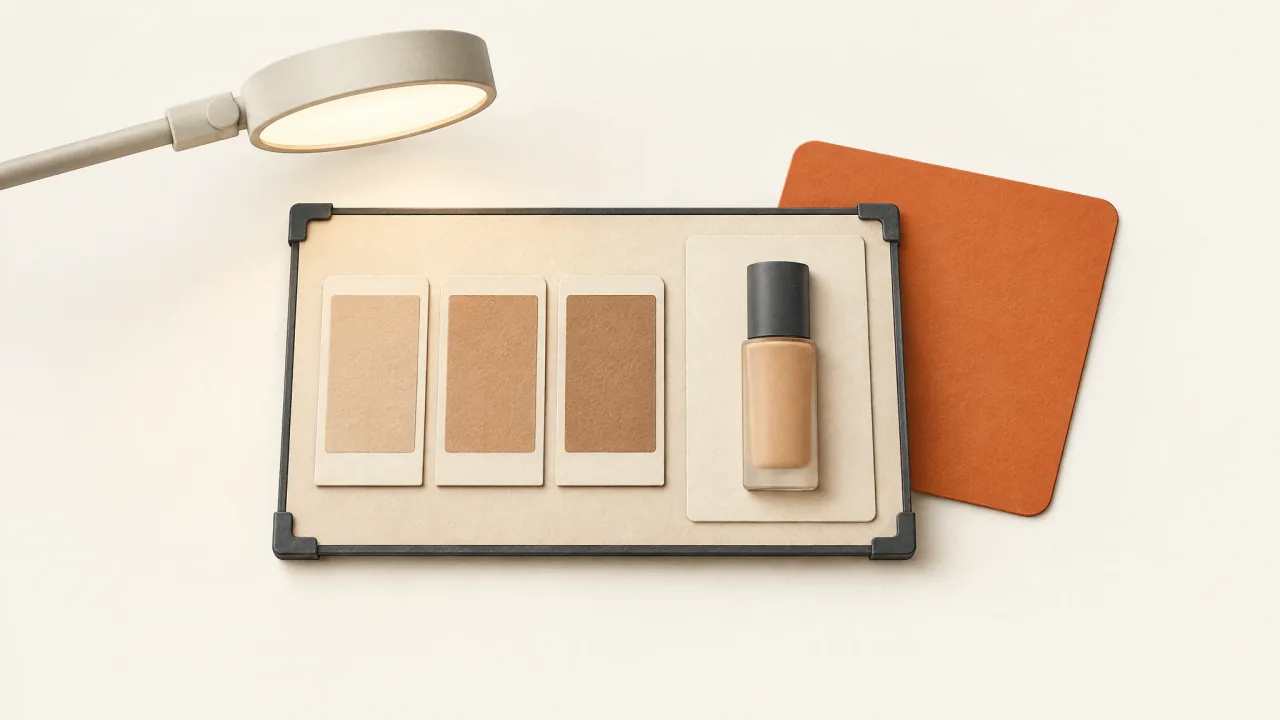
When a foundation ad asks viewers to judge shade or coverage, use genuine product swatches and actual application footage. Keep those source pixels separate from generated backgrounds, transitions, and decorative scenes. AI styling can give the presentation a distinctive look, but generated skin or swatches can't prove a shade match or demonstrate real coverage.
Write an evidence-and-treatment separation plan that tells production which material supports the product claim and which can be redesigned. Spell out the edits that would change what the evidence appears to show.
Decide what the viewer is being asked to judge
The viewing task determines the source material. A bottle against a sculptural background asks viewers to recognize a product; three labelled swatches ask them to compare colours. A skin close-up showing application needs footage they can use to evaluate coverage.
Write the viewing question in one sentence: “Compare these three supplied shades under the recorded lighting.” Keep it that specific instead of promising “Find your perfect match.” A real swatch recording captures a particular application under particular lighting. It can't establish how every viewer's skin will look or reproduce colour identically on every screen.
The FTC's advertising guidance explains that pictures, as well as words, contribute to express and implied claims. Look at what a smooth skin image seems to promise, even if the headline only names the foundation.
Assemble an evidence pack with identifiable sources
For each shade, collect the exact product name, shade code, approved reference image, and original swatch file. Record the surface or person shown and the capture lighting, along with any supplied notes about exposure, white balance, application amount, and editing. Keep the originals beside the approved working versions.
For coverage, request actual footage that shows the application clearly. Record the amount and method if they matter to the message. With an abrupt cut from bare skin to a polished finish, the viewer can't inspect the application. Ask for enough source footage to show it instead of generating the missing result.
Use the product-reference preparation guide to organize product identities and views. A shade chart made for graphic design may be approved as a label reference without being a colour-calibrated view of applied foundation. Note which job the chart can support.
Every shade label needs its exact source
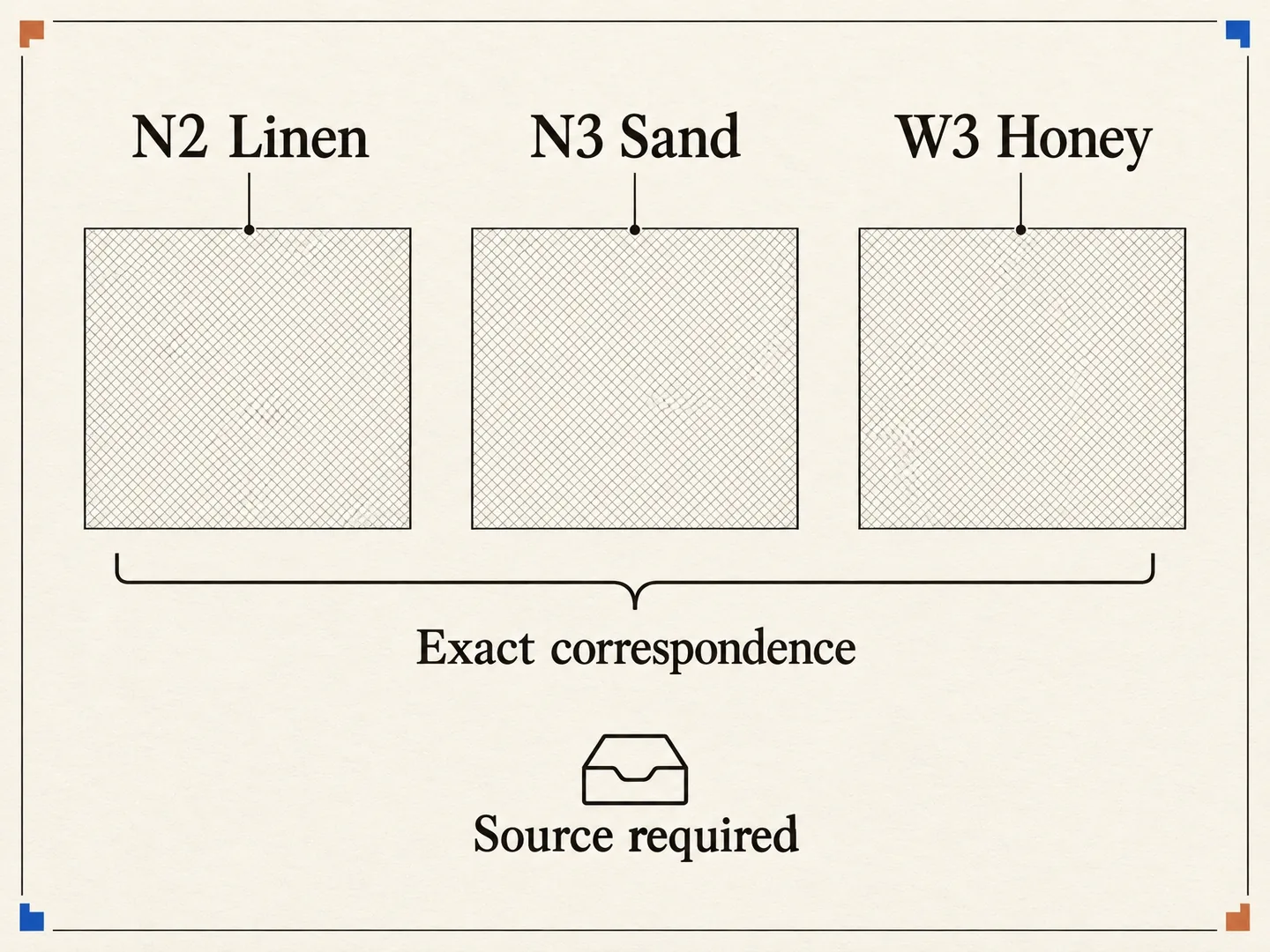
The fictional Morrow Base brief reserves a genuine source for each shade. The empty panels leave that evidence to be supplied.
View full-size (opens in a new tab)Image explanation
- The fictional Morrow Base exercise names N2 Linen, N3 Sand and W3 Honey. Each needs its own genuine source and correct label correspondence.
- Retain the originals and capture conditions. Generated colour placeholders supply no evidence of shade appearance or personal match.
Protect evidence while allowing a designed frame
Mark a protected region around the swatch or application material. Protect it from generative skin replacement, colour shifts to harmonize it with the background, beauty smoothing, and reconstructed coverage. Use the exact supplied shade labels as text; don't ask image generation to invent the lettering.
Use the surroundings for the brand mood: a paper border, an abstract stage, a separate package shot, or a transition between evidence panels. Keep coloured light and decorative overlays off the material the viewer is judging.
Confirm edits that could change the explanation. Cropping may hide where application begins, a contrast adjustment may alter apparent coverage, and a loop may make one application look like several passes. Name each allowed edit and its purpose instead of approving a general “enhancement”. Use the product-fidelity ledger to locate a mismatch and compare it with its source.
Design the frame, protect the evidence
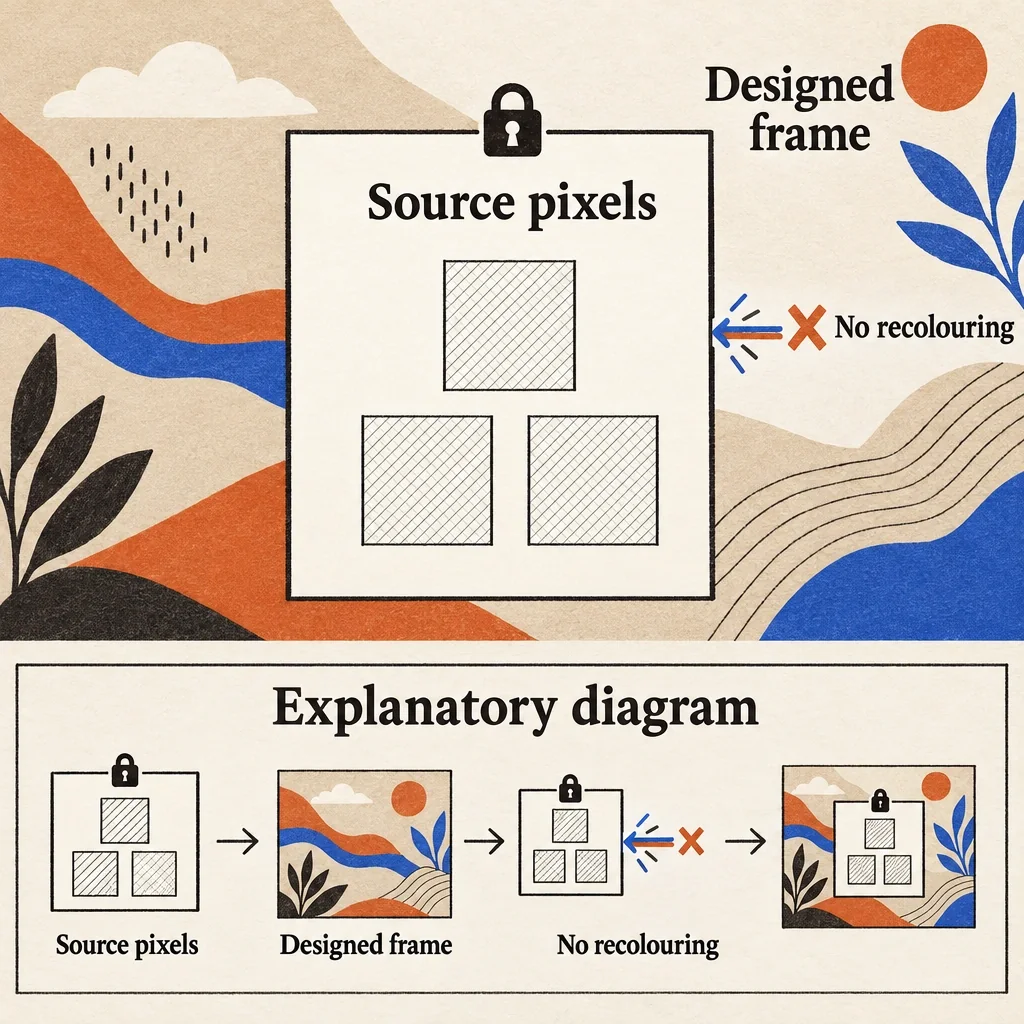
The empty panel reserves genuine shade and application material. Style the surrounding frame while leaving that evidence intact.
View full-size (opens in a new tab)Image explanation
- Keep genuine swatch or application pixels in the protected panel, with their source labels and capture context.
- The diagram contains empty placeholders. When real evidence is supplied, leave its colour and skin texture unchanged and keep coloured light from spilling across it. Never generate replacement skin for that panel.
Worked example: a three-shade card becomes a short video
For the fictional Morrow Base range, use N2 Linen, N3 Sand, and W3 Honey. Assume the brand supplies one controlled swatch card, its original capture, exact shade names, bottle photographs, and an unretouched application recording for N3 Sand. This is an illustrative plan; no media has been produced for the example.
Put the three genuine swatches together on the static card, with each exact name beside its sample. Use a neutral border and separate bottle image for the campaign identity. The headline reads “Compare three Morrow Base shades.” Keep it to that comparison; it can't identify a viewer's undertone or claim a match.
Begin the proposed short video with the same card, then show a selected passage from the actual N3 Sand application recording. Label it with the shade and supplied capture context. Return to the labelled swatches and approved product reference at the end, keeping decorative motion outside the evidence panels.
If the recording can't support the intended coverage message, leave that message out and keep the shade comparison. The product-campaign-pack showcase suggests how to organize companion assets. Use its directions for planning; they don't show finished Fablo foundation examples.
Copy the evidence-and-treatment separation plan
Complete one evidence entry for each swatch or application passage. Attach the files named in the plan.
Product/range and exact shades: [approved names and codes]
Viewer's judging task: [shade comparison / recorded coverage]
Evidence source: [original file, version, permission]
Capture context: [lighting, surface/person, amount and method]
What it establishes: [the narrow recorded observation]
What remains unestablished: [personal match, wear, other outcomes]
Protected region: [swatch/skin/application area]
Allowed edits: [specific trim, crop or label placement]
Excluded edits: [recolouring, smoothing, generated replacement]
Exact labels: [shade-to-source correspondence]
Generated treatment: [separate background or decorative scenes]
Video sequence: [source card → evidence passage → ending]
Approved viewer action and destination: [wording and URL]
Review: [compare each evidence panel with its source]
Production request: assemble one candidate; explain scope and
estimate before paid work; retain originals for my final review.
Review the delivered evidence, then the complete ad
Compare each exported panel with its original. Check that the shades and labels match, look for visible colour changes or skin retouching, and inspect application continuity. Make sure the source context is still readable. Then watch the whole sequence: does a decorative transition suggest a result the real footage never showed?
Bring the plan into the product-ad workflow and open Fablo to assemble your genuine shade evidence into a finished creative. Plan, evaluate, and scope corrections around protecting that evidence, then make your final selection. For recurring shade launches and collection updates, compare the subscription options with the work each production request needs.