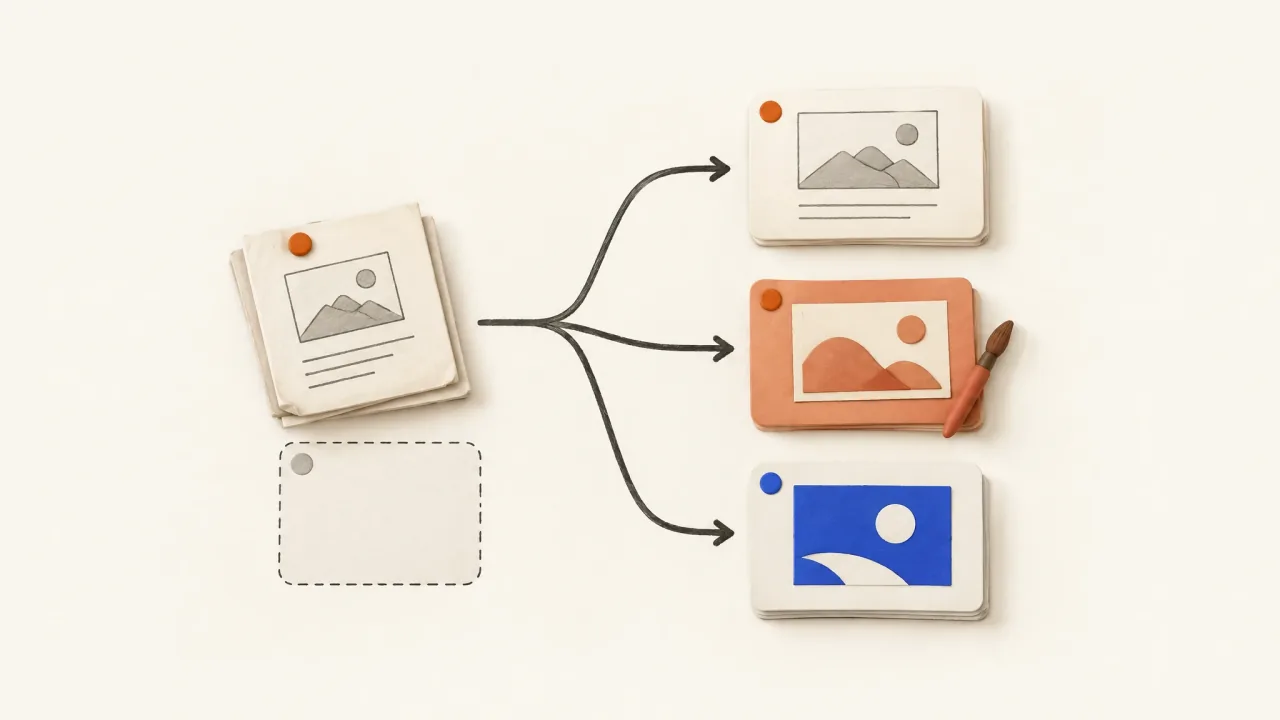
Before commissioning a refresh, name the communication problem you think it will solve. Rising frequency alone won't tell you whether the audience is saturated, the message is repetitive, or something else has changed in the campaign.
Sometimes the useful decision is "collect more context" or "no creative change yet." Ask what new production would address before commissioning another batch of videos in response to a disappointing report.
Separate two hypotheses before choosing a remedy
Audience saturation means you suspect the available audience has already had substantial exposure to the campaign. To investigate, you'll need campaign-side information about delivery and audience composition. Changing the colour palette won't tell you whether a different group of people will see the ad.
Repetitive creative means you suspect the ads keep making the same argument in substantially the same way. You can inspect this directly. Write down the argument and demonstration in each current asset, leaving out descriptions of its style.
Both problems can occur together. But an offer change, a broken destination, or a shift in delivery can also be mistaken for fatigue. Use the concept-versus-variant audit to describe the creative set accurately before attributing a campaign trend to it.
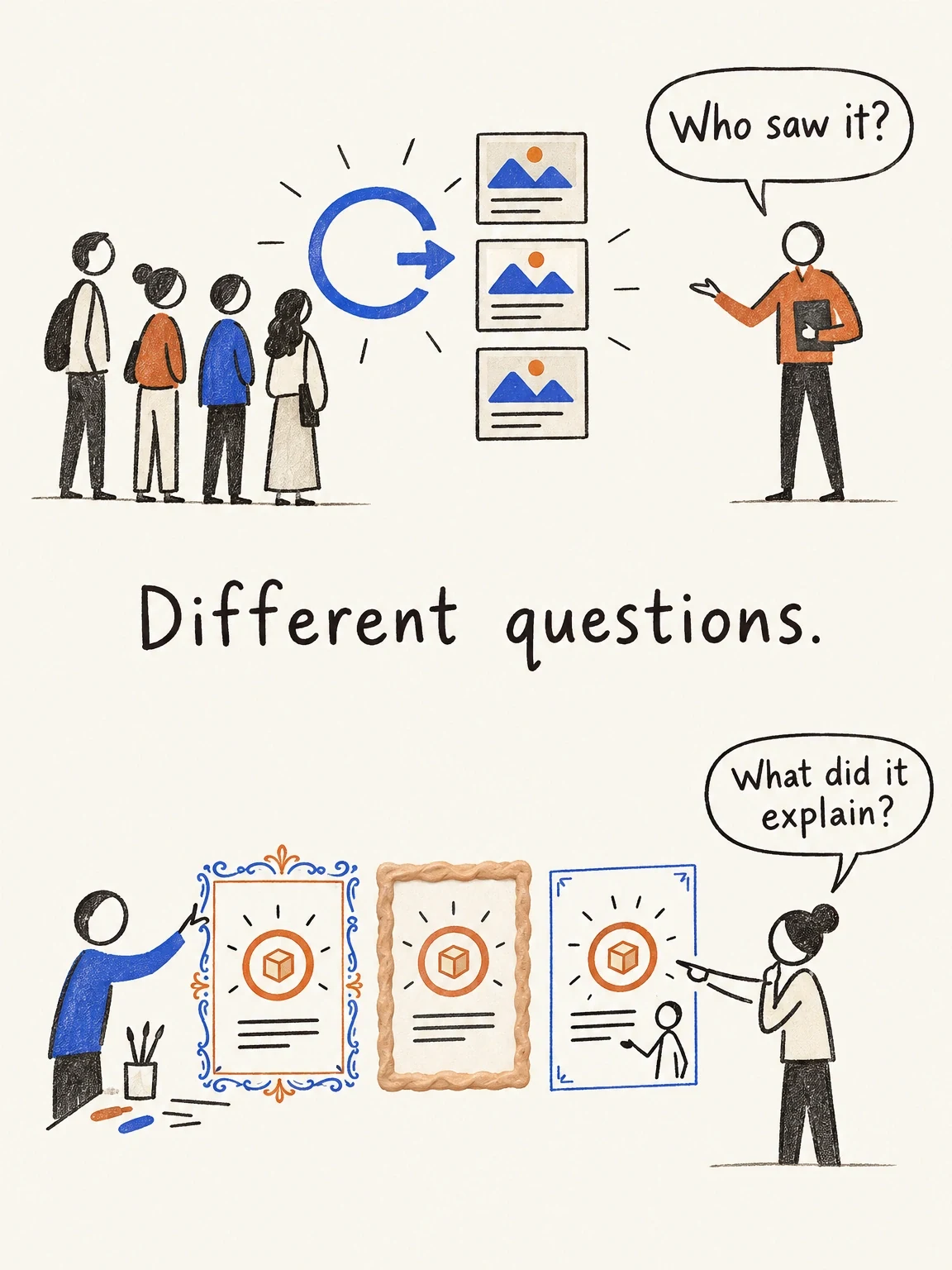
Two different fatigue questions
Repeated exposure and repeated creative arguments need separate checks. Changing the look of an ad cannot tell you whether its audience is saturated.
View full-size (opens in a new tab)Image explanation
- Exposure and audience composition need campaign context. Repeated creative arguments can be checked in the ads themselves.
- Rising frequency alone cannot diagnose either problem, and a fresh visual treatment cannot establish the right remedy for audience saturation.
Gather context that changes the production decision
Ask the campaign owner which outcome deteriorated and get the reporting period, objective, exact assets, and exposure information. Record when each creative entered delivery. Check whether the offer, destination, audience settings, or budget changed during the comparison.
Keep the metric definitions with the report. Google's reach and frequency documentation, for example, lists average exposure and frequency distribution separately. An average can't describe every individual's experience. Reports from another platform need that platform's definitions.
Inspect the ads alongside the report. Three filenames may all lead to the same repeated scene, while a familiar product ending can appear after several genuinely different arguments. Collect both asset history and campaign history so you can see what changed in each.
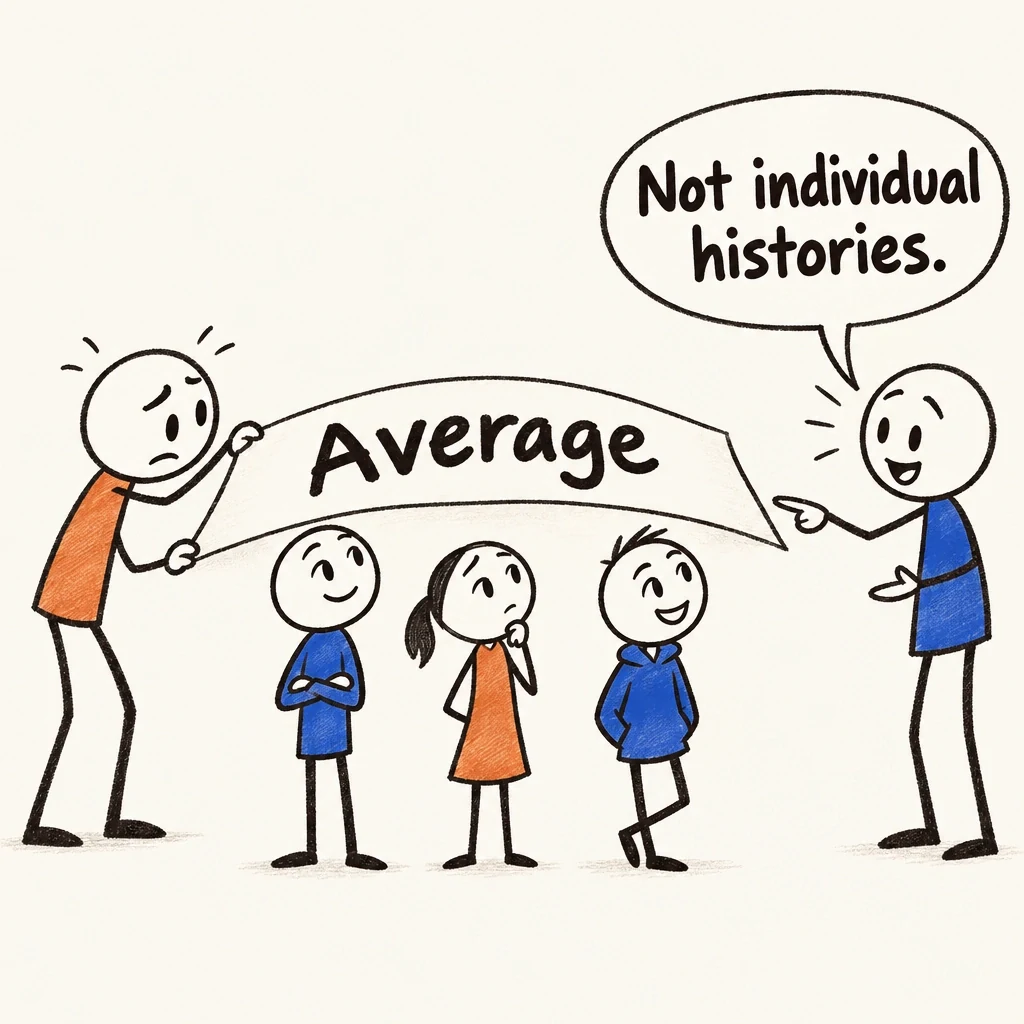
One average cannot dress everyone
The average fits neatly on paper. Individual exposure histories still need their own information, and a changed response still needs campaign context.
View full-size (opens in a new tab)Image explanation
- The article's Google reach-and-frequency documentation, checked October 8, 2026, treats average exposure and frequency distribution as separate measures. Use another platform's own definitions for its reports.
- Gather the reporting period, exact assets, delivery history and changes to the offer, destination, audience settings and budget before choosing production work.
- The sheet and people are a cartoon about aggregation. They contain no campaign data or exposure pattern, and an average alone cannot diagnose fatigue or explain a changed response. Inspecting ads answers a different question from reading the report.
Copy this diagnosis-to-production decision tree
Work through the tree with the campaign owner and keep the evidence behind the chosen branch. It helps route the next decision; it can't diagnose fatigue by formula.
REFRESH DECISION
Report period and exact asset versions: [attach]
Observed concern: [state the supplied change, without its assumed cause]

1. Are reporting context and asset history sufficient?
   NO -> INSUFFICIENT EVIDENCE: request the missing context.

2. Did the offer, destination, delivery, or measurement change?
   YES -> Campaign owner investigates those changes first.
          NO CREATIVE CHANGE YET unless a separate defect is visible.

3. Can we identify a specific communication problem in the ads?
   NO -> Keep the current creative pending campaign-side review.
   YES -> Name it: [repeated argument / unclear demo / stale treatment].

4. What production change addresses that problem?
   Repeated argument -> Brief a different supported buying question.
   Unclear demo -> Replace the explanatory view or sequence.
   Stale treatment -> Retain the argument; request a new expression.

Decision, supporting evidence, owner: [record]
What remains uncertain: [record separately]
A "Stale treatment" decision should name the repeated opening, delivery, setting, or pacing you want to change. Calling it fatigue doesn't tell a producer what to do.
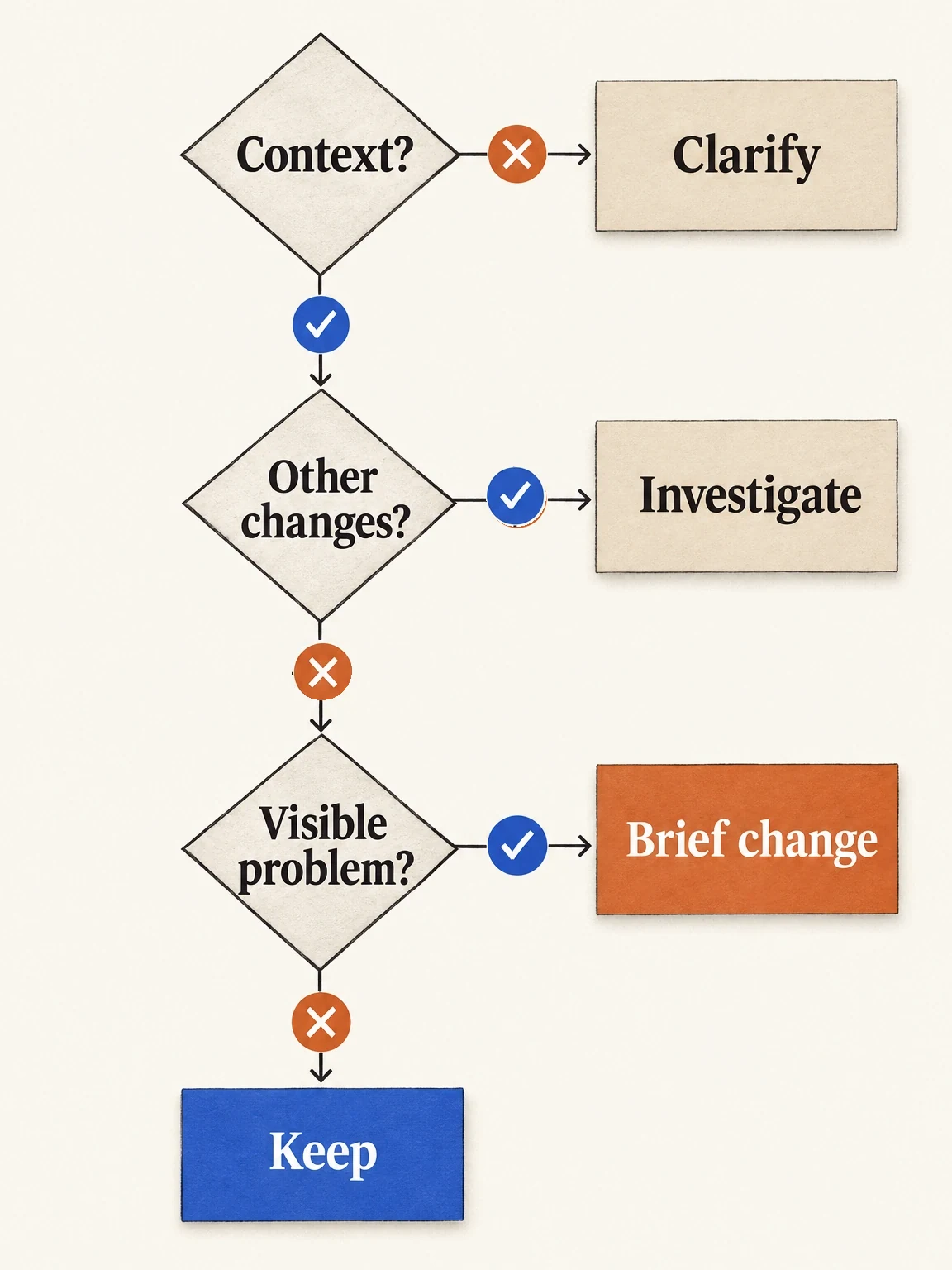
A refresh can end with no render
A refresh decision can lead to clarification, campaign investigation or keeping the current creative. Another render needs a reason.
View full-size (opens in a new tab)Image explanation
- Clarify insufficient reporting context and asset history first. Investigate changes to the offer, destination, delivery or measurement before commissioning creative.
- With adequate context and no confounding change, brief production for a visible communication problem. Otherwise, keep the creative pending campaign review.
- Circled ticks mean yes and circled crosses mean no. The tree routes work; it leaves the cause of declining results undiagnosed.
Worked decision: a basket shown only in kitchens
For a documentation example, consider IKEA's RISATORP basket. Its official product page, checked October 8, 2026, describes storage uses in a hallway, bedroom, or home office as well as produce storage. Those documented uses give an ad something else to explain without inventing a capability.
Imagine the campaign owner writes: "Exposure has increased and response has weakened." For this exercise, suppose every current video opens on fruit in the same kitchen composition. The note and videos are illustrative; no real campaign results or Fablo outputs have been supplied.
The incomplete report belongs under "insufficient evidence." The asset inspection does reveal something useful, though: the videos explain the basket only as kitchen storage. If the owner wants to show another documented use, a home-office concept is reasonable to explore. That choice broadens the explanation. It doesn't establish why response declined.
If the owner also reports a broken destination, investigate it before commissioning a refresh. And if the videos already cover several use contexts, the kitchen-only explanation no longer fits. The same symptom can lead to different decisions once you have more context.
Commission the change that survived the decision
Use the result-to-production brief to carry the supplied observation, remaining uncertainty, and selected change into the request. Keep it with the actual asset version so the next producer can understand why you commissioned the refresh.
In the illustrative basket case, request one home-office concept. Show the same recognizable basket with stationery stored inside, then end with the approved action. Leave out any carrying capacity, organization outcome, or customer quotation you can't support.
The new concept explains another use. Repainting the kitchen scene would keep the original argument. Use the creative-testing production matrix to scope the selected asset without expanding it into every possible treatment.
If the argument should stay fixed and only its expression needs to change, use the proposed change-and-preserve structure in the winner-remix showcase brief. Its references are external. The brief doesn't document a completed Fablo refresh or a campaign winner.
Judge the refresh against its assigned job
Before handing the asset back to the campaign owner, check that the new use is understandable, the product remains recognizable, and the offer is accurate. This tells you whether it fits the brief. You'll need to interpret campaign results separately after delivery.
Bring the decision and approved references into the creative-variations workflow. Fablo can develop the scenes and produce a candidate. Checks of the assembled video can guide targeted corrections before you make the final selection.
Once you have a reason for new work, open Fablo with your refresh request. If you expect to refresh creative regularly, review current plans and pricing against the production scope you need.