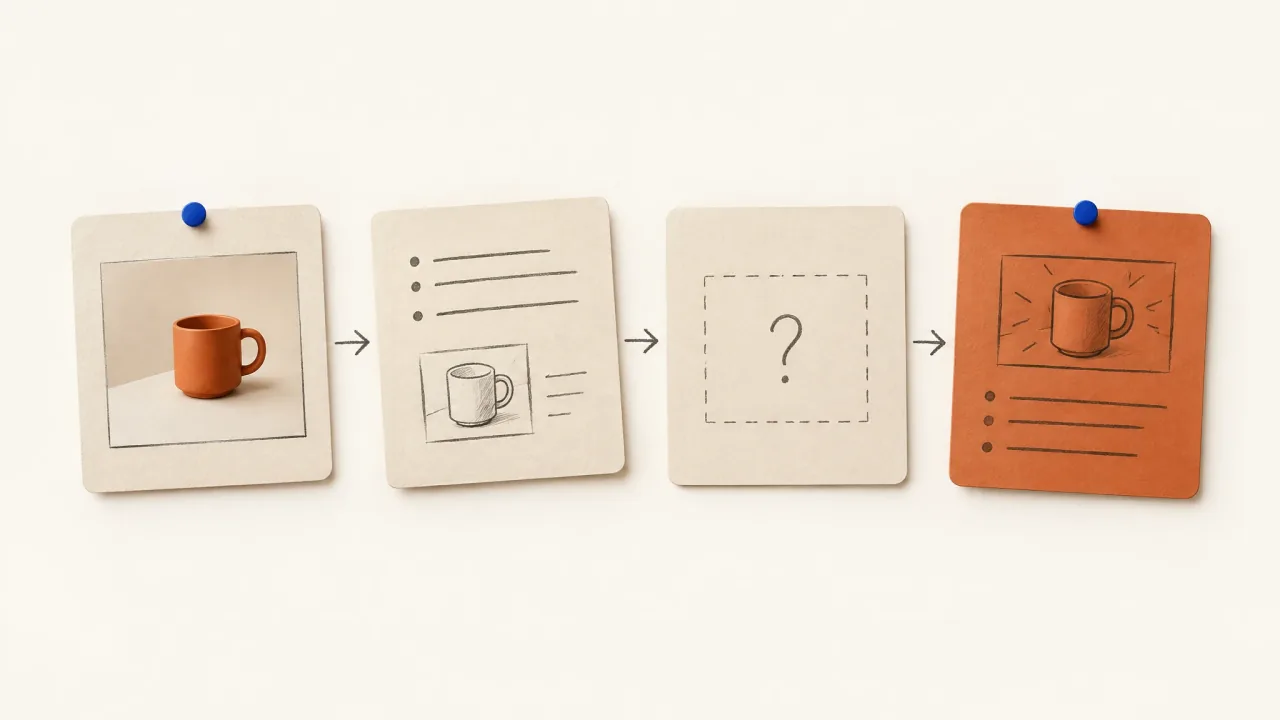
Record the supplied observation and its limits, then choose the smallest creative change that addresses a useful question. More clicks alone won't justify copying an ad's opening or calling it a winner.
You may need clarification before another render. When the findings justify production, explain what changes, what stays fixed, and how the new asset follows from those findings.
Identify the actual asset before interpreting the result
Match each reporting label to the exact exported file, version, and destination. Inspect what was delivered as well as the original brief. Rewritten captions or a changed offer can turn an apparent opening comparison into a broader creative comparison.
Use the creative-test asset manifest to trace those files. Record the intended difference and any additional changes that survived production.
Name what you're comparing: complete concepts, openings attached to one body, presenter deliveries, or format adaptations. Two complete concepts may differ in background colour, but their results can't isolate that colour's effect just because it's the most visible difference.
Write the result without its assumed explanation
Write three separate statements:
- Observation: what the supplied report shows, for a stated period and metric.
- Interpretation: a possible reason for that observation.
- Production consequence: what you now want a creative asset to explain differently.
Ask the campaign owner about exposure, spend, delivery conditions, attribution, and changes to the offer or destination. Those details affect how much weight the comparison can bear. Record missing context so the next reader can see the limits.
NIST's experimental-design guide separates objectives, variables, and design selection. Preserving the commercial message helps define what you want to compare. A controlled campaign experiment also depends on its design; production consistency alone can't create one.
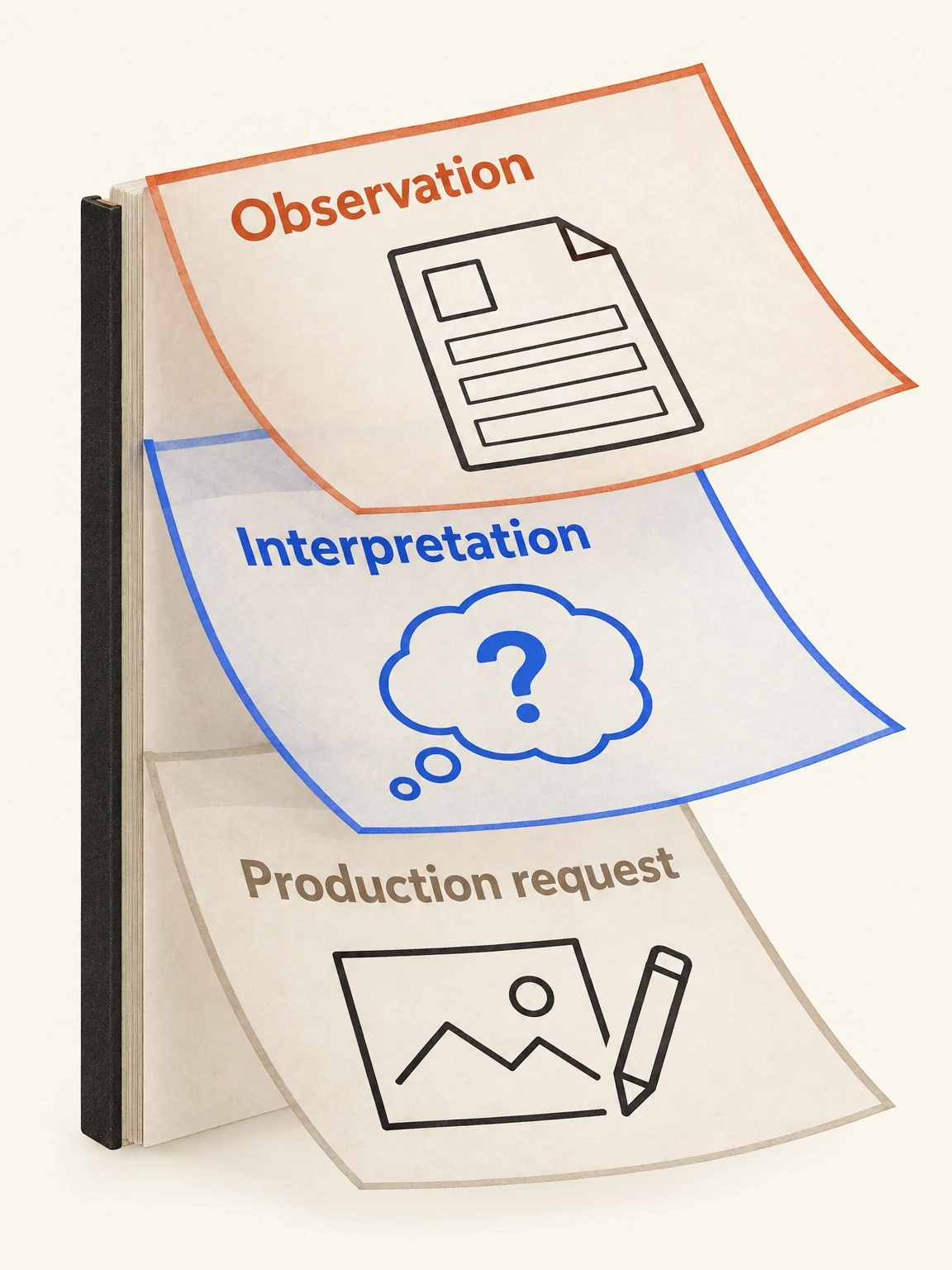
Peel apart the observation, interpretation and request
What the report shows, what might explain it and what to change next belong in separate statements.
View full-size (opens in a new tab)Image explanation
- The observation names the supplied metric, reporting period and source. Interpretation offers a possible explanation. A justified production request names what the next asset should explain differently.
- Retain the campaign context: exposure, spend, delivery, attribution and changes to the offer or destination. Missing information can call for clarification or no new creative yet.
- Keeping a commercial message fixed supports a defined comparison, but a controlled campaign experiment needs more. The blank layers contain no result readout or Fablo analytics view.
Worked readout: more clicks, fewer recorded purchases
Consider an illustrative creative exercise using IKEA's PÄRKLA storage case. Its official product description, checked October 8, 2026, says the case stores seasonal clothes or extra duvets and pillows, and folds into a flat package when empty. That supports an explanation of its two states.
Imagine two proposed source ads. A opens on the case in a wardrobe. B opens on the empty, folded case before showing it open. Both are intended to lead into the same storage explanation and ending.
The supplied note might read: “B had a higher link click-through rate, but fewer recorded purchases.” It omits the reporting window, spend, attribution details, and delivery comparison. The exercise uses constructed observations, with no actual campaign or Fablo results behind them.
“People love the folding feature” is a possible interpretation. Different exposure, chance variation, or a changed destination could also explain the observation. The note leaves you unable to establish which asset better served the campaign objective.
First, clarify the comparison and verify both files. The product fact still gives you a separate creative question: can a clearer open-to-flat explanation make the case's storage-between-uses function understandable?
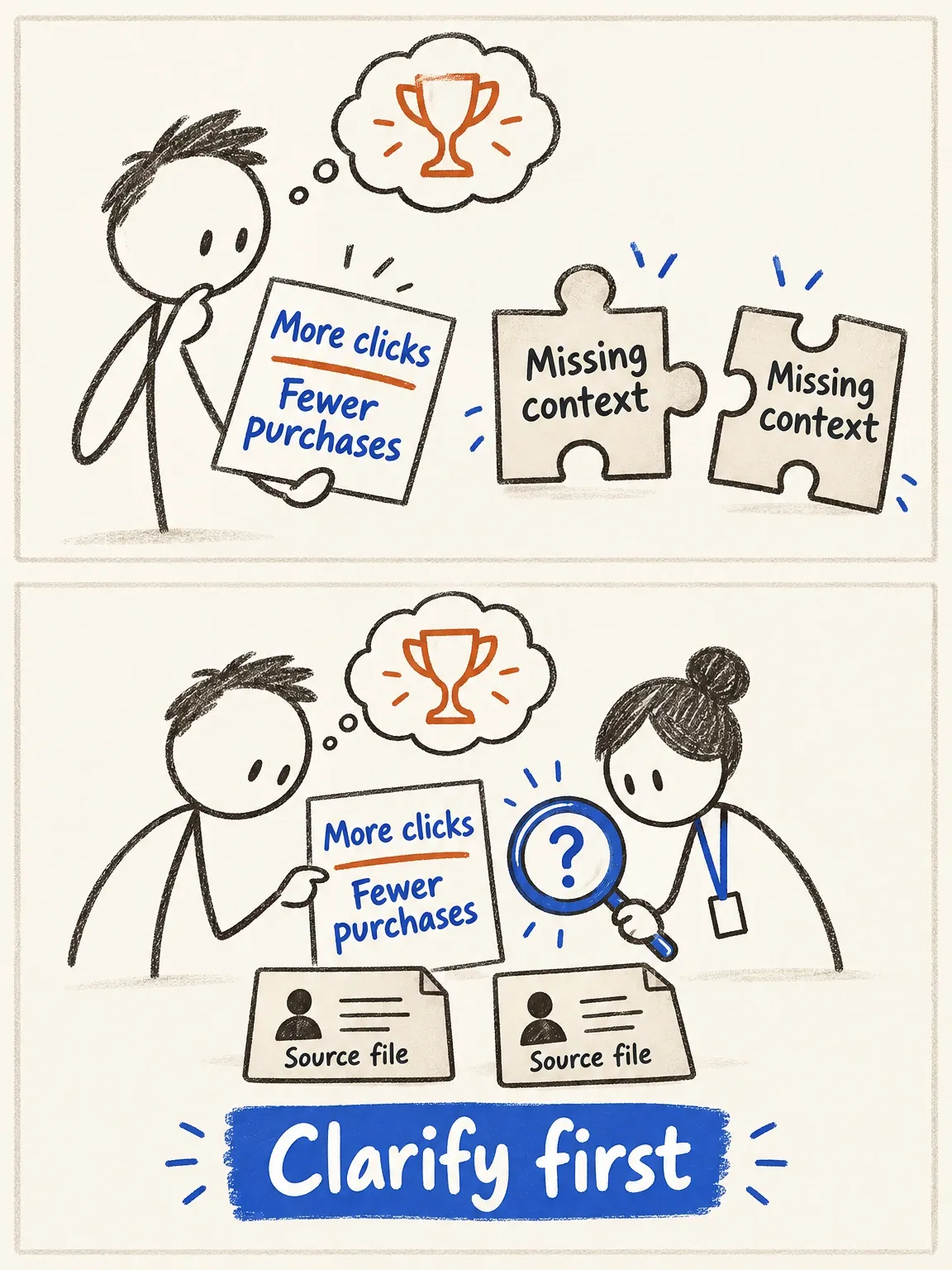
A note is not a verdict
The comic uses a separate click-count example. The article's higher click-through rate does not establish more total clicks. Both examples need context before anyone names a winner.
View full-size (opens in a new tab)Image explanation
- This hypothetical comic reports more clicks and fewer recorded purchases, with reporting and delivery context missing. The article's worked example reports a higher link click-through rate, which does not establish more total clicks without impression counts.
- Verify the exact files and clarify that context before naming a winner or assigning a cause. A separate communication question may still justify new work.
Choose clarification or one new commission
If the reported difference is your only reason for new work, get the missing context first. Keep the accepted files available while the campaign owner evaluates the readout. The decision can be “No new creative yet”.
If the owner independently identifies a communication gap, commission a candidate to address it. For the case example, request a recognizable open-state view, genuine footage of the empty case being folded, and a clear flat-state ending.
Keep the case empty during the folding action, as the source fact requires. Depicting it collapsing around clothes would change that fact. Use authorized footage of the real folding action; generated styling around it can't prove the action occurred.
Preserve the approved body, offer, destination, language, and requested delivery format wherever the new sequence permits. If it needs a longer body explanation, record the wider scope and remove the opening-only label.
Use the production matrix to scope the next packet once you've made this decision. The winner-remix showcase brief proposes a change-and-preserve approach using external references. Its name supplies no evidence of your source ad's performance.
Copy this observation-to-production card
Keep this card with the new commission so the next reviewer can see why you requested it and what remains uncertain.
RESULT-TO-BRIEF CARD
Source assets: [exact files, versions, destinations]
Compared unit: [concept / opening / delivery / format]
Supplied observation: [metric; direction; period; source]
Known campaign context: [conditions supplied by the owner]
Missing context: [questions still unresolved]
Possible explanations: [hypotheses, separate from findings]
What the result does not establish: [causal or performance limits]

Decision: [clarify first / no creative change / one new commission]
Production consequence: [the communication question to address]
Requested change: [specific scene, line, or sequence]
Preserve: [exact body, facts, offer, destination, delivery]
Evidence required: [approved facts and authorized source material]
Scope exception: [unavoidable related changes to disclose]
Acceptance condition: [what the returned video must communicate]
Campaign evaluation owner: [who interprets the next result]
For the storage case, accept the video when a viewer can distinguish the open storage state from the empty folded state. Any improvement in click-through rate or purchases remains unproven.
Carry the reasoning into the production conversation
Supply the card, source files, product references, and selected request through the creative-variations workflow. Fablo uses the context you provide to plan, produce, evaluate, correct, and assemble a candidate for your selection.
Supply campaign findings with their context. Include that context again in a new conversation, and update the manifest when an accepted revision creates a new file.
When the card supports a clear commission, open Fablo with your findings and next request. For an ongoing testing-to-production cycle, review current plans and pricing against the work you intend to authorize.