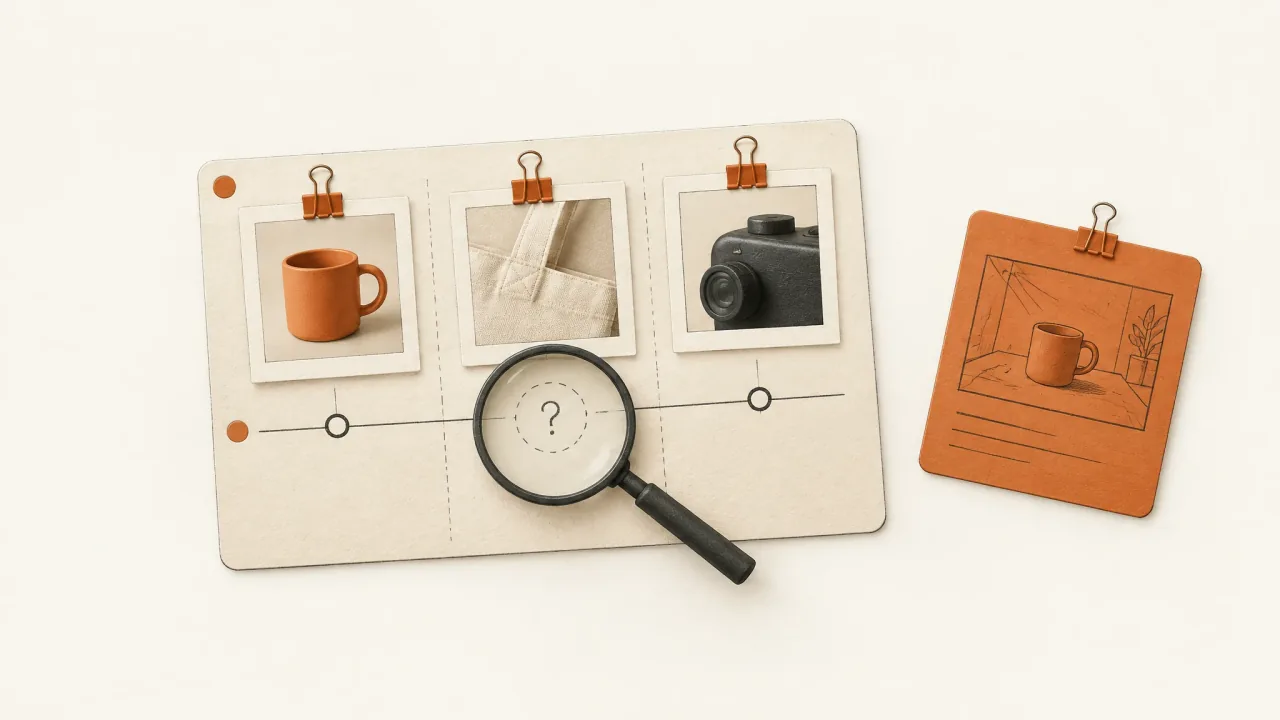
Watch the sampled competitor ads to see what they explain, then look for a useful question they leave unanswered. Record a gap in the sampled set. That gap says nothing about the rest of the market or whether answering it will outperform competitors.
Build a dated question-coverage log and one original video brief. You can do the research manually from public references. The workflow uses Fablo for production without relying on it as an ad-spy database or a competitive analytics service.
Set a narrow question before collecting references
Choose a product decision you can inspect. “What do phone-stand ads communicate about storage between uses?” gives you something observable to check. “What are the best competitor ads?” requires performance evidence you may not have.
Define the category, advertised product, relevant country or language, and inspection date. Record the search terms or advertiser pages you use. Decide which entries qualify before reviewing them.
Keep the sample small enough to watch in full. Thumbnails can miss an answer given in a later scene or spoken line. If you can access only part of an ad, mark the question as unknown because inspection is incomplete.
Record the public material as it appeared
Meta's Ad Library documentation, checked October 8, 2026, describes a searchable ads-transparency database that includes active ads across Meta products. Keep the exact public-record link and your inspection date with each reference.
Write what you see or hear: a product shown unfolded, an exact headline, a visible mechanism, or a spoken qualification. Add the scene location when it helps another reviewer find the evidence.
Check captions, speech, and the final card too. The opening may leave a question unanswered that a later scene resolves. Record whether you inspected the whole available creative and its text, and note any material you couldn't access.
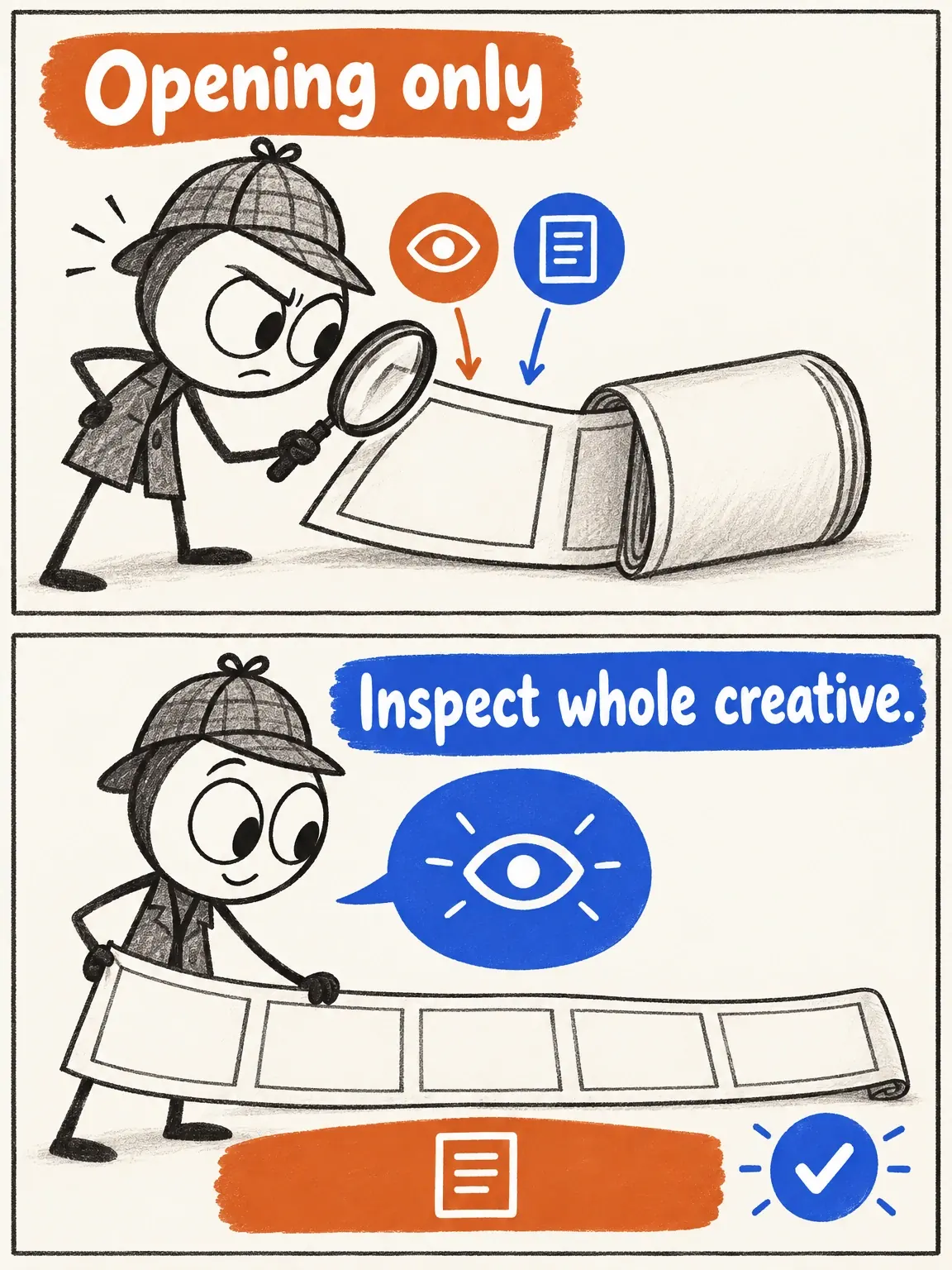
The detective stopped at the opening
The detective has only seen the opening. Later scenes, speech, captions or the ending may still answer the question.
View full-size (opens in a new tab)Image explanation
- Record incomplete inspection as unknown. Distinguish it from a question absent in fully inspected material, including the available text.
- Flag inaccessible material and retain the exact public source link, actual inspection date and useful evidence location.
- The blank strip contains no inspected competitor material or discovered answer. Full inspection still leaves campaign spend, targeting, demand and performance unestablished.
Separate coverage from unknown performance
On their own, visibility and repeated messaging leave sales performance and buyer preference unknown. A polished demonstration doesn't verify the product's performance either.
Draw conclusions about spend, targeting, sales, conversion rate, or ROAS only when you have appropriate independent evidence. Additional transparency information still doesn't establish which creative argument caused a commercial outcome.
Use these classifications: answered, partly answered, not observed in the inspected material, or unknown because inspection was incomplete. Any opportunity you identify remains an idea to explore with your own product facts.
Worked sample: the stand disappears into a pouch
This self-authored exercise is dated October 8, 2026. Its three entries are constructed ad descriptions. No competitor campaigns were inspected for them, so they have no public source URLs or performance results.
Entry A shows an open folding phone stand on a bedside table, with the line “Set your phone here.” It explains where the product is used, but never shows its stored state.
Entry B shows an unfolded stand and a close view of its hinge. Its proposed text emphasizes the viewing angle. That supplies a different explanation, but the folded shape is still absent.
Entry C ends on a small travel pouch beside the stand and says “Ready to go.” The pouch suggests a travel context. It does not reveal whether or how the stand fits inside, because the product remains unfolded throughout the constructed sequence.
The narrow gap statement is: “None of these three constructed entries shows the folded product clearly.” It is not “competitors fail to explain portability,” and it says nothing about demand for a folded-state demonstration.
Before choosing this direction for your product, confirm that it folds and obtain a reference showing its actual folded state. A pouch in someone else's reference tells you nothing about your product's dimensions or compatibility.
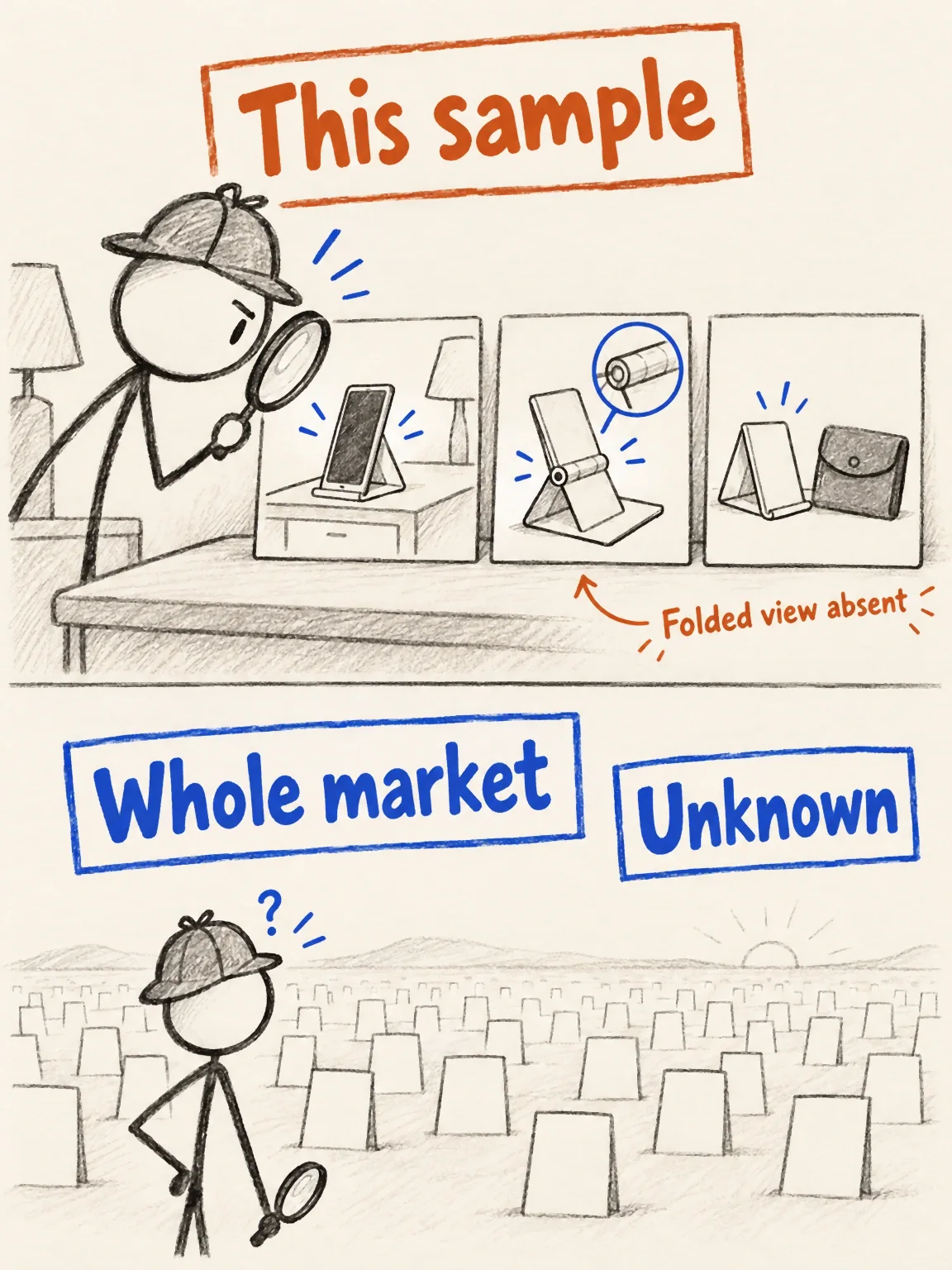
The tiny-sample detective
The detective finds a missing view in three constructed examples. That is the limit of this sample's evidence.
View full-size (opens in a new tab)Image explanation
- The constructed three-entry sample never shows a clearly folded phone stand.
- The gap belongs to this sample. Incomplete inspection stays unknown, and these entries reveal neither market-wide coverage nor campaign performance.
Copy this dated question-coverage log
Create one entry per source and repeat the same question across the set. Use actual inspection dates only for material you inspected.
QUESTION-COVERAGE LOG
Scope: [category; product decision; country/language]
Question being checked: [one answerable question]
Sample collection method: [terms or advertiser pages]

Source entry: [label]
Official/public ad URL: [exact source]
Inspected on: [actual date]
Inspection coverage: [whole available creative and text / partial]
Visible or spoken observation: [exact words or literal scene]
Evidence location: [timestamp or text location]
Question status: [answered / partly answered / not observed / unknown]
Reason for status: [what evidence supports it]
Performance: [unknown; do not infer from visibility]

Set-level gap statement: [absent only from these inspected entries]
Our original hypothesis: [why an answer might be useful]
Our approved answer and source: [own-product facts]
Production dependency: [material needed before commissioning]
Next action: [collect more evidence / brief one answer video]
If another sampled ad clearly shows the folded product, update the gap statement. Let the log disprove the idea when the evidence changes.
Turn the gap into your own explanation
For the stand exercise, an original sequence could show the real product open, a supplied recording of its folding action, and a clear final folded view. Write your own wording around that fact, leaving out competitor slogans, cast, visual signatures, and unsupported promises.
Use the reference-structure guide to separate the explanation you need from the execution you saw. The reference-ad-recipe showcase brief contains proposed adaptation directions and credited external references. It doesn't show completed Fablo outputs.
Add the approved answer to your brand-input packet, then use the product-ad workflow to turn the script and scene plan into a complete video. Inspect the assembled explanation and request specific corrections before selecting it.
When your own facts support the answer, open Fablo with the log and original brief. For a recurring research-to-video process, consult current pricing after defining the production scope.